Senate Florida Republican Marco Rubio wants the stigma about UFO to go away
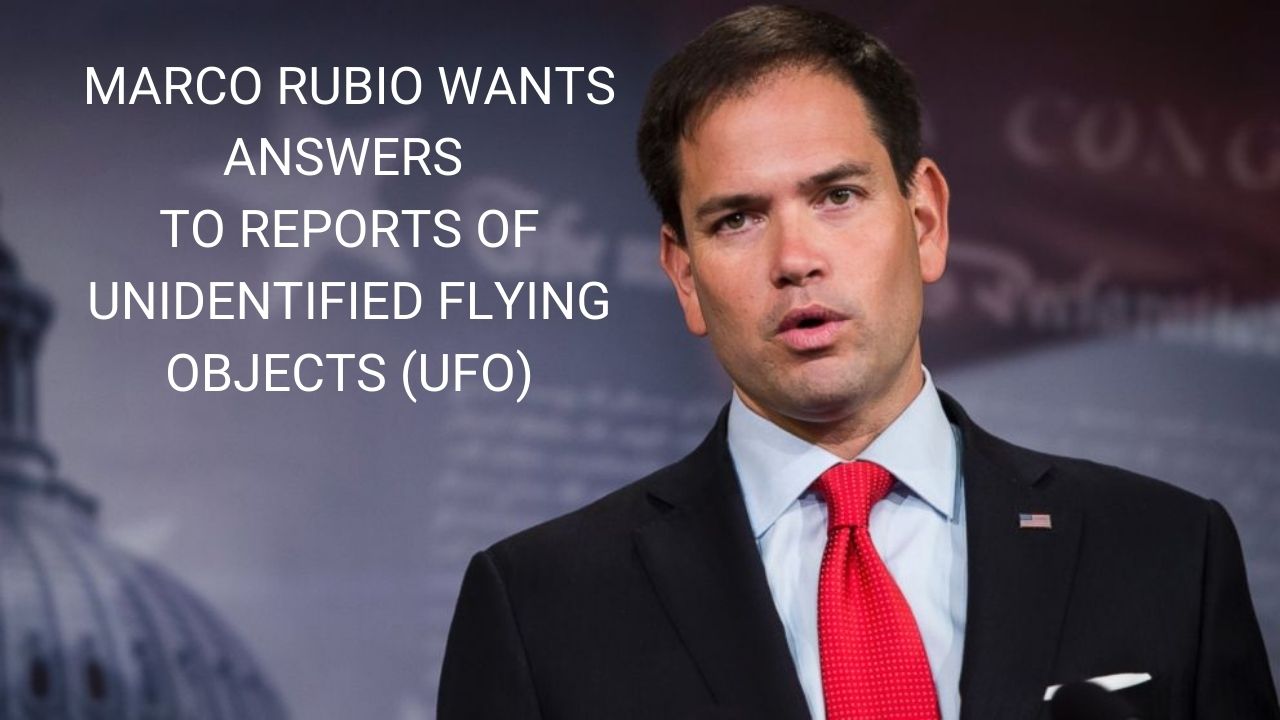
Marco Rubio declared he wants answers to reports of Unidentified Flying Objects (UFO) “flying over military installations.” In late December, this $2.3 trillion appropriations bill signed into law by former President Trump did more than give emergency relief for the economy. It provided some funding for the Intelligence Authorization Act for Fiscal Year 2021.
But aside from financing intelligence services vital to U.S. security, it incorporated a section for “Advanced Aerial Threats.” It calls on the director of national intelligence and secretary of defense to produce a report analyzing UFOs, UAPs, or unidentified aerial objects.
Those security agencies were given 180 days from the bill’s signing to present the report to congress on all “observed airborne objects that have not been identified.” This with what they can of discovering by working with security authorities across the military and private sector.
Who is Marco Rubio?
Marco Antonio Rubio is a lawyer and politician serving as the senior United States senator from Florida. He is a Republican. Rubio previously served as speaker of the Florida House of Representatives.
Nuclear platforms keep attracting UFOs.
Senate Florida Republican Marco Rubio wants answers to UFO flying over military installations
Senate Florida Republican Marco Rubio is awaiting a report by top security officials who will brief Senate Intelligence Committee members on “unidentified aerial phenomenon” or UAPs, threatening military assets. In an airport interview with internet-based tabloid TMZ Monday, Rubio said he wants answers to reports of Unidentified Flying Objects (UFO) “flying over military installations.”
The term “black projects” inspires dark imagery of government figures operating in contrast to a free and open society’s principles. But how is the Department Of Defense’s System Classified? And what is the “Special Access Program,” acronym—”SAP.”I set out to shed light on the secret processes involved in maintaining the very intricate ecosystem that works to protect the Pentagon’s most closely held secrets.
How Does the U.S. government protect and restrict access to highly classified information?
How the U.S. government protects and restricts access to highly classified information is through a set of compartmentalization protocols called “Special Access Programs,” acronym—”SAP.” SAPs are just a set of security protocols restricting sensitive information to only authorized and necessary people. So, now I will dig into The Department Of Defense’s Classified System.
How is National Security Information classified?And how is the department of defense’s system classified?
The deciding factor for how information is classified depends on how much damage an unauthorized disclosure would reasonably cause.
Top Secret:– “Exceptionally grave damage to national security.”
Secret: – “Serious damage to national security.”
Confidential: – “Damage to national security.”
The Department of Energy, or DOE, utilizes two differing equivalent levels of security clearance.
Q-Clearance: – Equivalent to a Top-Secret level clearance.
L-Clearance: – Equivalent to a Secret level clearance.
Furthermore, a single SAP or Special Access Program can contain multiple components, each with different classification levels.
“Black Programs”
Moreover, according to the Center for Development of Security Excellence’s (CDSE) Special Access Programs Training Course, from the 1970s to 1980s, SAPs—referenced even within the government as “black programs”—were virtually exclusively restricted safeguarding DoD acquisition programs.
“Special Access Programs,” acronym—”SAP.”
By the mid-1990s, those secret workshops shed the “black program” moniker, opting to go by the more contemporarily well-known SAP or “Special Access Program.” In addition to the more dexterously smooth title, intelligence, operations, and support programs were added to the SAP, establishing the Special Access Program regime we’ve come to know today.
When viewing the term “special access program,” people envision one of the three categories within the Department of Defense.
Acquisition SAPs:- Programs including research, evaluation, development, testing, modification, or procurement of new technologies. Moreover, according to the CDSE, Acquisition SAPs make up 75-80% of all DoD SAPs.
Intelligence SAPs: – The planning and execution of sensitive, intelligence or counter-intelligence operations.
Operations and Support SAPs: – Planning, implementation, and support of sensitive military enterprises.
Furthermore, separate from an objective category, all SAP’s (special access programs) fall under one of two protection levels:
“Acknowledged” – Those are programs whose existence and purpose can be openly recognized. Only intimate details, like technologies, materials, or techniques, are kept secret. And funding for Acknowledged SAPs is unclassified mainly and can be readily seen in the government’s fiscal budget.
“Unacknowledged”- This is the shy sibling of the SAP family. When an SAP is designated as “unacknowledged,” not only is a program’s purpose carefully guarded, as the name implies, its mere existence may be denied to everyone but a few who aren’t a part of the program. It should come as no shock; the funding for unacknowledged “special access programs” is either classified or is purposely hidden within the Federal budget.
The principal authorities for all those Special Access Programs
Serving on the secrecy mosaic’s front lines is the “Special Access Program Central Offices” (SAPCO). It thrives on compartmentalization, and by “central,” the DoD means there are three different types of SAP Central Offices.
SAPCO or Component-Level SAP Central Office: – They can be found within each branch of the U.S. military. The Joint Chiefs of Staff. The Defense Advanced Research Projects Agency (DARPA). The MDA or Missile Defense Agency. The Component-Level SAPCOs is responsible for starting the prospective process for accessing an SAP. Once a Special Access Program has been installed, a Component-Level SAP Central Office working as the hands-on manager for the Special Access Program that falls under their scope.
OSD SAPCO or Office of the Secretary of Defense-Level SAP Central Office: – It was installed to assist the Deputy Secretary of Defense. Furthermore, the Secretary of Defense-Level Central Office’s Office serves as the overlooking authority for all SAPs.
DOD SAPCO or Department of Defense SAP Central Office: – Working to help streamline this entire fragmented, the Department of Defense SAP Central Office functions as an ambassador by communicating and advising the executive branch and Congress agencies on all matters relating to SAPs.
The Special Access Program administration structure
Spearheading the Special Access Program governance or administrative structure is the SAPOC or Oversight Committee. Its made up of a who’s who of Pentagon Under Secretaries, Assistant Directors, and Vice Chiefs. The Oversight Committee’s main role is to assist and advise the Secretary and Deputy Secretary of Defense in the governance, management, and oversight of all Department of Defense (DoD), Special Access Programs.
Ensuring that the limitation of secrecy to only a picked few isn’t a decision made in a vacuum, assisting the Special Access Program Oversight Committee is:
Senior Review Group (SRG): – The main working-level body that governs the process of Special Access Program oversight.
SAP Senior Working Group (SWG): – Gives recommendations to the Senior Review Group and works as a senior program protection forum coordinating, deconflicting, and integrating special programs.
Guarding Special Access Programs
In the span of SAP controls, OUSDI or the Office for the Under Secretary of Defense for Intelligence SAP Control Office fills the important role of monitoring and investigating counter-intelligence matters, security violations, or infractions of all Department of Defences SAPS.
Supporting OSDi’s Central SAP Office in this work is the Office of the Director of National Intelligence and the 17 individual agencies which make up the United States intelligence community. Reinforcing this mighty SAP Central Office, the U.S. Defense Security Service (DSS) provides operational assistance and security oversight for all DoD SAPs.
But the first line of defense in guarding the integrity of SAP secrecy starts with who is granted access to a secret program. So, regardless, if a person is a federal-civilian employee, or in the military, or a private contractor, many requirements must be met before working within an SAP.
Once inside an SAP, there are still many vital roles that help ensure each special access program’s secure integrity. And some of those are:
The Government Program Manager (GPM), and their private industry equivalent, the Contractor Program Manager (CPM): – The person who oversees all overall aspects of a specific program.
Program Security Officer: – The person responsible for all aspects of security in the program. Every SAP has a PSO. However, large or complex SAPS can additionally have extra Government SAP security officers or contractor program security officers to support the Program Security Officer.
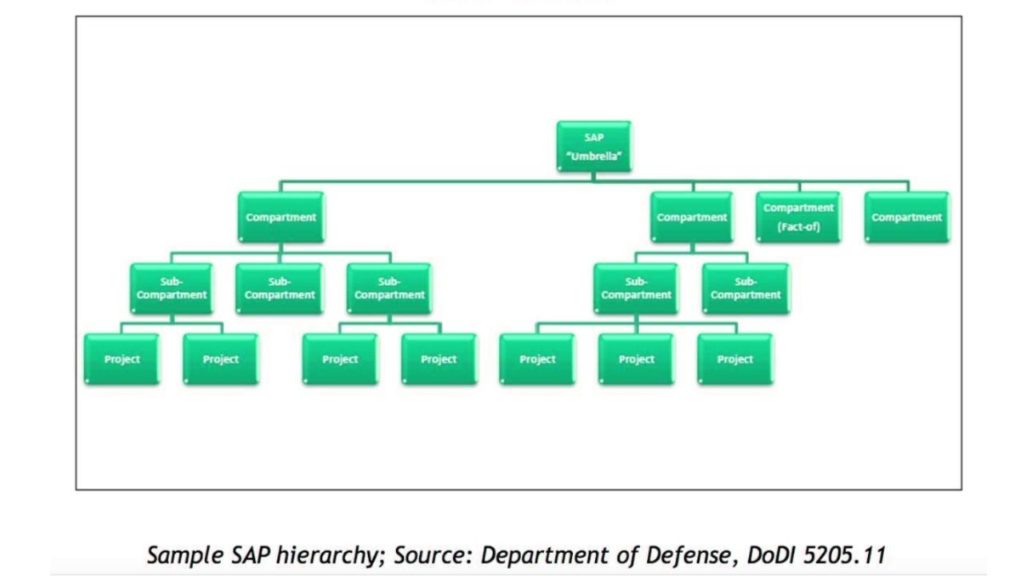
Additionally, protecting who knows what, an SAP’s overarching scope and purpose can fall under one program “umbrella.” Nevertheless, multiple compartments, which can further break down into separate sub-compartments, and numerous projects can all emerge from under a single SAP umbrella.
So, it’s completely possible for a compartment, sub-compartment, or project not to have access or be aware of the work that’s going on in other sections of the same SAP.
Oversight Of Special Access Programs
All SAP or Special Access Programs are subject to federal and defense acquisition regulations. Therefore, all Special Access Programs can be audited and inspected by many oversight entities, including the DoD Inspector General or the Government Accountability Office.
Equivalently, oversight of SAPs isn’t merely left to agency directives and policies. Instead, it’s a matter of federal law.
All active acknowledged, and non-waived unacknowledged SAPs must submit reports to the House and Senate Authorization, Appropriations, and Intelligence Committees yearly by federal statute. Those yearly reports give committee members an estimated total budget request for the upcoming fiscal year, a short description of the program, including the number of persons involved, current issues, or the status of significant milestones and the program’s actual cost for each previous fiscal year.
Each member not assigned to one of the defense or intelligence committees may be granted access to non-waived special access programs. They receive permission from the ranking and minority members from each of the respective committees and with the Secretary or Deputy Secretary of Defense’s approval.
So, when it comes to Special Access Programs (SAPs), like virtually all government operations, they are mostly cumbersome bureaucratic affairs.
However, now you hopefully know how the underlying secrecy processes work.
According to a report, many drones repeatedly swarmed over Navy destroyers off the California coast in July 2019. It remains unclear who was behind the brazen nighttime flights.
Drones Hovered Over Navy Destroyers Off California Coast
How did inexplicable drones violate restricted airspace again & again over several Navy warships off the coast of California & then disappear into the night? Our latest on UAVs and #UAPs this morning on NBCNewsNow. Is it just the battlegroup being tested against an asymmetrical threat/USAP test prior to SCS deployment. What do you think the UAPs (drones) are?
What Are Drones?
An uncrewed aerial vehicle (UAV) or uncrewed aerial vehicle, commonly known as a drone, is an aircraft without a human pilot on board. UAVs are components of a UAS or unmanned aircraft system. It includes a UAV and a ground-based controller. Furthermore, also a system of communications between the two. Uncrewed aerial vehicles’ flight can operate with various degrees of autonomy: either under remote control by a human pilot (operator) or autonomously by onboard computers, referred to as an autopilot.
Compared to crewed aircraft, UAVs were originally used for missions too “dull, dirty, or dangerous” for humans. While drones mainly originated in military applications, their use is rapidly finding many more applications, including aerial photography, product deliveries, agriculture, policing and surveillance, infrastructure inspections, science, smuggling, and drone racing.
The name unmanned aircraft system (UAS) was adopted by the United States Department of Defense (DoD) and also the United States Federal Aviation Administration in 2005, according to their Unmanned Aircraft System Roadmap 2005–2030.
Who is Christopher K. Mellon? Christopher K. Mellon is a former Deputy Assistant Secretary of Defense for Intelligence and a former Minority Staff Director and Senate Select Committee on Intelligence.
Chris Mellon And UFOs
Christopher K. Mellon worked with Leslie Kean in a UFO organization and is a private equity investor, shareholder, and former advisor for Blink 182 Tom DeLonge’s To The Stars Academy of Arts & Sciences. And according to the company’s website, Mellon’s title was “national security affairs advisor.” Mellon assisted in the production and now works with the former Pentagon Director of the famous AATIP, Luis Elizondo. He served as a cast member for the cable television network History, and it distributes the show Unidentified: Inside America’s UFO Investigation.
Chris was featured in the 2020 UFO documentary, The Phenomenon, directed by longtime UFO-enthusiast James Fox. In the documentary, Christopher K. Mellon said that he was the primary source who provided the three Pentagon UFO videos which made the “lavish front-page Sunday spread” [of the New York Times on December 17, 2017, named “Glowing Auras and ‘Black Money’: The Pentagon’s Mysterious UFO Program”
Furthermore, In the documentary, Chris claims he met with an unnamed individual in the Pentagon parking lot and was delivered a package containing the three famous UFO videos recorded by U. S. Navy pilots between 2004 and 2015.
Chris Mellon is joining Avi Loeb’s Galileo Project as a research affiliate.
As research affiliates, Elizondo intends to support the Galileo Project’s mission through the selection of sites where the UAP-Scope systems will be located and in assessing the societal implications of the data.
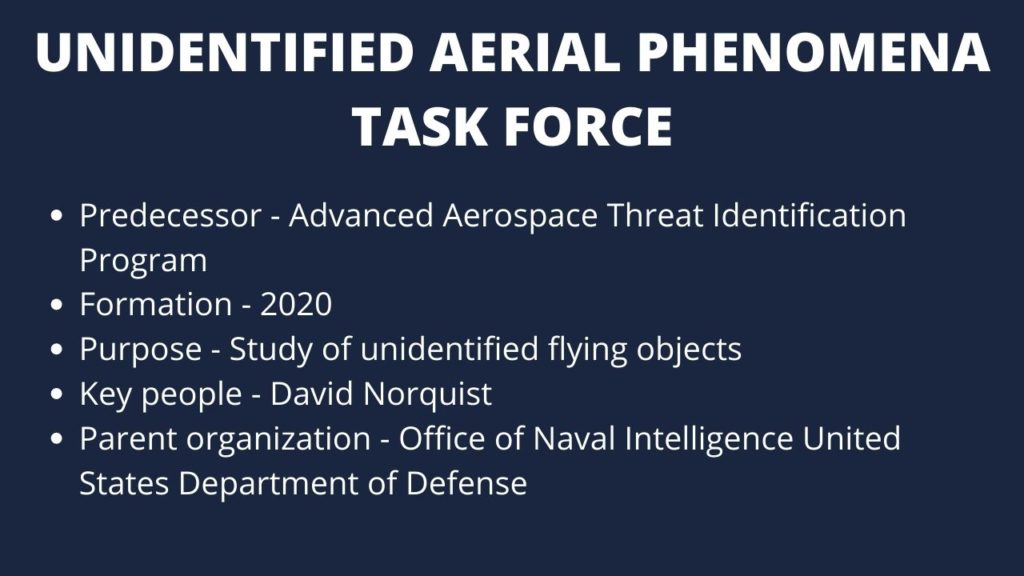
In the military, a task force is put together to deal with a specific situation or problem—the situation, in this case, the anomaly and enigmatic UAP.The newly formed Unidentified Aerial Phenomena Task Force, or UAPTF, is a program in the United States Office of Naval Intelligence used to “standardize collection and reporting” on unexplained aerial vehicles’ sightings. The program was detailed in a June 2020 hearing of the United States Senate Select Committee on Intelligence.
On Aug. 4, 2020, Deputy Secretary of Defense David L. Norquist approved the establishment of an Unidentified Aerial Phenomena (UAP) Task Force (UAPTF). The Department of the Navy, under the knowledge of the Office of the Under Secretary of Defense for Intelligence and Security, will manage the Unidentified Aerial Phenomena Task Force.
The Department of Defense established the UAPTF to increase its understanding of and gain insight into the characteristics and origins of UAPs. The task force’s mission is to analyze, detect, and catalog UAPs that could potentially pose a threat to U.S. national security.
The DOD and the military departments take unauthorized aircraft incursions into their training ranges or designated airspace very seriously and examine each UAP report. This includes analyses of incursions that are initially reported as UAP when the observer cannot immediately identify what he or she is observing.
Franc Milburn of the Begin-Sadat Center for Strategic Studies published this remarkably insightful assessment of the USG’s new UAP investigation. It’s called “The Pentagon’s UAP Task Force.” He’s done a thorough job reviewing the open-source literature and is asking the right questions.
Why Develop Unidentified Aerial Phenomena Task Force, or UAPTF?
On June 24, 2020, the Intelligence Committee publicly asked the United States Intelligence Community and the United States Department of Defense to track and analyze unexplained aerial vehicles’ data. And the task force will issue a report to the Intelligence Committee 180 days after the passage of the intelligence authorization act.
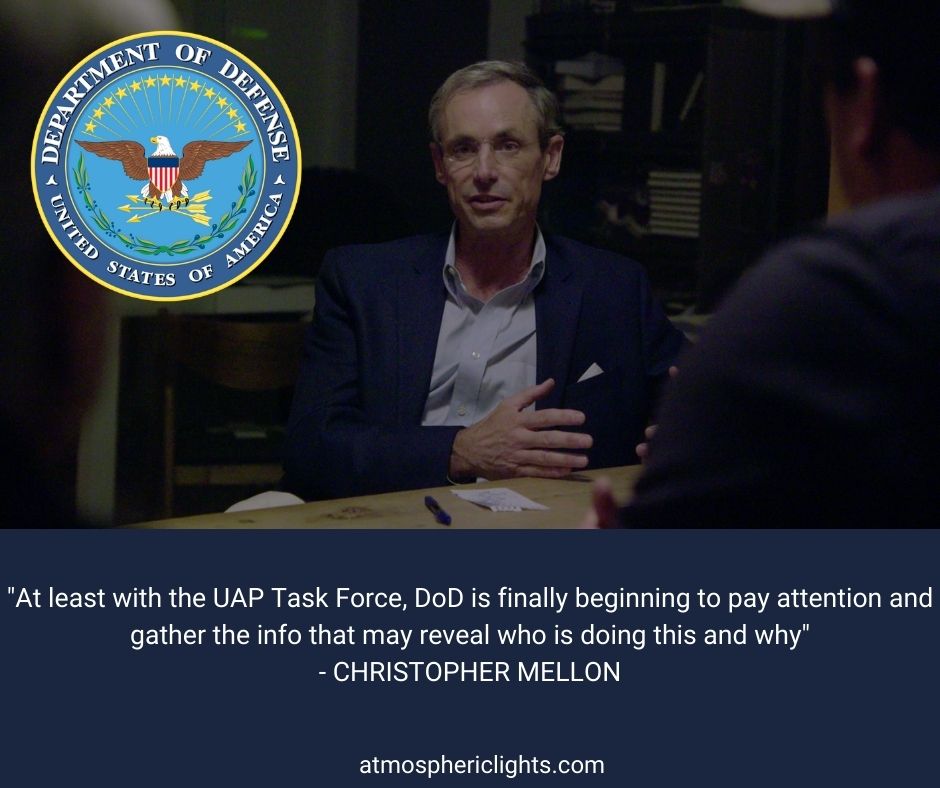
The well-known public figure Christopher Mellon, a former Deputy Assistant Secretary of Defense for Intelligence and an advisor to the UFO-promoting company To the Stars, said, “We are talking dozens of incidents in restricted military airspace over the years.”
Marco Rubio, a lawyer and a republican politician serving as the senior United States senator from Florida, previously served as speaker of the Florida House of Representatives. He said that he was troubled that an adversary had achieved “some technological leap” that “allows them to conduct this sort of activity.”
Why is the Defense Department Interested in UFO/UAP Reports?
There are numerous non-extraterrestrial reasons why the Defense Department is interested in UFO/UAP reports. Below are eight reasons.
First, identify and facilitate instrumental in new sensory technology to make sure they don’t accidentally misinterpret or overlook future UFO/UAP readings.
Second, to determine how hackers and real enemies might deliberately induce detection of UAPs and what they can do to prevent such efforts.
Third, to intentionally induce anomalous targets into the range of their new detection and tracking technology as a way of testing them.
Fourth, to test adversary detection systems with deliberate pokes to identify exploitable vulnerabilities.
Fifth, to evaluate which reports from within or near adversary nations indicate their classified military testing and operations, they need insight.
Sixth, to determine which detections accidentally reveal highly classified operations of their own that might indicate enemy nations looking for such indications to improve their masking, misdirection, and stealth.
Seventh, observations of UFO reports from adversary nations are indicators of leaked visual clues to military capabilities. Because to do nothing to provoke such regimes from reducing their own news media coverage of the “pseudo-UFOs.” Never announce, to the enemy, how innocent news items can be exploited.
Eighth, domestic UFO or UAP reports may be accurate indicators of classified military activities, purposefully design camouflage and masking reports to distract and confuse foreign observers.
UAP could technically include aircraft or objects that are just unauthorized, as well as aircraft or objects that cannot immediately be identified. Furthermore, if a pilot sees something they cannot explain, but someone else explains it later, it could still fall under the definition of a UAP. It’s difficult to judge how well-positioned the task force will be to seriously investigate UFO and UAP reports, but we must remain cautiously optimistic for now. If you are interested in these phenomena, please head over to my YouTube Channel.