The 2014 Ford Taurus is a full-size sedan that offers a spacious interior, a range of features, and good value. The Taurus hasn’t changed notably for the new model year, with the only slight change being the addition of an available lane-keeping system in Limited and SHO trim levels.
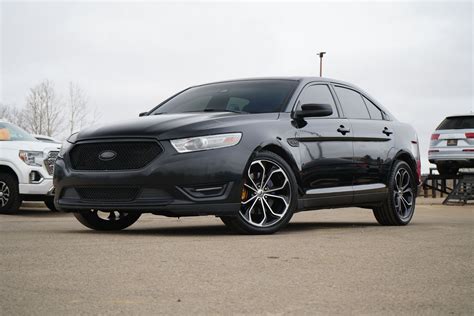
Image of a 2014 Ford Taurus SHO
Trim Levels
The 2014 Taurus has four trims to choose from:
- The front-wheel-drive Ford Taurus SE.
- The front- or all-wheel-drive (AWD) SEL and Limited.
- The AWD SHO, all of which are powered by a high-performance, twin-turbo V-6 engine.
The SE can also be had with a four-cylinder.
Exterior Design
The Ford Taurus comes in a range of 10 available exterior colors with body-colored door handles. The Ford Taurus’ front grille looks a little like the wide, gaping mouth of a whale shark. It does get a little better from there, however, with additional bits of chrome jewelry on the exhaust tips and solid, grounded-looking 19-inch wheels on the Limited version I drove.
Read also: Comprehensive Guide: 2006 Ford Taurus Catalytic Converter
Family-Friendly Features
As a family workhorse, this full-size Ford sedan has the ability to haul even full-size families with full-size cargo needs. All three positions of the rear seat are quite comfortable. A low floor hump below the center passenger’s feet and a bench that’s almost as soft and comfortable there as in the outboard positions makes the center seat just as usable as the others.
The 20.1 cubic feet of trunk space in the Ford Taurus was the most voluminous in our Challenge thanks to the Taurus’ recessed floor. It allowed a shocking 10 golf bags to be piled in. Hockey sticks, backpacks, sleeping bags and Costco runs can all be swallowed without so much as a burp from the Taurus.
Interior Aesthetics and Technology
The Ford Taurus’ functionality and backseat are overshadowed, however, by the antiquated and messy aesthetics of the front of the cabin. An abundance of black plastic surfaces gives this brand-new vehicle the look of a gently used rental car. I loved having three cupholders in the center area between the driver and passenger, as I regularly have both a latte and a bottle of water during my morning run; having that third cupholder meant my husband could also store his coffee. However, the cupholders have hinged lids that have to be flipped open to use the cupholders. This created a cluttered look, with sharp, squared-off corners and edges sticking up this way and that.
While Ford and Microsoft have theoretically improved the MyFord Touch system, there’s still a general lag in touch-response time, not to mention the cluttered and confusing interface that’s impossible to interact with without removing your eyes from the road. If my $200 iPhone can react instantaneously when I touch it, a $35,000 car with touch-screen technology should be at least as quick and easy to use. Tall drivers with longer legs may also complain about the wide center console cutting into their knee room. The consumer who test-drove all the cars in our Challenge had to press his knee and leg up against the side of the console for the entire drive in order to properly reach the accelerator.
Driving Experience
Unfortunately, the Ford Taurus just didn’t live up to the high driving standard set in our Challenge. When accelerating, there was quite a lag before the Limited’s 3.5-liter V-6 engine’s power really kicked in. The Ford Taurus suffered a lot of lean in corners, which I noticed both as a driver and as a backseat passenger. In the back, I was thrown around on a twist and then a turn while the driver got up to speed approaching a highway on-ramp. From the center rear seating position, I had to grab the handles on either side of the car to catch myself and stay upright. This lack of support isn’t just in the rear seat, but can also be sensed by the driver as a feeling of apprehension when cornering, plus an innate desire to brake midway through a corner just to gain a sense of sure footing.
Read also: Exploring the Last Taurus
Cabin noise inside the Ford Taurus was quite obtrusive, even on smoother roads. I had to raise my voice to be heard from the backseat, and the notes I dictated to my iPhone while in the Taurus were illegible. You might be quick to blame this on Siri’s lack of voice-recognition skills, but I could easily decipher all my notes taken in other cars in our Challenge, which covered the same roads at the same speeds.
Fuel Economy
The front-wheel-drive Ford Taurus gets an EPA-estimated 19/29/23 mpg city/highway/combined with the V-6, which puts it in the middle of the similarly equipped sedans in our Challenge. The 3.5-liter V-6 gets an EPA estimated 18-19/26-29 mpg city/highway, depending on FWD or AWD and the 2.0-liter EcoBoost I-4 returns a respectable 22/32 mpg. The twin-turbo 3.5-liter EcoBoost V-6 in the SHO churns out some serious power, but only takes an EPA-estimated dip to 17/25 mpg, for a total of one mpg loss over the stock AWD V-6 equipped models.
Safety Features
The 2014 Taurus received an overall crash-test rating of five out of five stars from the National Highway Traffic Safety Administration. In Insurance Institute for Highway Safety testing, the 2013 Taurus earned the institute’s Top Safety Pick designation, which represents top scores in all tests except the new small-overlap crash test, to which no car in this class has been subjected.
As has been required since the 2012 model year, the 2014 Taurus has standard antilock brakes, electronic stability control and traction control. The Taurus also features six standard airbags, including driver and passenger front airbags, driver and passenger torso side airbags, and side curtain airbags extending to cover both rows. A Belt Minder system that alerts the driver if any of the front or rear occupied seats have an unbuckled seat belt is standard on all trim levels, as is a tire pressure monitor. A rearview camera is standard on Limited and SHO trims and optional on the Ford Taurus SEL.
The wide backseat in this Ford makes it one of the few sedans we’ve tested than can fit three child-safety seats side by side, in certain configurations. One of the Taurus’ Latch anchors is directly behind a seat belt buckle.
Read also: Engine Details: 2003 Taurus
The Taurus’ Latch anchor configuration is a little different from most vehicles. While most cars have two sets of Latch anchors (one set in each of the outboard seats), they typically don’t allow a center seat to be installed via Latch by using an anchor from either side. The Taurus’ anchors are different. They’re slightly offset, but built to allow for attachment to either the center position or the outer positions, but not both at the same time. This allows for greater flexibility for a growing family with one or two child-safety seats to install with the Latch anchors. However, three cannot be used with Latch at the same time.
Performance Specs
The 2014 Ford Taurus, the automaker's full-sized sedan, is available in three base trim levels, and as the high performance SHO model. The base engine is a 3.5-liter V-6 producing 288 hp and 254 lb-ft of torque paired with a six-speed automatic, and available in FWD or AWD on the SEL and Limited trim levels. Buyers have the option of a turbocharged 2.0-liter EcoBoost I-4 that makes 240 hp and a healthy 270 lb-ft of torque, coupled to the same six-speed, only in FWD form. While not for lead-footed drivers, the 2.0 EcoBoost model provides a bit more fuel economy for those who are willing to pay the $995 over the naturally aspirated 3.5-liter V-6.
The 2014 Taurus SHO comes with a grin-inducing twin-turbocharged 3.5-liter EcoBoost V-6 that pumps out 365 hp, 350 lb-ft of torque, AWD, and a six-speed automatic.
So You Want Ford Taurus SHO
Potential Issues and Tuning
The hack way is to do whatever it takes to run leaner at WOT. Most engines run rich to protect components, and the SHO engine is no different than that. The component protection is designed to make sure the engine will last regardless of how it's being run, so it's fairly conservative. For DI motors in particular, you also can't just turn the boost up. Not due to the engine strenght, but the ability for the DI pump to move enough volume of fuel. On this engine, the best I've ever seen was about 410hp and the pump runs out of ability to move more fuel. Doing a mod wrong means that the engine has no idea, adds more boost, runs leaner, and before you know it, there's a hole in a few pistons. I've seen a video of that happening. That's the biggest bottleneck for the engine.
DI engines tend to put more fuel in the oil, so it's important to warm the engine all the way up. Similar, but the RWD set up helps, it has a better fuel pump (not interchangeable), and a few other things allow the truck engine to run higher torque. as for the hack- they are tampering, so I don't know much about that one.
Additional Features
| Feature | Specification |
|---|---|
| Transmission | Automatic Full-Time All-Wheel, Driver Selectable Mode |
| Axle Ratio | 2.77 |
| Battery | 72-Amp/Hr 650CCA Maintenance-Free w/Run Down Protection |
| Steering | Electric Power-Assist Speed-Sensing Steering |
| Fuel Tank | 19 Gal. |
| Exhaust | Dual Stainless Steel w/Chrome Tailpipe Finisher |
| Brakes | 4-Wheel Disc w/4-Wheel ABS, Front Vented Discs and Brake Assist |
| Passenger Capacity | 5 |
| Front Headroom | 39 in. |
| Front Legroom | 41.9 in. |
| Second Headroom | 37.8 in. |
| Second Legroom | 38.1 in. |
- Radio w/Seek-Scan, Clock, Speed Compensated Volume Control, Steering Wheel Controls and Radio Data System
- Alarm
- Back-Up Camera
- Cruise Control
- Adjustable Steering Wheel
- Leather Wrapped Steering Wheel
- Trip Computer
- Keyless Entry
- Power Door Locks
- Electrochromic rearview mirror
- Heated Mirrors
- Power Mirrors