Grey aliens, also referred to as Zeta Reticulans, Roswell Greys, or simply, Greys, are purported extraterrestrial beings frequently featured in claims of close encounters and alien abduction. They are typically described as having small, humanoid bodies, smooth, grey skin, disproportionately large, hairless heads, and large, black, almond-shaped eyes.
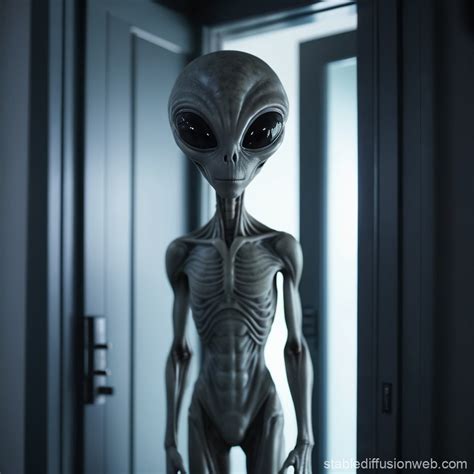
Typical depiction of a Grey Alien
Greys are typically depicted as grey-skinned, diminutive humanoid beings that possess reduced forms of, or completely lack, external human body parts such as noses, ears, or sex organs. Their bodies are usually depicted as being elongated, having a small chest, and lacking in muscular definition and visible skeletal structure. Greys are depicted as having unusually large heads in proportion to their bodies, and as having no hair, no noticeable outer ears or noses, and small orifices for ears, nostrils, and mouths. In drawings, Greys are almost always shown with very large, opaque, black eyes, without eye whites.
Early Depictions in Literature
In literature, descriptions of beings similar to Grey aliens predate claims of supposed encounters with them. In 1893, H. G. Wells presented a description of humanity's future appearance in the article "The Man of the Year Million", describing humans as having no mouths, noses, or hair, and with large heads. In 1895, Wells also depicted the Eloi, a successor species to humanity, in similar terms in the novel The Time Machine. As early as 1917, the occultist Aleister Crowley described a meeting with a "preternatural entity" named Lam that was similar in appearance to a modern Grey. Crowley claimed to have contacted Lam through a process called the "Amalantrah Workings," which he believed allowed humans to contact beings from outer space and across dimensions.
In 1933, the Swedish novelist Gustav Sandgren, using the pen name Gabriel Linde, published a science fiction novel called Den okända faran (The Unknown Danger), in which he describes a race of extraterrestrials who wore clothes made of soft grey fabric and were short, with big bald heads, and large, dark, gleaming eyes. The novel, aimed at young readers, included illustrations of the imagined aliens.
Read also: Unveiling the Mystery of Space Aliens
The Hill Abduction and "The Bellero Shield"
In his 1990 article "Entirely Unpredisposed", Martin Kottmeyer suggested that Barney's memories revealed under hypnosis might have been influenced by an episode of the science-fiction television show The Outer Limits titled "The Bellero Shield", which was broadcast 12 days before Barney's first hypnotic session. The episode featured an extraterrestrial with large eyes, who says, "In all the universes, in all the unities beyond the universes, all who have eyes have eyes that speak."
The report from the regression featured a scenario that was in some respects similar to the television show. Wraparound eyes are an extreme rarity in science fiction films. The resemblance is much abetted by an absence of ears, hair, and nose on both aliens. Barney first described and drew the wraparound eyes during the hypnosis session dated 22 February 1964. "The Bellero Shield" was first broadcast on 10 February 1964. Only twelve days separate the two instances.
Rise to Prominence in Ufology
After the Hills' encounter, Greys would go on to become an integral part of ufology and other extraterrestrial-related folklore. This is particularly true in the case of the United States: according to journalist C. D. B. Bryan, the creatures did not resemble any race of humans. They were short, shorter than the average Japanese, and their heads were big and bald, with strong, square foreheads, and very small noses and mouths, and weak chins. What was most extraordinary about them were the eyes-large, dark, gleaming, with a sharp gaze.
During the early 1980s, Greys were linked to the alleged crash-landing of a flying saucer in Roswell, New Mexico, in 1947. In 1987, novelist Whitley Strieber published the book Communion, which, unlike his previous works, was categorized as non-fiction, and in which he describes a number of close encounters he alleges to have experienced with Greys and other extraterrestrial beings. In 1988, Christophe Dechavanne interviewed the French science-fiction writer and ufologist Jimmy Guieu on TF1's Ciel, mon mardi !.
Greys have since become the subject of many conspiracy theories. In 1995, filmmaker Ray Santilli claimed to have obtained 22 reels of 16 mm film that depicted the autopsy of a "real" Grey supposedly recovered from the site of the 1947 incident in Roswell. In 2006, though, Santilli announced that the film was not original, but was instead a "reconstruction" created after the original film was found to have degraded.
Read also: Pop Culture Aliens
The Phenomenon of Alien Abduction
Greys are often involved in alien abduction claims. Abduction claims are often described as extremely traumatic, similar to an abduction by humans or even a sexual assault in the level of trauma and distress. Neurologist Steven Novella proposes that Grey aliens are a byproduct of the human imagination, with the Greys' most distinctive features representing everything that modern humans traditionally link with intelligence.
In 2005, Frederick V. Malmstrom, writing in Skeptic magazine, Volume 11, issue 4, presents his idea that Greys are actually residual memories of early childhood development. Malmstrom reconstructs the face of a Grey through transformation of a mother's face based on our best understanding of early-childhood sensation and perception.
Influence on Popular Culture
Depictions of Grey aliens have gone on to appear in a number of films and television shows, supplanting the previously popular little green men.
Ancient Aliens: Terrifying Humanoids Emerge from Subterranean Realm (Season 18) | History
E.B.E. - Extraterrestrial Biological Entity
"E.B.E." (short for extraterrestrial biological entity) is the seventeenth episode of the first season of the American science fiction television series The X-Files, premiering on the Fox network on February 18, 1994. The episode introduced the recurring characters of The Lone Gunmen, and helped explore the series' overarching mythology.
Plot Summary of "E.B.E."
In the skies over Iraq, an Iraqi fighter jet shoots down a UFO, which crashes in Turkey. Later, in Tennessee, a truck driver named Ranheim shoots at something in the dark as another UFO flies overhead. Fox Mulder (David Duchovny) and Dana Scully (Gillian Anderson) investigate the sighting the next day, but Ranheim is quickly let go by the uncooperative local authorities.
Read also: Alleged Alien Species
Back in Washington, D.C., Mulder introduces Scully to the Lone Gunmen, a trio of eccentric conspiracy theorists with whom he collaborates. After returning to FBI headquarters, Scully discovers a surveillance device within her pen. Mulder meets with Deep Throat, who provides him with documentation of an intercepted Iraqi transmission regarding the downed UFO. Scully continues to investigate the Tennessee incident, learning that two thousand pounds of extra weight had been added to Ranheim's truck. She also learns Ranheim's true identity as Frank Druce.
Mulder intends to track Druce's truck, which is on its way to Colorado. However, before he leaves, Deep Throat approaches him at his apartment, offering the photo of a purported UFO at Fort Benning. Mulder initially believes that Druce's truck is a decoy meant to distract him from the UFO, but discovers that Deep Throat's photo is a fake. When Mulder confronts Deep Throat, he admits his deception and confirms that the earlier transmission was genuine. He also divulges that the truck is transporting an extraterrestrial biological entity, or E.B.E., recovered from the Iraqi crash site.
Mulder and Scully catch up with the truck, and while pursuing it encounter strange weather. The truck stalls, but when they look inside it they find both Druce and the E.B.E. have vanished. When they investigate the truck and the area, Mulder concludes that the encounter was a constructed hoax, intended to convince the duo to cease further pursuit.
With help from MUFON and NICAP, Mulder tracks Druce and the E.B.E. to a power plant in Mattawa, Washington. With assistance from the Lone Gunmen, the agents enter the plant with fake identification. Deep Throat appears and calls off the guards, telling Mulder the E.B.E. is dead. He reveals a secret agreement made between multiple countries after Roswell that any living E.B.E. found would be killed, and that he is one of three men to have executed an E.B.E. Mulder looks through the window into the creature's holding cell, but it is empty.
Production and Inspiration
This episode was the first mythology-centred episode written for the show by writers Glen Morgan and James Wong. Morgan claims that the tone of the episode was inspired by the movie All the President's Men (1976). Some of the scenes were inspired by photographs sent to Morgan and Wong by location scouts of a BC Hydro power station, which was used as a shooting location in the episode.
The episode also introduced the characters of the Lone Gunmen-conspiracy theorists John Fitzgerald Byers (Bruce Harwood), Richard Langly (Dean Haglund) and Melvin Frohike (Tom Braidwood). The characters, who were used to help Mulder appear more credible, were originally meant to only appear in this episode, but due to their popularity on the Internet, they returned in the second-season episode "Blood" and became recurring characters. The inspiration for the Lone Gunmen came from a group of men that writers Morgan and Marilyn Osborn met at a UFO convention in June 1993.
Extraterrestrial Biological Entities (EBEs) in Ufology
Extraterrestrial biological entity (EBE), (short plural Ebens) is a ufology term that originated in the United States to identify the occupants of UFO incidents, namely recovered from the Roswell incident and Aztec (1948). “EBE” is not an academic term. Numerical classification of EBE, such as EBE-1, EBE-2, etc., has been used by UFO researchers to identify the first “extraterrestrial” recovered from succeeding ones.
Other sources designate EBE-1 and EBE-2 as being different types of extraterrestrials. EBE are said to have effectively communicated with US officials by use of pictographs, or logograms. They supposedly serve under a hive-mind like system (see Swarm intelligence), equated to “drones” (i.e. apoidea / bees), as indicated in Counterintelligence Assessment (1989).
Counterintelligence Assessment (1989) claims four types of EBEs: (1) Earth-like humanoids, (2) the Greys, (3) Non-humanoids, and (4) transmorphic. These “aliens of one or more advanced races of beings presumed to have originated elsewhere than on the planet Earth.”
In Counterintelligence Assessment, EBE-2, or the “Aztec EBE”, was recovered from the Aztec UFO incident in 1948. The Aztec EBE is an Earth-like humanoid male, who spoke very good English with an accent. He gave his name as Sethimus during a US interrogation that lasted over an eleventh month period. His interviews were classified as Project Aquarius, codename “Digger Command”. Selected transcripts of recorded conversations are compiled in the papers, on pages 31-37.
In the Serpo releases, "Eben" was used to identify entities from Zeta Reticuli, as a name designation to describe a race of “Browns” (Greys) who live on the world Serpo. Anonymous II describes EBE-1’s demeanor as always being docile, standing 4'3" tall, weighing 60-lbs., and maintaining body heat at 101 degrees. EBE-I wore a tight-fitting one-piece suit.
Anonymous II partially collaborates with Bob Lazar’s review of the briefing notes on the biology of these EBE types: having one primary organ- working as a heart with lungs combined. According to Milton Cooper, EBE-1’s system was chlorophyll-based. Guillermo Mendoza was assigned to monitor EBE-1’s phytoid biological functions.
| Characteristic | Description |
|---|---|
| Height | Approximately 4'3" |
| Weight | 60 lbs |
| Body Temperature | 101 degrees Fahrenheit |
| Attire | Tight-fitting one-piece suit |
| Physiology | One primary organ functioning as heart and lungs |
| Metabolism | Chlorophyll-based |