The blue light phenomenon has captured the imagination of people around the world, often sparking speculation about unidentified flying objects (UFOs) and extraterrestrial activity.
Thursday night there was an electrical surge, followed by an explosion, at a Con Edison substation in Astoria, Queens. Scattered power outages, including at LaGuardia Airport (LGA), ensued.
Con Edison spokesman Bob McGee sought to reassure New Yorkers Friday morning. “What people were seeing was an electrical arc flash,” he told CNN. The light was blue because of the nitrogen and oxygen in the air when the electricity arced through it, he added.
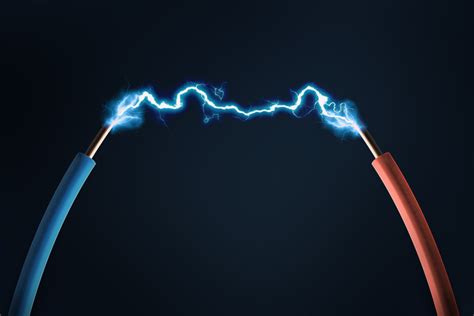
Electrical Arcing
Confirming incident in #Astoria was result of transformer explosion. No injuries, no fire, no evidence of extraterrestrial activity. But the idea that aliens were somehow involved would not go away, despite assurances from the NYPD. But try telling that to people on social media.
Read also: Light Blue: Calmness and Healing
The blue light was only the latest example of New Yorkers claiming visitors from another world had come to the Big Apple.
However, the blue light phenomenon is not unique to recent events. One of the most notable cases of unexplained lights in the sky is the Lubbock Lights.
The Lubbock Lights: A Historical Perspective
The Lubbock Lights were an unusual formation of lights seen over the city of Lubbock, Texas in August and September 1951.
According to Captain Edward J. Ruppelt, the first sighting was reported by three professors from Texas Technological College (now Texas Tech University), located in Lubbock on August 25, 1951, at around 9 pm. They were sitting in the backyard of one of the professor's homes when they observed a total of 20-30 lights, as bright as stars but larger in size, flying overhead.
Ruppelt said the names of the three professors were A. G. Oberg, chemical engineer; W. L. Ducker, a department head and petroleum engineer; and W. I. Robinson, a geologist who reported their sighting to the local newspaper, the Lubbock Avalanche-Journal.
Read also: History of the Foamposite One "Psychic Blue"
Clark writes that on September 5, 1951, all three men, along with E. Richard Heineman, a mathematics professor, and one other professor from Texas Tech, were sitting in Robinson's front yard when the lights flew overhead.
According to one of the professors named Grayson Mead, the lights "appeared to be about the size of a dinner plate and they were greenish-blue, slightly fluorescent in color. They were smaller than the full moon at the horizon. There were about a dozen to fifteen of these lights... they were absolutely circular... it gave all of us... an extremely eerie feeling."
Mead said that the lights could not have been birds, but he also stated that they "went over so fast..."
On the evening of August 30, 1951, Carl Hart, Jr., a freshman at Texas Tech, observed a group of 18-20 white lights in a "v" formation flying overhead. Hart took a 35-mm Kodak camera and walked to the backyard of his parents’ home to see if the lights would return.
Two more lights passed overhead, and Hart captured five photos before they disappeared. After having the photos developed Hart took them to the offices of the Lubbock Avalanche-Journal where the newspaper's editor, Jay Harris, told Hart that the photos would be purchased for $10 and published in the paper, but that he would "run him (Hart) out of town" if the photos were fake.
Read also: Summer's Hottest Foamposites
The photographs were soon reprinted in newspapers around the nation and in Life magazine.
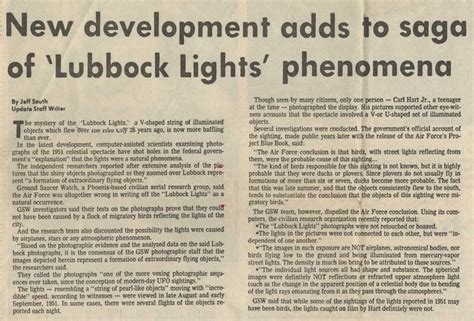
Lubbock Lights Article
The physics laboratory at Wright-Patterson Air Force Base in Ohio analyzed the Hart photographs. After an extensive analysis and investigation of the photos, Edward J.
In late September 1951, Ruppelt learned about the Lubbock Lights and investigated them as part of Project Blue Book.
Ruppelt traveled to Lubbock and interviewed the professors, Carl Hart, and others who claimed to have witnessed the lights. Ruppelt's conclusion at the time was that the professors had seen a type of bird called a plover.
The city of Lubbock had installed new vapor street lights in 1951, and Ruppelt believed migrating plovers were reflecting the new street lights. Witnesses who supported this assertion included T. E. Snider, a local farmer who on August 31, 1951, had observed birds flying over a drive-in movie theater; the birds' undersides were reflected in the light.
Another pair of witnesses, Joe Bryant and his wife, on August 25 observed groups of lights flying overhead. When a third group of lights passed overhead they began to circle the Bryants' home, and were identified by sight and sound as plovers.
J. J. C. "They weren't birds, they weren't refracted light, but they weren't spaceships [...] [they were] positively identified as a very commonplace and easily explainable natural phenomenon [...] It is very unfortunate that I can't divulge exactly the way the answer was found because it is an interesting story of how a scientist set up complete instrumentation to track down the lights and how he spent several months testing theory after theory until he finally hit upon the answer. Telling the story would lead to his identity and, in exchange for his story, I promised the man complete anonymity.
In November 1999, Dallas, Texas-based television station KDFW aired a news story about the Lubbock Lights. Reporter Richard Ray interviewed Carl Hart, Jr.
While the Astoria incident was attributed to a transformer explosion and the Lubbock Lights were eventually linked to birds reflecting street lights, these events underscore the human tendency to seek explanations for the unknown, often leading to speculation about extraterrestrial phenomena.