The brown-headed cowbird is a common bird, often seen in fields and meadows. Male Brown-headed Cowbirds are a shiny black with distinctive brown heads. Females are a dirty brown with light streaking on the back and belly, while juvenile males become a mottled black and brown until their full adult plumage develops. While they are seen occasionally on feeders, they are more likely walking around beneath the feeder scavenging for seeds that other birds dropped.
But the reason the brown-headed cowbird warrants attention is because of its peculiar breeding methods. It is what is known as a “brood parasite.” Instead of building their own nests, the female cowbirds lay their eggs in the nests of other birds, leaving the chore of feeding and raising the young to the parasitized unwitting host birds. Essentially, they adopt their young.
The Cuckoo was made famous by William Shakespeare who was familiar with the same trait of the cowbirds that the Cuckoo also has, that is, laying its eggs in other birds’ nests and having the host bird raise the Cuckoo’s young. Shakespeare made the Cuckoo famous as the symbol of male infidelity, probably because there weren’t any (and still aren’t any) cowbirds in Great Britain.
Not only do the female cowbirds sneak in and lay their egg in the other species’ nest, but they also brazenly remove one of the host parent’s own eggs to increase the likelihood that the Cowbird’s chick will be the lone survivor of the nesting effort of the host birds. To further increase that likelihood, the Cowbird’s egg is programed to hatch quicker than the host bird’s own eggs. When the Cowbird’s chick is born it has an innate reflex to push anything else in the nest over the edge and out, whether it be any other eggs or even the host bird’s own babies that may have hatched before the Cowbird chick. Female cowbirds will lay up to 30 eggs in a single breeding season.
It is not uncommon to see a backyard nest with four or five eggs in it where all the eggs are of the same type, except for one usually larger egg. So how do other birds receive the concept of having to adopt a baby from a different bird species?
Read also: Alien Species Overview
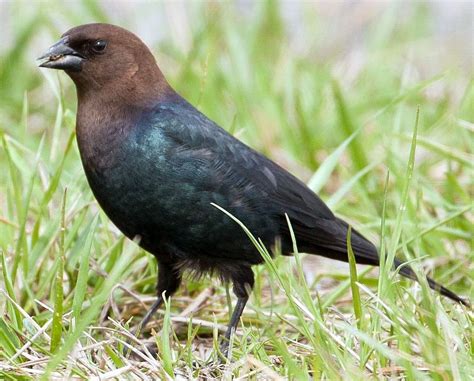
Male Brown-headed Cowbird
The Response of Host Birds
Most birds reject the eggs. Larger birds will often just toss the cowbird egg out of the nest and continue on with their own. Smaller birds that do not have the wherewithal to pick up the usually larger eggs of the cowbird will often start their breeding process anew. This means abandoning the eggs they have already laid. What they do is keep the same nest, but build a new floor in the nest over the already-laid eggs. They then will lay another clutch of eggs.
Cowbirds often return and lay an egg with the new clutch, and this breeding dance continues. In some cases, the nesting bird will actually accept the cowbird egg as her own and hatch and feed it. The problem is that the baby cowbird hatches more quickly than most other eggs in the nest and becomes dominant. It is typically larger than the other hatchlings and eats more. One of the saddest moments in my entire birding lifetime was observing a beautiful little male Hooded Warbler feeding a Brown-headed Cowbird chick that was more than twice its size.
While cowbirds parasitize over 160 different species of birds, some species have learned to identify their eggs and either abandon the nest or build a new nest on top of the old nest with the cowbird egg in it. I have seen Yellow Warbler nests with as many as three nests on top of each other, with the lower nests each containing a cowbird egg. Red-winged Blackbirds are notorious for chasing cowbirds out of their nesting areas.
Read also: Understanding anemia spiritually
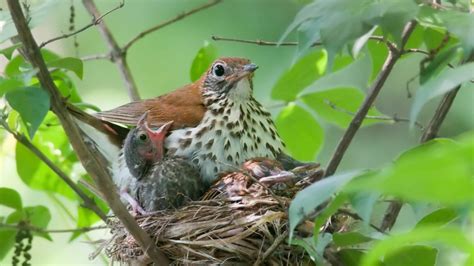
Cowbird parasitism on a Yellow Warbler
The Evolutionary Basis for Brood Parasitism
While it is easy to dismiss the cowbird as a lazy parent, there is actually a biological disposition as to why this brood parasite behavior occurs. Cowbirds historically have followed herds of bison and cattle across large swaths of prairie, feeding off the bugs that the animals kick up from the grass as they move and migrate. They were always on the go.
If a female cowbird would have taken the time to build a nest, incubate eggs, and raise the young, she would have been separated from, not only her own flock, but the herd of bison or cattle that was responsible for her food. Brown-headed Cowbirds developed this parasitic breeding technique many years ago in the mid-west when they followed the traveling buffalo herds and had to keep moving as the herds kept moving. They could not take time off to build a nest or raise their own young as the constantly moving herds were their only food source. As settlers came and cut down the forests, they opened whole new territories of potential cowbird food sources with numerous stationary cattle farms. The Brown-headed Cowbirds expanded their territories both east and west so that they now are found throughout all North America. And bird feeders have become a new and popular food source for the cowbirds.
Read also: Light Blue: Calmness and Healing
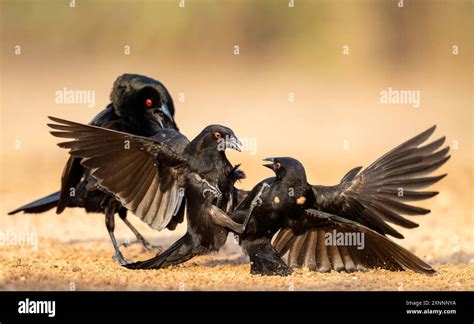
Male cowbirds perform elaborate mating displays to attract the females.
As seen in the picture above, male cowbirds perform elaborate mating displays to attract the females. They will often dance in front of the female and cause lots of commotion.
Conservation Efforts
In Michigan, the Brown-headed Cowbirds were a very serious threat to wipe out the Kirtland’s Warbler, an endangered species particularly susceptible to cowbird parasitism. Fortunately, the U S Fish and Wildlife Service undertook a widespread cowbird trapping program in the Kirtland’s breeding areas which has contributed significantly to the gradual regrowth of the Kirtland’s population.
BROWN HEADED COWBIRDS: the Parasite explained | #animals #love #happy
Other Cowbird Species
In addition to Brown-headed Cowbirds there are two more species of cowbirds with limited ranges in North America.
- The Bronzed Cowbird, a primarily Mexican species, with its bright red eye in both the male and female, has a very limited range in southern most Texas, New Mexico and Arizona. They overlap with Brown-headed Cowbirds and it is not uncommon to see both species on a feeder at the same time.
- The Shiny Cowbird is a bird of Cuba and the West Indies, but in the past 35 years they have been found in south Florida and along the coast as far north as South Carolina.
Watch backyard feeders for cowbirds. The males will be identifiable due to its deep brown head. Females are non-descript and look similar to the females of other species as well as certain immature birds.
| Species | Distinguishing Features | Range |
|---|---|---|
| Brown-headed Cowbird | Male has brown head, female is dull brown | Throughout North America |
| Bronzed Cowbird | Bright red eye in both sexes | Southern Texas, New Mexico, Arizona |
| Shiny Cowbird | Found in Cuba and the West Indies | South Florida, coastal South Carolina |