Music is an art, an expression of feeling conveyed through vocal and instrumental sounds. Often, a song can evoke nostalgia, even on first listen. Vampire Weekend's newest album, "Only God Was Above Us," perfectly embodies this, drawing out the wistfulness associated with their formative era.
Vampire Weekend performing live. Photo by Mingle Media TV and Red Carpet Report
Vampire Weekend, an indie group of four that formed in New York City in 2006, has been teasing new music since 2021, leaving fans anxiously awaiting this release for the past three years. Luckily for the fans, this announcement also comes along with a tour promoting the album. Before the tour officially kicks off, Vampire Weekend will be playing a solar eclipse show in Austin. Then, the band will take off in June for four months of stops across the US and Canada, joined by the band Cults.
Vampire Weekend have released two singles from their upcoming album Only God Was Above Us. "Gen-X Cops" is upbeat subway surf-rock about the generation wars, while "Capricorn" is a meditative and melodic song with death on its mind. "Capricorn" was released on February 16, 2024, by Columbia Records as a double A-side with "Gen-X Cops", and is the band's first single since 2019's "This Life"/"Unbearably White".
The Album's Landscape: From Buoyant Beginnings to Hopeful Endings
The album begins with the song “Ice Cream Piano” that is the musical equivalent of driving with windows down through the country. As elegant and freeing as the intro piece is, the following song “Classical” was teased prior to the album release and features, 90s café jazz highlighted by its prevalent saxophone solos. Next up is the song “Capricorn.” Succeeding this hit is the track “Connect,” a sharp contrast to the last song with its cool, sorrowful undertones. The piece starts with what sounds like an advanced piano warmup before flowing into pessimistic thoughts that are laced with a grieving of the future. While this one is about searching for connections with people socially and romantically, the main theme points towards the despair that ensues not finding these connections. “Prep-School Gangsters” is the next track, and the title easily describes the mood the narrator brings forward throughout the song.
Read also: Traits of the Capricorn Third Decan
Coming next in the lineup of titles on this album is “The Surfer.” This song has a simple message, that one can feel stuck and not good enough no matter where they may be in life. It explains how in this age no one can ever seem to achieve quite what they want or desire and the disappointment that ensues at this realization. The song is characterized by its soft drums and airy piano style that drones on for a minute into the song, an artistic choice that reaffirms the overall emotion of struggling against the weight of life that this piece delivers. The seventh title on this album starts with a siren-like guitar intro which is appropriate for the track name “Gen-X Cops.” This song was released prior to the album release and the music video is one that is easily identifiable as 1980s themed. As one would guess, this song has a lot of hidden meaning.
The concurring two tracks, “Mary Boone” and “Pravda,” discuss the depression of the narrator’s friend and the painful truth that the narrator has to accept that they see the world different because of their differing experiences. Finally, the ending song “Hope” is not what you would expect from the title. This track talks with both encouragement and numb recognition. The chorus states, “I hope you let it go” and continues this phrase with lists of good events, but that came about or had poor consequences. An example is America winning the war. The pain associated with a war was overlooked by the fact that America won. This is a good event, but the narrator emphasizes remembrance, the destruction and pain that linger even in presence of good. That hope is beautiful as long as we respect the struggle it took to get to where we are today.
"Capricorn": A Deep Dive into the Song's Meaning
“Capricorn” is a big, hazy tune featuring a swell of synthesizers, piano, guitar, harmonica, and strings. In “Capricorn,” the band expresses a mid-life crisis, singing of getting lost in time and searching for moments and purposes of their own. This track is a bit crisp and is reminiscent of a brisk, sunset walk during the fall. The song merges from soft tones to a peppy chorus of violin and crunchy electric guitar that is just chaotic enough to feel calming. If you want a song that encompasses Vampire Weekend’s popular sound, “Capricorn” is the one, as this track sits at second in their list of top songs and has garnered roughly six and a half million streams.
The song opens with smooth, polished instrumentals and lyrics of defeat, “Can't reach the moon now, can't turn the tide. The world looked different when God was on your side.” As the song builds, the lyrics become more encouraging. Towards the second chorus, the song takes on this eerie almost screeching sound in the background, juxtaposing the previously fairly calm instrumentals. This shift marks a turning point in the song, with the screeching becoming gradually louder and the instrumentals getting more and more disheveled.
The verses all end the same: “I know you’re tired of tryin’ / Listen clearly, you don’t have to try.” It’s the unwanted person lingering at the party that everyone is saying, “Who invited him??” about, but the party is … Earth? New York under the unbearable weight of latter-day capitalism? Human life itself? Koenig finds the best metaphor for that out-of-placeness in the plight of the December Cap: “Capricorn / the year that you were born / finished fast / and the next one wasn’t yours.”
Read also: Overview of Capricorn Countries in Africa
Spanning December 21st to January 19th, the astrological sign Capricorn marks the 10th position in the zodiac. Those born in the final weeks, dubbed "December Capricorns," experience a birth year that seems to vanish rapidly, potentially shaping their perception of time and beginnings. Vocalist Ezra Koenig addresses someone here who is full of unease and confusion. The line, "The world looked different when God was on your side," paints a picture of optimism fading, replaced by a bleak reality. Stuck in the tide, this person feels powerless to change their circumstances.
Hope whispers in the distance: Despite the darkness, "Capricorn" isn't devoid of hope. The line "Good days are comin', not just to die" offers a glimmer of light, urging the listener to persevere. Koenig's soothing "Listen, baby, you don't have to try" suggests accepting the unchangeable while holding onto hope for the future.
It is so rare that Capricorns are seen like this! Even rarer that we get pretty piano riffs and noise-inflected interjections and a strings section. The Capricorn brand is too grind-set-coded: all about working hard, trudging forward, and pushing through.
Could just be because I’m a Capricorn myself-“Takes a while to warm up to people,” “Motivated by duty,” “Full-grown adult since age six,” according to the astrology app Co-Star-but I found the song’s final verse almost unbearably romantic. What’s kinder than telling someone they don’t have to work so hard? “Good days are comin’ / Not just to die / I know you’re tired of tryin’ / Listen, baby, / You don’t have to try.”
Complete with videos that show pre-millennium NYC, these Only God Was Above Us singles highlight the passage of time and all the crushing disappointments and bittersweet realizations that come along with it.
Read also: Capricorn Compatibility
This track goes into greater detail about the expectations tied to a person by their age. The first line of this quote could be referring to the fact that “dying young” is known to be an extremely tragic event - worse than dying at an older age. The second line has a very clear meaning that has been a well-protested and represented expectation. Once you reach a certain age, you are expected to settle down with a partner, create a family and a stable income. We have seen many protagonists who do not abide by these expectations as a way to lash back at the so-called “haters,” but that hasn’t changed the overall view of mankind.
Ezra Koenig takes a “still waters run deep” approach to our maligned sign and creates something soft and beautiful. This ruminative little track on aging is about trudging along in what feels like the fallout of some bygone heyday. Capricorns are both the youngest and the oldest sign of the year, straddling the ball drop. “Too old for dying young / too young to live alone.”
Songfacts®:"Capricorn" is a wistful and subdued song by Vampire Weekend that reflects on the passage of time and the complexities of existence.
Here’s the thing about Capricorns: We normally don’t get to have this. There is no definitive “Virgo’s Groove” or “Medley: Aquarius” for the water goat. We don’t have the evocative edge of Scorpios or confident simplicity of Leos. We don’t even get to have our own season; overshadowed by Christmas and New Year’s, we’re stuck with the universally loathed dregs of January. Also, Capricorns simply don’t have muse energy. At our worst, we are status-obsessed workaholics. At our best, we’re boring: dependable, practical, fiscally responsible. None of it makes for compelling art.
On the new single "Capricorn," the spacious reverb emphasizes the aching, unavoidable melancholy of growing old and discovering that adults feel just as powerless as kids do. The grinding, harsh distortion that enters in the second chorus emphasizes that inner turmoil.
The drums, played by Chris Tomson, opened the song with a more fluid style than the classic drum beats he locks into in each song.
| Aspect | Description |
|---|---|
| Themes | Aging, societal expectations, hope amidst disillusionment, passage of time |
| Musical Style | Meditative, melodic, with elements of rock ballad, incorporating synthesizers, piano, guitar, harmonica, and strings |
| Lyrical Content | Reflects on the complexities of existence, struggles with time, and the search for purpose |
| Music Video | Features archival footage from artist Steven Siegel, documenting scenes from New York City since the ’80s, contrasting utopia and dystopia |
The Music Video: A Visual Representation of Dystopian Realities
The music video which corresponds with the new release was directed by Nick Harwood and features archival footage from artist Steven Siegel, who has documented scenes from New York City since the ’80s. In it, scenes flash between the daily commotion of life in New York and a broken, empty, almost dystopian city. The video opens with the band in a trashed, zero-gravity subway car, and regularly switches between utopia and dystopia. However, while they’re in the “utopia” that is supposed to be NYC, there is still a dark reality lurking under the surface. The video is shot on grainy film that often shows holes or underdeveloped edges.
The screeching sounds similarly mark a turning point in the music video, where the people get stranger and the film gets grainier. The video quickly flips through a mix of outwardly scenes, while the film gets increasingly harder to see.
Vampire Weekend's Evolving Sound
Vampire Weekend felt slightly out of step with the arch, fuzzy, forward-thinking indie rock of the time. Its music was polished and sunny, a little cocky, with melodic sensibilities indebted to the dynamic, sensitive songs and songwriters of the seventies and eighties: the Beat’s “Save It for Later,” Paul Simon’s “Under African Skies,” Harry Nilsson’s “Gotta Get Up.”
The band’s second album, “Contra,” released in 2010, debuted at No. 1 on the Billboard 200. The songs were idiosyncratic but had shockingly broad appeal. That winter, the single “Holiday,” a reggae-inflected rock track that, for better or worse, could have been airlifted from a third-wave ska compilation, appeared in two major television commercials at the same time. More albums followed-“Modern Vampires of the City,” in 2013, and “Father of the Bride,” in 2019.
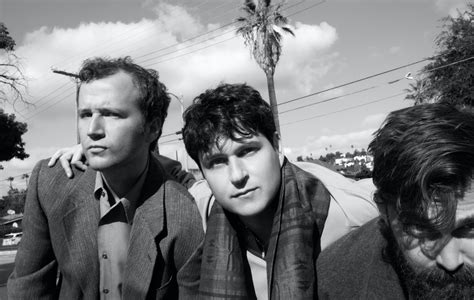
This month, Vampire Weekend will release “Only God Was Above Us,” its fifth album. The band’s current lineup includes Koenig, the drummer Chris Tomson, and the bassist Chris Baio. (In 2016, the visionary multi-instrumentalist and producer Rostam Batmanglij announced that he had left the group, on amicable terms; he is credited as a co-writer and a co-producer on “The Surfer,” a gorgeous, spacey new song.) Vampire Weekend has never made a bad album, but “Only God Was Above Us” is one of its best. The songwriting is less compact and urgent, and the sound is looser, hazier, more free. Koenig will turn forty this month. We all soften and uncoil, in different ways, in middle age.
“Capricorn,” along with the band’s other just-released single “Gen-X Cops,” come years in the making with the band’s last album Father of the Bride having made its debut in 2019.
Every Monday, our music staff brings you a new Pick of The Week, detailing some of our favorite songs.
Capricorn - Vampire Weekend | Song Analysis Livestream Pt.2 (WED 3.13.24 7pm EST)
For a while, in the late two-thousands, it was extremely fun to dunk on Vampire Weekend. Formed at Columbia University in 2006, the band made perky, bleating indie rock about Cape Cod, mansard roofs, and Oxford commas. The singer and guitarist Ezra Koenig wore khakis and sometimes loosely knotted a sweater around his shoulders, a look that everyone knows is the unofficial uniform of rich, scummy boyfriends in high-school movies. The band’s vibe was preppy but lightly debauched, somewhere between “Dead Poets Society” and “Less Than Zero.”
Koenig's Lyrical Motifs: Religion, Time, and Inheritance
Koenig’s voice is high, clear, and mannered, but there’s something unusually intimate about his phrasing and delivery. It always sounds, to me, as if he’s both close and far away, maybe on the other end of a phone, shouting across some vast distance. He has a few recurring lyrical motifs, one of which is a vague religiosity-a deep and persistent curiosity about faith and the divine. In this way, Koenig most resembles Simon, whose music-including its deft (if ballsy) adoption of polyrhythms from sub-Saharan Africa-has always been a major touchstone for the band. Like Simon, Koenig grew up around New York City and was raised Jewish.
Another of Koenig’s lyrical preoccupations-surely not unrelated-is the unstoppable trudge of time. (Koenig co-hosts an online radio show titled “Time Crisis.”) On “Step,” also from “Modern Vampires,” he worries about man’s inevitable trajectory: “Wisdom’s a gift, but you’d trade it for youth.” What if at the end of all this there is simply more unknowing? “Age is an honor, it’s still not the truth,” Koenig adds.
I can’t stop hearing the lyrics of “Only God Was Above Us” as a treatise on inheritance, decay, generational dissonance, and the delicate idea of choosing optimism over defeatist grousing. We have to reckon with the past: the cascading spiritual fallout of our ancestors’ wars. We have to reckon with the present: the ghastliness of our current wars. But there’s also a way to understand violence and struggle as inherent to the human journey-a challenge we have survived countless times (though not without sustaining wounds). The album opens with Koenig singing, “Fuck the world,” his voice soft, almost trembling. But it turns out that he’s merely quoting someone who’s got himself mired in a self-fulfilling fear spiral. That song, “Ice Cream Piano” (on the lyric sheet, the titular phrase appears as “In dreams, I scream piano”), is noisy but buoyant. “We’re all the sons and daughters / Of vampires who drained the Old World’s necks,” Koenig, a descendant of Romanian and Hungarian immigrants, sings.
Koenig is a meticulous lyricist, not one of those say-any-old-thing types. He favors harsh, distinctive nouns (horchata, balaclava, pincher crabs, aranciata, Masada-and that’s just on one song, “Horchata,” off “Contra”), and he often has to do some major syllabic gymnastics to make the rhythm work, like in this part of “Ice Cream Piano”: “You talk of Serbians / Whisper Kosovar Albanians / The boy’s Romanian / Third-generation Transylvanian.” He seems to be suggesting, albeit gently, that it’s advisable to expand our historical understanding of conflict-that no bloodline is innocent, that righteousness is never totally earned, that war is constant. “Each generation makes its own apology,” he trills, on the chorus of “Gen-X Cops,” a whirling song built around a distorted slide-guitar riff that sounds buggy and possessed, like an insect careening around a porch light at dusk.
“Only God Was Above Us” is rife with semi-arcane references: “Gen-X Cops” is named after a Japanese action movie released in 1999, the cover of which will be familiar to anyone who haunted downtown video stores before the advent of streaming. Another song takes its name from a New York magazine cover story from 1996, titled “Prep-School Gangsters,” in which the journalist Nancy Jo Sales bums around Manhattan with a crew of trust-fund dirtbags. On “The Surfer,” Koenig refers to the construction of Water Tunnel No. 3, a New York City water-supply tunnel that broke ground in 1970 and will be completed, it’s estimated, in 2032. (It was once touted as “the greatest nondefense construction project in the history of Western Civilization.”)