In ancient Egyptian mythology, birds played a pivotal role, symbolizing divine power, protection, and connection to the sky. These winged creatures were woven into the fabric of Egyptian life, representing various concepts and aspects of their beliefs.
Birds were seen as messengers between humans and gods, carrying prayers and offerings between the mortal and divine realms. The ancient Egyptians believed that birds’ ability to fly and soar through the sky made them ideal intermediaries. In Egyptian mythology, birds played a crucial role in the afterlife, representing aspects of the soul and guiding the deceased through the spiritual transition.
Each of these bird gods played a role in Egyptian myths. Horus, for instance, was the falcon-headed protector of the pharaoh, while Thoth’s ibis symbolized knowledge and the scribes. The vulture goddess Nekhbet safeguarded the king, and the Bennu heron embodied the sun’s rebirth.
Pharaonic symbols were numerous in the life of ancient Egyptians and varied in their symbols, rituals, and use. Here are some prominent bird-related symbols and their meanings:
Key Bird Deities and Symbols
Horus: The Falcon-Headed Sky God
Horus was the falcon-headed sky god, son of Osiris and Isis. Isis gave birth to Horus after Osiris was murdered and hid him from his wicked uncle Seth by concealing him under her magic hair. Horus was king of the living.
Read also: Eye of Horus Tattoo Symbolism
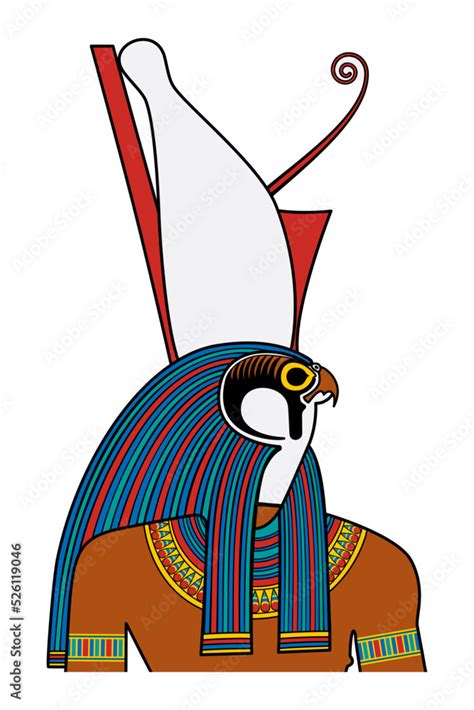
Horus, the falcon-headed god.
Thoth: The Ibis-Headed God of Wisdom
Thoth is the ibis-headed god of wisdom, knowledge, learning, writing, measurement, historical records, science, magic, and scribes. He had a good memory and was involved in the after-life ceremony of the dead in which the heart was weighed against the feather of truth. Thoth is the lord of the moon and is sometimes represented as a baboon.
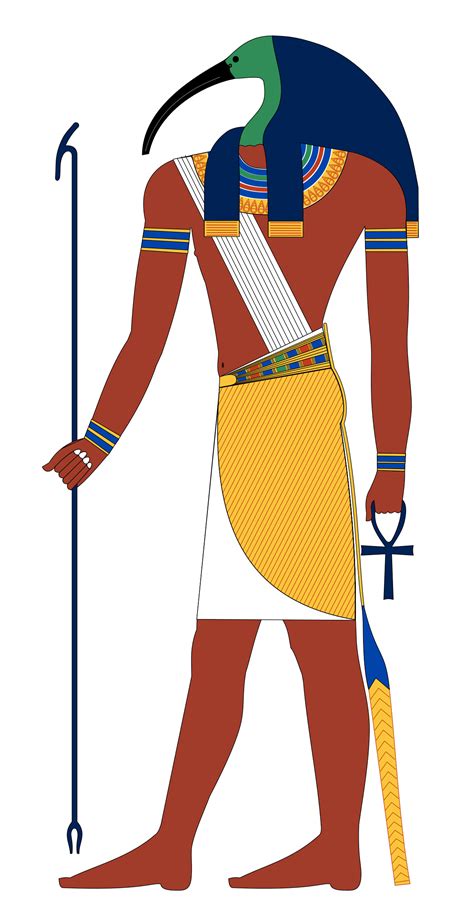
Thoth, the ibis-headed god of wisdom.
The Ibis: Sacred Bird of Thoth
The ibis, with its narrow, curved beak and flashy white feathers, was the sacred bird of Thoth, the ancient Egyptian god of wisdom and writing. Bundled up ibises were the most common type of animal mummy in ancient Egypt.
According to an ancient text, the Temple of Thoth in the necropolis of Saqqara at one time had 60,000 living ibises being readied for mummification, and archaeologists estimate that some four million ibis mummies were eventually buried there. A few mummies have been found with papyri petitioning the gods for help to resolve a family matter or cure an illness.
Read also: Meaning of Ancient Symbols
The majority of animal mummies in the necropolis were not accompanied by written petitions and that it’s possible most were intended to carry oral messages. Perhaps pilgrims whispered their requests in the ears of the mummies, which then delivered their messages to the gods.
Beginning about 600 B.C., ibises were frequently mummified and given as sacrifices to the god. “Pilgrims would offer an ibis mummy to Thoth on his feast day either to ask for a wish to be granted or to thank him,” says archaeologist Sally Wasef of Griffith University. At the peak of this practice, upwards of 10,000 ibises were sacrificed every year, a number so large that some scholars have proposed that the birds must have been bred in centralized farms to meet the demand.
Although more than four million ibis mummies have been found at the site of Tuna el-Gebel, which lies on the Nile River about 170 miles south of Cairo, no massive ibis breeding facility has ever been located. This has raised the question of whether such installations actually existed.
An international team of researchers recently conducted a study of genomes from 14 ibis mummies dating to 2,500 years ago, and found a surprising degree of genetic diversity. The ancient birds were nearly as diverse as the modern population, which inhabits most of Africa. The researchers suggest that the ibises sacrificed by ancient Egyptians were probably imported from across the continent.
Fifth Century B.C. Greek historian Herodotus wrote in Book 2 of “Histories”: On account of this deed it is (say the Arabians) that the ibis has come to be greatly honoured by the Egyptians, and the Egyptians also agree that it is for this reason that they honour these birds.
Read also: Unpacking the Bird-Window Symbolism
The Phoenix
There is also another sacred bird called the phoenix which I did not myself see except in painting, for in truth he comes to them very rarely, at intervals, as the people of Heliopolis say, of five hundred years; and these say that he comes regularly when his father dies; and if he be like the painting he is of this size and nature, that is to say, some of his feathers are of gold color and others red, and in outline and size he is as nearly as possible like an eagle.
This bird they say (but I cannot believe the story) contrives as follows: - setting forth from Arabia he conveys his father, they say, to the temple of the Sun (Helios) plastered up in myrrh, and buries him in the temple of the Sun; and he conveys him thus: - he forms first an egg of myrrh as large as he is able to carry, and then he makes trial of carrying it, and when he has made trial sufficiently, then he hollows out the egg and places his father within it and plasters over with other myrrh that part of the egg where he hollowed it out to put his father in, and when his father is laid in it, it proves (they say) to be of the same weight as it was; and after he has plastered it up, he conveys the whole to Egypt to the temple of the Sun. Thus they say that this bird does.
Northern Bald Ibis
Jírí Janák of Charles University in Prague wrote: “Three different kinds of ibis species are attested from ancient Egypt: the sacred ibis, the glossy ibis, and the northern bald ibis. Pictorial representations of the latter bird-easily recognizable by the shape of its body, the shorter legs, long curved beak, and the typical crest covering the back of the head-were used in writings of the noun akh and related words and notions (e.g., the blessed dead).
We can deduce from modern observations that in ancient times this member of the ibis species used to dwell on rocky cliffs on the eastern bank of the Nile, that is, at the very place designated as the ideal rebirth and resurrection region (the akhet). Thus, the northern bald ibises might have been viewed as visitors and messengers from the other world-earthly manifestations of the blessed dead (the akhu).
The material and pictorial evidence dealing with the northern bald ibis in ancient Egypt is accurate, precise, and elaborate in the early periods of Egyptian history (until the final phase of the third millennium B.C.). Later, the representations of this bird became schematized and do not correspond to nature. Thus, they do not present us with any direct and convincing evidence for the presence of the northern bald ibis in Egypt, and, moreover, they most probably witness both the bird’s decline and its disappearance from the country.
There are, however, scholars who have challenged the theory that the word akh was primarily connected with light and glare and suggested that the original meaning of the notions akh and akhu might have been linked, for example, to the idea of a mysterious, invisible force and to the efficacy of the sun at the horizon.
“Although there are many (probably secondary) aspects of the northern bald ibis’ nature that could have been important for the Egyptians such as, for example, the above- mentioned glittering colors on its wings, or its calling and greeting display, the main factor in holding the bird in particular esteem and connecting it with the akhu and the idea of resurrection was its habitat.
This member of this ibis species used to dwell at the very place designated as the ideal rebirth and resurrection region (the eastern horizon as the akhet); moreover, its flocks might have very well represented the society of the “returning” dead. The ancient Egyptians saw migratory birds as the souls or spirits of the dead, and the fact that the northern bald ibis counts among the migratory birds might also have been very important. The arrival of these birds could have been a sign of the coming “spring” or the harvest season, as was the case at Bireçik.
Jírí Janák of Charles University in Prague wrote: “The northern bald ibis is a middle-sized (height: 70 - 80 cm,weight: 1.3 kg, wingspan: 125 - 135 cm) gregarious bird that nests in colonies. These birds have a long curved red bill, red legs, and an unfeathered reddish head with the typical dark crest of neck plumes covering its back. The main color of the birds is black, with tints of blue, green, and copper. This iridescent purple and green “shoulder patch” on the wings of the bird is well visible in the sunlight.
The northern bald ibises prefer to inhabit an arid or semi-arid environment, with cliffs for breeding and nesting. These birds feed during the day in adjacent dry fields and along rivers or streams by pecking on the ground. They live in areas with low level vegetation (arid, but preferably cultivated, places), where they can find worms, insects, lizards, and other small animals on which they feed.
When the birds awake, or when they come together at sunset, this is always, but especially in the morning, marked by high activity.
“The northern bald ibis has been found in North Africa and Ethiopia, the Middle East, and throughout Central Europe. However, only a few colonies survive in the world today, totaling in all not more than about 400 individuals. Some of them nest in the Souss Massa Park in Morocco , a few breed in Central Syria, and many northern bald ibises are kept in zoos or raised in special projects. The northern bald ibis still counts among the most critically endangered species and is on the Red List. Causes of the decline are thought to be pesticides, human persecution, habitat loss, and global fluctuation in rainfall.
“These ibises are usually migratory, they spend about four months in a breeding area, and...
Other Significant Egyptian Symbols
While birds held special significance, other symbols were also integral to Egyptian culture:
- Ankh: Represents eternal life.
- Eye of Ra: Symbolizes the sun and protection.
- Scarab Beetle: Represents death, rebirth, power, and protection in the afterlife.
- Cartouche: A hieroglyphic nameplate symbolizing protection against evil spirits.
- Winged Sun: Symbolizes protection.
- Ouroboros: Represents the journeys of Aten, the solar disk.
- Amenta: Represents the land of the dead.
- Tiet (Knot of Isis): Similar in meaning to the ankh.
- Maat’s Feather: Represents justice and truth.
- Crook and Flail: Symbolize the authority of the pharaohs.
- Deshret (Red Crown): Represents Lower Egypt.
- Hedjet (White Crown): Represents Upper Egypt.
- Pschent (Double Crown): Represents a united Egypt.
- Stars: Represented the constellations and the Duat.
- Ajet (Horizon): Represents the sunrise and sunset.
- Menat: An Egyptian necklace associated with the goddess Hathor.
- Sistrum: An ancient Egyptian instrument used in rituals.
- Nemyss: The Egyptian ritual headdress of the pharaohs.
- Obelisk: A symbol connected to the “energies of the earth” and the Sun God Ra.
- Shen Ring: Represented as a knotted and braided rope in a circular form.
The Symbolism of the Ibis - The Icon of Djehuty
In conclusion, birds were deeply embedded in the spiritual and practical lives of the ancient Egyptians, serving as potent symbols of divinity, wisdom, and the eternal cycle of life and death.