The idea of witchcraft and sorcery certainly existed in 1300 (as indeed it had for centuries) but it was far more loosely defined. It was not particularly associated with devil worship. Concepts such as witch marks and black sabbaths were unheard of. When people thought of witches and sorcery, they were no more likely to think of women than of men. Indeed, the practice of magic was by no means automatically associated with anything inherently evil or harmful.
The concept of ‘the witch’, as we understand it, is present here, but only in an embryonic form. If you asked someone in Elizabethan England to explain what witchcraft was, you would receive a very clear and familiar description. Witches were, as everyone at that time knew, devil worshipping practitioners of black magic. They meet in covens, fly on broomsticks, consort with devils, perform satanic rituals, make human sacrifices, and cast evil spells and curses. It is tempting to believe that this definition of witchcraft is as old as Christianity itself. But it’s not.
If you were to describe a witch in that way to anyone living in 1300, they would have been utterly shocked. It would have been entirely unfamiliar and new to them. You might even have been accused of being mad.The truth is that the idea of ‘the witch’, as we know it today, was invented in the late Middle Ages. But how and why did this happen?
If I were to ask you to describe ‘a witch’, what image comes most easily to mind? Your first thought would probably be of an older woman, perhaps a hag. She probably lives alone to give her the privacy she needs to practice her dark arts. Images of black magic, devil worship, covens, black sabbaths, black cats, broomsticks, human sacrifices and orgies might spring to mind.This detailed image of ‘the witch’ was fully formed by Elizabethan times and persists to today. But, in 1300, it simply did not register in the cultural consciousness. In the two crucial centuries between 1300 and 1500 the concept of ‘the witch’ was invented.
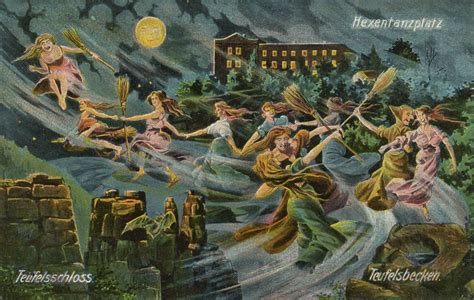
Walpurgis Night by Albert Joseph Penne
Read also: A Journey Through Witchcraft
Biblical Prohibitions
True enough, the bible itself, contains some firm proscriptions against sorcery and witchcraft:
- Thou shalt not suffer a witch to live. Exodus 22:18
- You shall not practise augury or witchcraft. Leviticus 19:26
- A man or a woman who is a medium, or who has familiar spirits, shall surely be put to death. Leviticus 20:27
But wait. The references to witches and witchcraft come from English translations of the Bible. These are all influenced by the King James Bible, which was compiled in the early C17th, at the height of the early modern witch-hunts.
In the Latin translation, used during the Middle Ages, the word ‘witch’ is not used. Instead, we find ‘maleficos’ - which specifically means practitioners of harmful magic (not witches in general). Additionally, nothing in the Bible explicitly links ‘witches’ with any kind of satanist cult.
For most of the Middle Ages the official Church position was that sorcery and witchcraft were viewed as misguided and to be discouraged. However, they were not seen as inherently evil, and they certainly did not warrant active persecution.
Medieval Magic
In fact, magic of various kinds was quite commonly practised in the Middle Ages. If the early medieval Church had imposed the death penalty on everyone dabbling in magic it would have led to a bloodbath. It would certainly have turned the pagan populations who the early missionaries were attempting to convert, against the faith. The Church saw magic as a misguided superstitious belief (much the same attitude as many people have today). Since this magic did not come from God, as far as the Church was concerned, it could not work. People could be deceived into such foolishness by demons, but this did not mean they worshipped demons.
Read also: Understanding Witchcraft in Scripture
The practice of magic was usually seen as no more than a symptom of pagan or heretical belief. The solution was therefore to stamp out paganism and heresy. The official Church teaching, for most of the Middle Ages, was that those who practiced magic were delusional and foolish rather than evil.
The relationship between medieval society and magic was therefore ambivalent. On the one hand there is no denying that the Church disapproved of it. But on the other, the Church saw no need to proactively persecute it.
‘Good’ and ‘Bad’ Magic
Of course, not all supernatural powers were classed as magic anyway. Miracles, visions, prophecy, and holy relics were all gifts from God. Deciding what exactly qualified as ‘magic’ in the medieval mind was not so clearcut as we might think.
Astrology provides a form of divination or augury not unlike prophecy. So does this count as sorcery or witchcraft? Or is it another gift from God?
Is not astrology simply observing the patterns in the heavens and discerning their meaning? Are not the stars in the heavens the work of God himself? So, is not astrology simply a means of foretelling the future through an understanding of God’s work?
Read also: Urdu Article: Understanding Witchcraft
Certainly, many people in medieval Europe believed so. If you were lucky enough to attend University, you’d certainly be taught astrology as part of your education.
And how about casting spells? If they are aimed at healing, or encouraging a good harvest, that is clearly not evil. It may be misguided, even foolish, but not evil in and of itself. Only if you tried to use magic to curse someone or create some evil effect could it be considered evil. This form of magic, as medieval folk would see it, was classified as maleficent. And practicing this kind of magic would make you ‘maleficos’.
Types of Magic
Magic was practiced openly by many people in the Middle Ages. However, magical practice cannot be regarded as a homogenous collection of beliefs.
Some within the literate elite formally studied magic and magical rituals. Their interest could range from casual curiosity to a serious practitioner. This form of magic required a degree of literacy since its rites and spells were learnt from books. These books represented a collection of medieval and classical spells and rituals. And, during the Crusades, other magical works were imported from middle eastern cultures.
Practitioners of this form of magic could and did perform rituals to summon and control demons. They argued that this was not devil worship since they controlled and commanded these demons rather than venerated them. They also argued that, since they used their magic for good, this was not evil. However, the type of magic practised by illiterate commoners was of a different sort. This form of magic represented folk traditions handed down orally from generation to generation. Typically, such magic encompassed simple charms, herbalism, crop blessings, fertility spells and so on. Its practitioners regarded magic of this kind as a traditional part of their local culture.
Neither form of magic was automatically regarded as maleficent, nor viewed as evidence of devil worship for most of the medieval period.

The Witches Kitchen by Israhel van Meckenem
Heresy
In fact, a far greater fear gripped the medieval Church than witchcraft or sorcery. The great enemy was not witchcraft but heresy. Heretical groups were organised in a way that witches and sorcerers were not. They preached dangerous doctrines that posed a direct (and often overt) threat to church authority. Witches, by contrast, were simply not seen as representing any kind of organised, insidious, or diabolic threat. Indeed, the official policy of Church inquisitions, right up until the early fourteenth century, was to ignore witchcraft unless heresy was involved.
Heretics were a very different story. Certain heretical sects were very real and very clearly involved many people who opposed the Church. Perhaps the most dangerous example of this had been the Cathars, who flourished in southern France during the C12th and C13th. A common accusation made against heretics was that they had been misled by demons or the devil. Satan was, after all, the great deceiver. For this reason, persecution of heresy would often attract accusations of demon worship, secret satanic rituals, and the practice of maleficent magic. This featured in the accusations levelled against the Templars in the early fourteenth century. However, the primary charge always remained one of heresy, not witchcraft.
Maleficence
For most of the Middle Ages, the practise of sorcery was only condemned if it was deemed to be maleficent. However, scholastic thinking during the thirteenth and fourteenth century was increasingly concerned to discourage the practice of magic. To do this, a sound theological case had to be made to condemn it.
The sorcerer’s argument that commanding a devil was not devil worship was one of the concepts that needed to be successfully refuted. This was done by pointing out the fact that to ‘trick’ a demon into serving the sorcerer, some form of lure was often offered. This could be blood or the sacrifice of an animal. This would attract the demon, which could then be bound and commanded. However, by offering the demon something such as blood, was this not a kind of transaction? Was it not, in effect, a pact?
This argument facilitated a blanket condemnation of sorcerous demonology. However, it also had the effect of strengthening the association between sorcery and devil worship.
Early Persecutions
The early persecutions of sorcerers and witches focused mainly on practitioners of ritual magic, where demonology was most likely to be involved.
However, these early persecutions (pre-1330) were primarily of a political nature. A good early example was the trial of Dame Alice Kytler in Ireland in 1324/5. The motive for her persecution was almost certainly political.
During her trial she was accused of maleficia. Not simply practicing magic but practicing ‘bad’ magic. She was also accused of belonging to a secret heretic sect. The accusation of heresy is significant. Since the Church still taught that witches were not worth prosecuting unless heresy was involved.
The case against Alice included several accusations that were commonly made against heretics. Many of these echoed the inditements against the Templars nearly twenty years before. The prosecutors alleged that the heretics met in secret, denied the cross, made sacrifices to demons and engaged in lewd sexual acts. They were even accused of brewing evil potions from the clothing of dead babies.
Eleanor Cobham
A classic case of how accusations of sorcery could be used for political ends is that of Duchess Eleanor Cobham. She was accused of consulting various astrologers who predicted an illness would afflict the young King Henry VI in 1441. Eleanor denied her involvement but admitted procuring magic potions (which she claimed were to help her conceive) from one Margery Jourdemayne. Jourdemayne was a well-known witch, frequently consulted by several members of the nobility of that time (of whom only Eleanor was accused of any wrongdoing).
Eleanor Cobham was convicted of ‘treasonable necromancy’ and forced to do penance by walking barefoot between Churches. However, whilst she was imprisoned, her crimes were not deemed serious enough to warrant a death sentence.
Eleanor, Margery, and several of Eleanor’s associates were charged with ‘treasonable necromancy’. Those of lesser rank all met grisly ends but Eleanor herself escaped death. However, she was forced to divorce her husband and sentenced to life imprisonment. She was also made to do penance by walking barefoot between three Churches.
Her prosecution clearly had a strong political dimension. Her husband had several powerful political enemies who were itching for an opportunity to see his influence curbed. Eleanor’s conviction was therefore a major blow to his reputation and authority.
Had Eleanor not been the wife of such a political heavyweight, it is unlikely her dabbling in the world of magic would have been so vigorously prosecuted.
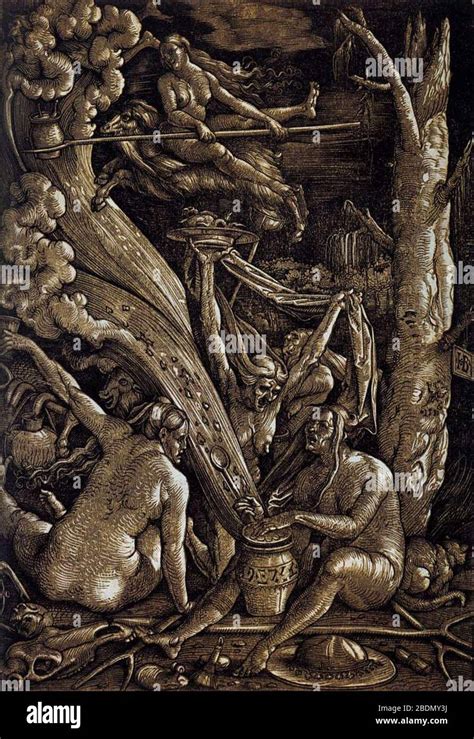
The Witch by Hans Baldung Grien
Persecution Evolves
Until 1330, prosecution without some political motive was rare. However, these early cases served to establish the precedent that at least some witches and sorcerers could and should be persecuted.
By the mid-fourteenth century persecution without any obvious political motive began to become more common. Accusations of devil worship, pacts with demons and/or secret conspiracies to perform acts of maleficence also became more common.
The net began to widen from the obvious targets (scholarly sorcerers who openly engaged in demon summoning) to others. Most ritual sorcerers were men, but a much higher proportion of folk magic practitioners were women. This transition, inevitably, led to an increasing association between women and witchcraft.
By the late fourteenth century, the association between witchcraft and devil worship had become much stronger. It now appeared far more frequently in accusations made against witches and sorcerers.
The Witch-Hunt
The first systematic witch-hunt on any scale began in Valais, in Switzerland, in 1428. Here a total of 367 witches were hunted down and killed over eight years. Most people targeted, even by this time, were still male. Accusations included not only witchcraft but also murder and (still) heresy. Even by this stage society found it hard to conceive of a conspiracy of witches unless some underlying heretical belief lay at the heart of it.
The active persecution and burning of witches gradually became more common after the late fourteenth century.
The details of the Valais trials were studied by a scholar by the name of Johannes Nider. He also studied other cases of reported sorcery and witchcraft. This inspired him to write a treatise, defining and codifying the phenomenon of witchcraft. He was one of the first scholars to formally attempt this.
Codification
The result of Nider’s research was Formicarius, written sometime between 1435 and 1437. In it he argued that witches were not simply people who practised magic. They were, in every case, also guilty of renouncing their faith, trampling on the cross and selling their souls to the devil. Nider was also keen to draw attention to this practice amongst the more common folk, especially amongst women. It was, Nider argued, a more common and serious problem than people imagined.
Formicarius was quite shocking and represented completely new thinking to many. Nider’s insistence on directly linking devil worship with witchcraft and his emphasis on female witches were both new developments. Despite this, Nider did not advocate mass witch hunts. He personally believed that Church reform and adherence to traditional monastic rites were the correct antidote to witchcraft, not burning people.
Panic
Whatever the intentions of scholars like Nider, a paranoid fear of witchcraft was beginning to infect the public consciousness.
The Early Modern period was characterized by widespread witch hunts, particularly in England, Scotland, France and Germany. Thousands of individuals accused of witchcraft, tortured and executed. The infamous Trier witch trials in Germany and the Pendle witch trials in England are a demonstration of how witchcraft accusations often stemmed from societal fears, personal grievances, or community tensions. More than three-quarters of those burned as witches in Europe were women - often described as old, frail, or insane.
Religious and secular authorities worked together to root out and prosecute witches, driven by a mix of fear, superstition and the desire to protect the established religious order. King James I of England also played a crucial role in witch persecution. His obsession with witchcraft began with a personal encounter. During his courtship of Anne of Denmark, severe storms wrecked the fleets sent to bring her to Scotland. James interpreted these events as the work of witches acting under the influence of the Devil and solidified his conviction that witches could manipulate natural elements like storms as tools of destruction.
The use of "spectral evidence," or testimony that a person's spirit had been seen committing witchcraft, fueled paranoia. Nineteen people were executed, and the trials marked a turning point as public sentiment began to shift against such extreme measures.
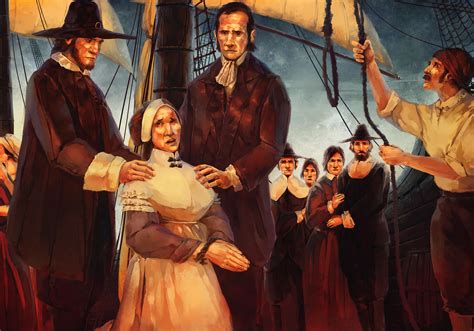
Witch Persecution
tags: #witchcraft #and #curses