The Tree of Life is an important symbol found in numerous mythological, religious, and philosophical traditions around the world. The tree of life meaning includes enlightenment, wisdom, resilience, longevity, spiritual growth, and connectivity. It often symbolizes the connection between heaven, earth, and the underworld, as exemplified by the Yggdrasil in Norse mythology.
Various cultures and peoples, from Vikings to the Chinese, have long incorporated the tree of life symbolism into their religions, art, and culture. The meaning of the tree of life carries deep symbolism for many cultures, hence its prevalence in traditional arts such as textiles, paper prints, jewelry, and sculptures. Stylistic differences also distinguish each representation of the tree of life.
The Tree of Life holds profound spiritual significance across various cultures and belief systems, symbolizing connection, growth, and the cyclical nature of existence. Rooted deeply in the earth, its branches reaching towards the skies, it embodies balance and harmony between the material and spiritual realms. Often depicted with abundant foliage and intricate patterns, it represents the breadth and diversity of life’s experiences.
The tree of life symbol is found in various cultures around the world, depicted in myths, philosophies, folklore, and religions. Depicted as a mighty tree with a developed root system and a thriving crown, the tree of life takes on new meaning between cultures.
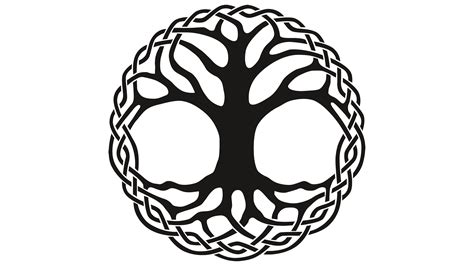
Celtic Tree of Life Symbol
Read also: The Wiccan Perspective on Christmas Trees
Tree of Life in Different Cultures
Kabbalah Tree of Life
The Kabbalah Tree of Life is a central symbol in Jewish mysticism, representing the divine structure of the universe and the path to spiritual enlightenment. Comprised of ten interconnected spheres, known as Sephiroth, and 22 paths, it maps out the journey of the soul from the material world to the divine. Each Sephirah embodies a unique aspect of the divine emanations, ranging from wisdom and understanding to mercy and victory.
Celtic Tree of Life
The Celtic Tree of Life, rooted in ancient Celtic spirituality, represents the bond between living beings, the natural world, and the divine. Symbolized by a tree with roots reaching into the earth and branches stretching towards the sky, it embodies balance, growth, and renewal. In Celtic culture, trees such as oaks symbolized wisdom, strength, and longevity. Each tree species held specific meanings and qualities, contributing to the rich tapestry of Celtic folklore and symbolism.
The Tree of Life serves as a reminder of the cyclical nature of existence, the eternal cycle of birth, growth, death, and rebirth.
Chakra Tree of Life
The Chakra Tree of Life integrates the spiritual understanding of the chakra system with the symbolism of the Tree of Life, offering a holistic framework for personal growth and healing.
TREE OF LIFE 🌳 CLEANS THE AURA AND SPACE ✨ ATTRACT PROSPERITY LUCK & LOVE, HEAL ROOT CHAKRA #4
By aligning and balancing these energy centers, individuals can cultivate physical, emotional, and spiritual well-being, fostering a sense of harmony and wholeness within themselves and their connection to the universe.
Read also: The Magical Rowan Tree
Norse Tree of Life (Yggdrasil)
In Norse mythology, the Nordic Tree of Life, known as Yggdrasil, stands as the cosmic axis that binds together the nine realms of existence. As a colossal ash tree, Yggdrasil’s roots delve deep into the underworld, its trunk rises in the middle realm, and its branches stretch into the heavens. It serves as a conduit for communication between worlds and a symbol of the unity of all things.
The Nordic tree of life is inhabited by various creatures, including the wise eagle at its highest branches, the mischievous squirrel that scurries up and down its trunk, and the serpent that gnaws at its roots. Yggdrasil embodies the cyclical nature of life, death, and rebirth, reflecting the Norse worldview of fate and cosmic order.
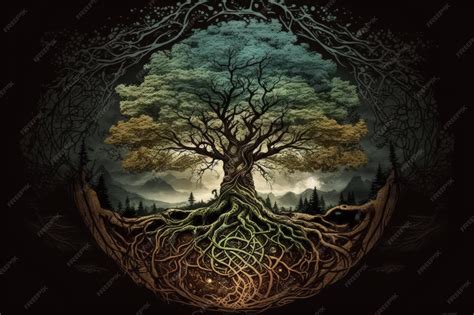
Yggdrasil: The Norse Tree of Life
Chinese Tree of Life
In Chinese mythology, the Tree of Life holds a significant place as a symbol of immortality, vitality, and the interconnectedness of all living beings. Referred to as the “Tree of Immortality” or the “Tree of Knowledge,” it is often associated with Taoist and Buddhist beliefs. In Taoism, the tree is said to grow on a mystical mountain, producing peaches of immortality that grant eternal life to those who consume them.
In Buddhist tradition, the Bodhi tree, under which Siddhartha Gautama attained enlightenment and became the Buddha, symbolizes spiritual awakening and liberation from suffering.
Read also: Science of Chakras
Hindu Tree of Life
In Hinduism, the Tree of Life is symbolized by the banyan tree, and is revered as a manifestation of divine wisdom, enlightenment, and oneness. This tree is often associated with Lord Vishnu and Lord Krishna, who are believed to have meditated beneath its branches. In Hindu mythology, the Tree of Life is considered eternal and representative of the cycle of birth, death, and rebirth (samsara).
Its roots represent the divine connection to the earth and the ancestors, while its branches reach towards the heavens, symbolizing spiritual growth and liberation (moksha). As a symbol of vitality, wisdom, and divine grace, the Hindu Tree of Life serves as a reminder of the eternal nature of the soul and the unity of all existence within the cosmic order.
The Tree of Life in Art and Decor
The Tree of Life has long served as a powerful source of inspiration for art across various cultures throughout history. In ancient cultures such as Mesopotamia and Egypt, the Tree of Life was depicted in religious iconography, often as a central motif in temples, tombs, and royal artifacts. Throughout medieval Christian art, the Tree of Life frequently appeared in illuminated manuscripts, church decorations, and stained glass windows, serving as a visual metaphor for the Garden of Eden and the promise of salvation.
In Islamic art, the Tree of Life is often depicted in intricate geometric patterns and calligraphy, symbolizing the unity of creation and the divine order of the cosmos. In Eastern art traditions such as Chinese and Japanese, the Tree of Life is represented in various forms, including paintings, woodblock prints, and ceramics. These depictions often highlight the tree’s connection to nature, the seasons, and the cyclical rhythms of life.
Within modern and contemporary art, the Tree of Life continues to inspire artists from diverse cultural backgrounds. Artists often explore the tree’s symbolic significance in relation to themes of ecology, environmentalism, and the harmony of all living beings.
The Tree of Life continues to be a powerful symbol in art, particularly religious art. It is the subject of one of the most famous works by Austrian painter Gustav Klimt. The Tree of Life, Stoclet Frieze (1905) is a mural from Klimt’s golden period that symbolizes the unity between heaven, earth, and the underworld.
Here are some ideas for incorporating the Tree of Life into your home decor:
- Wall Art: Hang a large tapestry, canvas painting, or metal wall sculpture featuring the Tree of Life as a focal point in your living room, bedroom, or meditation space.
- Textiles: Decorate with throw pillows, blankets, or rugs adorned with the Tree of Life symbol. These textiles can add warmth, texture, and visual interest to your furniture and floors while infusing your space with spiritual significance.
- Home Accessories: Incorporate Tree of Life motifs into your home accessories, such as lamps, candle holders, vases, decorative bowls, or framed prints.
- Jewelry: Display Tree of Life jewelry, such as necklaces, bracelets, or earrings, on jewelry stands or trays in your bedroom or dressing area.
- Outdoor Decor: Extend the Tree of Life motif to your outdoor spaces by incorporating garden sculptures, wind chimes, or birdbaths adorned with the symbol.
- Functional Decor: Choose everyday items with Tree of Life designs, such as mugs, coasters, wall clocks, or throw quilts to integrate the symbol into your daily routine.
The Origins of the Tree of Life Concept
Because the tree of life is so old and widespread, it is unlikely that it had an Indo-European origin. There is much debate over the origins of the Tree of Life concept, with some scholars arguing that the symbol arose independently in different cultures, while others argue that there is a cross-cultural influence. Various representations of the Tree of Life appear in folklore and different cultures, often associating it with themes of immortality and fertility. It is unlikely that the Tree of Life is an expression of an overarching global religion.
The origin of the tree of life may have been in the Ural Mountains. Around 3000 BC, Proto-Uralic was spoken here (the mother tongue of modern Hungarian and Finnish, among others). A group of Indo-European speakers moved through the Ural Mountains to Persia and India. When a group of Proto-Uralic-speaking people moved north and into Scandinavia, they brought the tree of life with them to Europe. In that case, the Greek concept of the tree of life would have been influenced by ideas from the Near East and contact between the Proto-Uralics and the hunter-gatherers in Northern Asia ensured its spread throughout Asia.
Another theory, put forward by Hilda Ellis Davidson, among others, is that the tree of life originated in Northern Eurasia. Both Native Americans, speakers of Proto-Uralic, Proto-Indo-European steppe herders and speakers of later Indo-Aryan had (indirect) contact with the peoples of Siberia.
Indeed, there are similarities with the Scandinavian Yggdrasil and shamanistic traditions from Northern Eurasia. Davidson suggests that this concept is based on a very old idea, possibly influenced by the North Star, which was seen as the center of the sky. In Siberian shamanistic traditions, a central tree often functions as a means to reach the sky. She also points out the similarities between the image of an eagle on top of Yggdrasil and a snake winding around the roots of the tree. These elements seem to show similarities with cosmological images from Asia.
The Tree of Life in Indo-European Mythologies
The Vedic Aśvattha
The name Aśvattha comes from Sanskrit and is composed of two words: "śva" (श्व) from a word meaning "tomorrow" or "future", and "stha" (स्थ) meaning "to stand" or "to remain standing". Together, Aśvattha can be translated as “that which remains standing tomorrow” or more freely, “that which remains stable in the future.” An alternative interpretation is a compound of "aśva" (अश्व, "horse") and "stha", "where a horse stands."
The roots of the Aśvattha point to the sky, and its branches hang down. In this context, the tree represents the entire universe, with its roots anchored in the divine and its branches extending out into the world. This symbolism points to the connection between the transcendental and the earthly.
The Persian Gaokerena
The Avesta, the holy book of Zoroastrianism that preserves many elements of the ancient Persian religion, mentions several sacred plants and trees associated with life, immortality and healing.
The Avesta describes the haoma, from which an important ritual drink is made. The Persians believed that the haoma was medicinal and promoted fertility. It was mildly hallucinogenic, with no harmful side effects. The Avestan drink made from haoma is related to the Sanskrit soma, a ritual drink in the Vedic religion, suggesting a shared religious feature of the Indo-Iranian traditions that preceded Zoroastrianism.
The mythological haoma plant Gaokerena had medicinal properties and the ability to grant immortality. The name Gaokerena comes from the Avestan “gao” (from Proto-Indo-European *gʷou̯-), “cow” and “kerena,” which may be traced back to the Proto-Indo-European root *ḱer-" or "ḱerh₃-," meaning “to grow” or “to arise.” Alternatively, it can be interpreted as “ox horn.”
The Germanic Irminsul
The Old Saxon word Irminsûl, meaning "great pillar," has an important place in Germanic mythology. The first part, Irmin-, means "great" and is found in several Germanic traditions. Irmin can be translated into Old Norse as Jörmunr, like Yggr one of Odin's epithets.
The Saxons believed that Irminsul was a cosmic pillar that supported the heavens, and he was sometimes also considered a symbol of their tribal identity and pagan beliefs. It was a specific sanctuary and had a distinct cultic function. It was probably venerated with sacrifices and rituals as a symbol of tribal and religious unity.
The Scandinavian Yggdrasil
Yggdrasil is the immense ash tree that plays a central role in Norse cosmology. The tree symbolizes the universe and connects the Nine Worlds, each with its own unique properties and inhabitants.
The name literally means “horse of Yggr”, with Yggr being one of the epithets of Odin, “the fearsome”. This refers to the Poetic Edda, in which Odin sacrifices himself by hanging from a tree. From this comes the symbolism of Yggdrasil as Odin’s gallows.
The Greek Garden of the Hesperides
In the mythologies described above, the Tree of Life is associated with fertility and life. Interestingly, Greek mythology assigned a very different role to a sacred tree.
The goddess Hera receives a branch of golden apples from her grandmother Gaia (Earth), which she plants in her Garden of the Hesperides. These trees are guarded by the dragon Ladon, who scares off intruders.
Celtic Sacred Trees
Unlike the mythology of many other Indo-European peoples, Celtic mythologies did not have an individual sacred tree, but trees were certainly considered sacred.
There were five sacred trees in Ireland: the Éo Rossa (a yew tree), Bile Dathi (an ash tree), the Éo Mugna (an oak tree), the Cráeb Uisnig (an ash tree), the Cráeb Uisnig (an ash tree) and the Bile Tortan (an ash tree). The letters of the ogham alphabet were already explained in the Middle Ages with tree names, an important source for this are the lists of the bríatharogaim (‘word oghams’).
The Old Irish law texts distinguish between different types of trees, the Airig Fedo (‘nobles of the forest’), Aithig Fedo (‘citizens of the forest’), Fodla Fedo (‘camps of the forest’) and Losa Fedo (‘shrubs of the forest’). The Airig Fedo were the oak, hazel, holly, yew, ash, Scots pine and crab apple.
| Tree (Ogham) | Symbolism |
|---|---|
| Oak (Dair) | Wisdom, Strength |
| Hazel (Coll) | Wisdom, Knowledge |
| Holly (Tinne) | Protection, Strength |
| Yew (Idad) | Rebirth, Transformation |
| Ash (Onn) | Connection, Power |
| Scots Pine (Ailm) | Endurance, Resilience |
| Apple (Cert) | Fertility, Immortality |