The concept of getting a Buddha tattoo is surrounded by much discussion. While some view it as a sign of devotion, others consider it blasphemy. This mainly boils down to cultural differences, making it extremely important to keep these contrasts in mind to empower the teachings of Buddha through respect.
In this article, we will provide a brief introduction to Buddhism and examine the legality, controversy, and cultural importance of Buddha representations. Additionally, we've curated some of the best Buddha tattoo designs for inspiration!
Why Buddhism and Buddha Tattoos?
The teachings of Buddha reach far and wide. Many people resonate with the life he led and the lessons he taught. Buddhism may have been split over many different sects over the centuries, but the foundation remains the same: the Four Noble Truths.
These four truths acknowledge the existence of suffering but also provide relief for that suffering, not just for oneself but for everyone. The key to freedom from innate pain is The Noble Eightfold Path, a practice that includes compassion, meditation, mindfulness, giving, and other traits that have a powerful and positive effect on the world.
Beyond Buddha’s advice to live a more fulfilling life, he also taught that all sentient beings have "Tathāgatagarbha": inherent Buddha nature. This means everyone already has enlightenment within them; they just have to uncover it.
Read also: Pisces Woman and Zodiac Signs
Buddhism is beautifully inclusive at its core. All these aspects have inspired many people to follow his way or illustrate their skin with depictions of him, whether it be a small Buddha tattoo or a Buddha symbol tattoo. There are many ways to show your love, and ink is just one of them that can be highly transformative if done in a way that is pure of heart.
Buddha Tattoo FAQ
What is the meaning of Buddha tattoo?
The meaning of a Buddha tattoo usually signifies love and devotion to the Buddhist practice. Similar to getting a cross or rosary bead tattoo, a Buddha tattoo denotes a person's seriousness about their faith and their desire to display it on their skin. However, some people simply like the aesthetics of Buddhist culture, which may not be the right reason to get a Buddha tattoo, as we will explain below.
Are Buddha tattoos offensive?
Yes, a Buddha tattoo can be offensive to some people in varying cultures, especially those that keep Buddhism at the core of its religious or value system. The teachings of Buddha and depictions of him are considered deeply sacred and holy. They deserve respect, especially because they are not meant to be merely decorative or ornamental.
Is it disrespectful to have a Buddha tattoo?
Yes, it can be disrespectful. Yoni Zilber, a tattooist who specializes in Tibetan art, explains, “Images of the Buddha and Tibetan mantras are very sacred and should be respected. It is customary to hang pictures of Buddha at the highest place in your house, and treat it with respect. If you put it on your body, especially on a lower part, it can be seen as extremely disrespectful. You sit on the toilet with this part of the body and lay it on the sand at the beach. The Buddha is not supposed to end up in such inappropriate places.”
Can Buddhist monks get tattoos?
Yes, Buddhist monks can get tattoos! Perhaps the most famous example of this are the monks of Wat Bang Phra. The Buddhist monks of this Thailand-based temple practice the sacred art of Sak Yant tattoos. There are many different monks who are also tattooed.
Read also: Gemini Woman: Love & Relationships
Alexander Reinke, also known as Horikitsune, is a skilled Irezumi tattooist who was ordained as a Zen monk in 2011. Josh Korda, although he chooses not to be an ordained monk, is tattooed from the top of his head to toe and is extremely significant to the United State’s contemporary Buddhist community.
They are both great examples of many Europeans and Westerners who have embraced the Buddhist way as well as tattoos….but this does mean that they have training, and appropriate understanding, to get tattoo designs that are respectful and honorable.
Are Buddha tattoos illegal in Thailand and other buddhist countries?
Technically, no. Buddha tattoos are not illegal in Thailand nor in Sri Lanka. But they are seriously frowned upon, and both Thailand, as well as Sri Lanka, have called for bans. Myanmar, also known as Burma, is another country where these tattoos are not acceptable. They not only see Buddha tattoos as cultural appropriation but also as highly disrespectful to their religious values, icons, and history.
Can you get arrested if you have a Buddha tattoo?
Yes, you can get arrested in certain areas if you have a Buddha tattoo. In an article by Mark Hay for Tricycle Magazine, he gives a few examples, “In 2013 and 2014, respectively, Sri Lanka deported British tourists Anthony Ratcliffe and Naomi Coleman, both of whom had Buddhist tattoos on their arms. In August 2015, 15 state officials arrested Jason Polley, a Canadian tourist, and his girlfriend, Margaret Lam, at their Myanmar hostel after photos of Polley’s Buddhist tattoos went viral.”
What are the most acceptable body parts to get a Buddha tattoo?
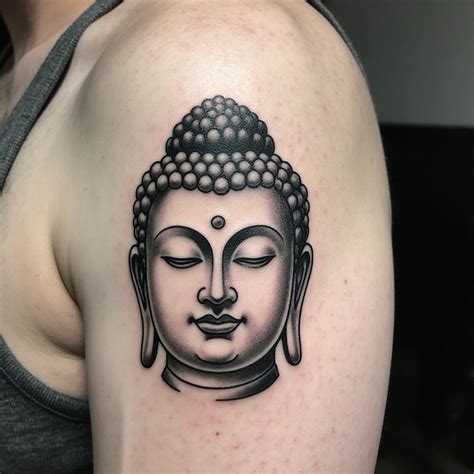
The most acceptable body part to get a Buddha tattoo is anywhere above the waist.
Read also: Love and Relationships: Venus in Capricorn
Should I cover my Buddha tattoo while traveling in Buddhist countries?
Yes, you should definitely cover your Buddha tattoo while traveling in Buddhist countries. It is a sign of respect and will ensure that you don't incur any unnecessary trouble during your stay.
Why is getting a Buddha tattoo bad?
Getting a Buddha tattoo may be bad if not done in a respectful or pure-hearted manner. Some people who hold these beliefs as sacred see it as cultural appropriation or simply blasphemous. While others argue that because Buddhism is a “universal belief system”, or because Buddhism embraces nonattachment and the integral emptiness and transience of all things, that the imagery really doesn’t matter.
But, regardless of your belief, if your tattoo causes pain to others then it may go against Buddhist values. In short, your ego-based choice to do something that you know specifically may hurt others emotionally, can invert a piece that you meant as something beautiful.
What can I get instead of a Buddha tattoo?
Instead of a Buddha tattoo, you can get many Buddhist symbols that are also very meaningful and indicative of your strong devotion or beliefs. So much of Buddhist art is absolutely beautiful.
Buddhism is a personal journey for all of us. For others, an endless knot may merge their Irish and Buddhist histories together. Or perhaps, a motorcycle wheel can be an homage to your love of bikes and the Dharmachakra.
Buddhism is about being authentic, pure, open...so, what does that mean for you and your personal visual language? If you don’t know yet: play with it! Create it! Be spontaneous and have fun with it. It also truly helps if you find an artist who knows about these things and can help you on a journey to find a Buddhist tattoo with unique meaning just for you.
Advice on Buddha Tattoos from Yoni Zilber
In an interview with Ross Howerton, Yoni Zilber spoke of a significant experience he had in relation to tattooing. “I met a very high-ranking Lama in India, and I asked him what he thought about sacred Tibetan images tattooed on people’s bodies. He said tattoos are beautiful, but he’s not so fond of seeing mantras and Buddhas tattooed on people,” Zilber recalls.
“But he also acknowledged that if it’s done in a respectful way, not on your butt or close to your crotch, he sees it as a way that you can show respect in a meaningful way. Because of this, now I won’t tattoo any sacred image under the waist, and I believe, if you put it on your skin, then you better respect it.”
“If someone wants to get a tattoo of a Buddha, please know that the image is sacred to many people, and they don’t look at it as only a decorative thing,” Zilber says. “I would get something else if it’s just for the look, but if you’re going to, don’t get it under your waist. Position it on your arms or upper back, that way if you travel to the Far East you don’t get weird looks or, worse, in trouble, depending on who you encounter.”
Properly Placed Buddha Tattoo Design Ideas
Buddha tattoo sleeve
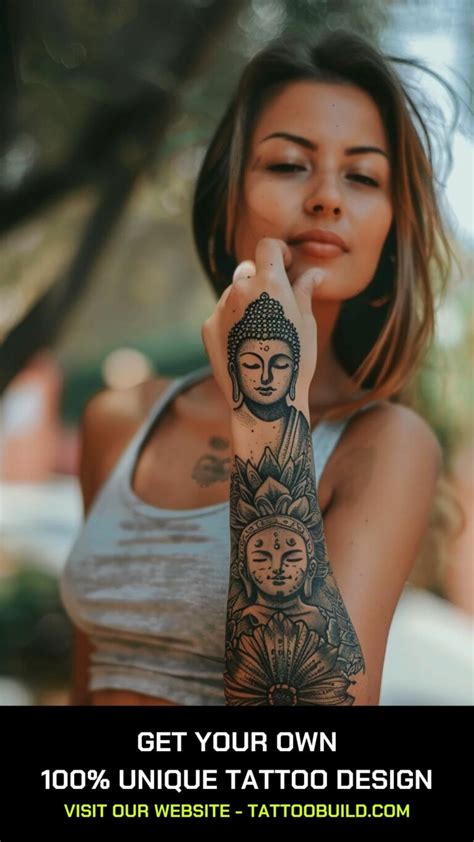
A Buddha tattoo sleeve involves the whole arm and is a great way to show people that you are truly devoted to your path. This is also a great chance to include many different symbols from Buddhism as well.
Buddha back tattoo
Though you may not be able to see it yourself, think of a Buddha back tattoo as a way to carry him with you always in a very special place!
Buddha tattoo forearm
Similar to a Buddha tattoo sleeve, a Buddha tattoo forearm placement is great because if you want this piece as a permanent reminder to keep to the Buddhist way, he’ll always be there to guide you.
Buddha tattoo arm
The torso is the best place to put a Buddha tattoo in general, especially because it means that you can easily cover them if you're in the company of someone you don't want to upset! Upper arm is best but truly anywhere on your torso is a good spot.
Buddha chest tattoo
Many people choose to get a Buddha chest tattoo because this placement is the closest to the heart. You’ll see him everyday, as will others you choose to show your piece to.
Popular Types of Buddha Tattoos
Here are some Buddha tattoo ideas that may help you find something you feel comfortable with. Many people get these sorts of tattoos to help them remember their chosen path and devotion to such a loving and compassionate way of life!
Buddhist symbol tattoo
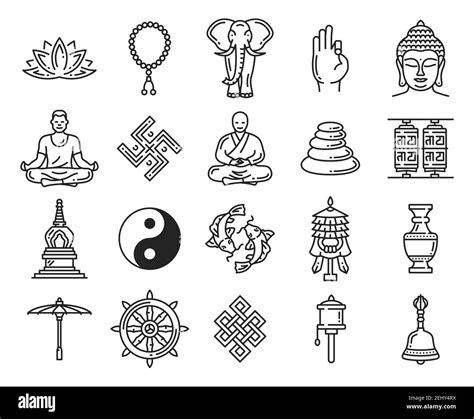
A Buddhist symbol tattoo is the perfect way to go if you’d love to demonstrate your devotion to the Buddhist way but are concerned about hurting or disrespecting other peoples values and culture. Plus, even if you aren’t worried about that, there are so many beautiful Buddhist symbols! Perhaps the most popular are: the om symbol, prayer wheel, conch shell, victory banner, treasure vase, parasol, dharma wheel, endless knot, lotus, stupas, and the triratna.
Buddha hand tattoo
Also known as a “hand of Buddha tattoo”, people are usually looking to get a Buddha hand tattoo in a particular mudra, which is a gesture of the hand. There are mudra’s that are used for meditation, teaching, empowerment, balance, etc.
Fat Buddha tattoo
So, funny story, but the Fat Buddha tattoo isn’t actually Buddha! He’s a highly venerated Chinese monk named Budai. For many people who praise or worship him, his big belly represents abundance and contentment.
Laughing Buddha tattoo
Many laughing Buddha tattoos are also not Buddha, but Budai. However, don’t let this stop you from loving him! His big smile was meant to attract people and show that Buddhists come in many different shapes, sizes, personalities, and backgrounds. A happy Buddha tattoo, one that is laughing, is a great way to help break that stereotype some people believe that Buddhists are ultra serious and no fun!
Gautama Buddha tattoo
A Gautama Buddha tattoo is referring to a version of Buddha’s historically accurate name: Siddhārtha Gautama. Pretty much any Buddha tattoo is depicting a Gautama Buddha tattoo...cuz that’s his name! But if you’d like to know more, check out the book Siddhartha by Herman Hesse or Osamu Tezuka’s thrilling manga series.
Buddha elephant tattoo
Many people, when asking for a Buddha elephant tattoo, are speaking of the deity Ganesha. Worship of him spans Hinduism, Buddhism, and Jainism. He is known as a remover of obstacles, an intellectual, as well as a patron of the arts! There are many festivals that celebrate him, such as Ganesha Chaturthi.
Female Buddha tattoo
There are many Buddhist deities that make for beautiful Female Buddha tattoos. Guanyin, sometimes referred to as Kuan Yin, is the Buddhist bodhisattva that stands for compassion. Similar is Tara, the Tibetan bodhisattva that is also affiliated with compassion. Tara actually comes in different colors such as green, red, black, and white. Each hue reflects a different form and subsequent meanings.
Buddha lotus tattoo
A Buddha lotus tattoo is a truly beautiful symbol in Buddhist iconography. Remember how we spoke about every sentient being having Buddha nature? The lotus flower partly symbolizes the journey to uncovering this inherent quality. Though it rises from the mud, the lotus flower blooms show no sign of the dirt that formerly covered its beautiful bulb.
Buddha head tattoo
A simple portrait, like a Buddha head tattoo, is a straightforward way to demonstrate your belief in Buddhism. Just like many people get portraits of their loved ones, you will be showing your devotion and care for this sacred icon. By the way, that little top knot you see on Buddha’s head? That’s not his hair or snails taking a nap. That’s his “ushnisha protuberance”, which historically symbolizes both a crown and his powerful enlightenment.
Buddha mandala tattoo
A Buddha mandala tattoo celebrates not only Buddhism but Sacred Geometry as well...which you can find within the Buddhist symbols of the conch shell and eternal knot as well! The mandala is also a sacred motif that can mean wholeness, balance, and even circles of connectivity.
Derived from Sanskrit, the word mandala translates into the word circle. While a mandala tattoo is often composed of many multiple shapes, the circle is always present and holds the deepest meaning. Typically, mandala tattoos are intricate and in-depth.
Modern mandala tattoos often include Celtic aspects, flowers such as the lotus, an aspect of nature or qualities associated with celestial bodies. Traditionally, a mandala is created while chanting.
The variations of the mandala all hold differing symbolic meaning, some designs being more popular for men, while others are more common for women. The lotus mandala - The lotus flower is very symbolic. The yantra mandala - This mandala represents a particular deity.
The mandala is traditionally used as a tool to focus the mind as the self undertakes a spiritual journey, which is why the mandala is so commonly used in meditation or spiritual ceremonies regarding Hinduism and Buddhism. In Native American culture, the use of the mandala was symbolic of life and death, rebirth, the seasons and the heavens.
A person who wears a mandala tattoo is likely to be intuitive and intelligent, understanding or seeking understanding of the interconnectedness of all things. As each mandala is so very personal, it is likely that the wearer has encountered a spiritual journey of great significance, emerging changed or wiser.
We like the mandala tattoo because it is a creative expression of the personal journey and growth each person experiences in life. No two mandala designs are representative of exactly the same thing, making this tattoo one that requires in-depth planning and symbolic representation.
Simple Buddha tattoo
A simple Buddha tattoo may mean finding a tattooist who does Fineline or tiny tattoos. Of course, your piece doesn’t have to be big or intricate to mean something important. Great things come in small packages may be slightly a cliche, but it’s still certainly true! A small Buddha tattoo can still be a very strong and powerful reminder and symbol. Just make sure that it really resonates with you. That’s what’s most important.
Zen Buddhist tattoos
Believe it or not, although Zen Buddhism may seem like a very stoic way of life from the outside, it is full of many different art forms. From tea ceremonies, to silk and scroll painting, pottery, and woodblocks, Zen philosophy permeates daily life with mindfulness and meditation...even when creating art like those for Zen Buddhist tattoos. Perhaps the most iconic being an enso, which is a circle of black ink created in a mindful, but spontaneous, moment.
Thai Buddha tattoo
A Thai Buddha tattoo would probably be done in the traditional artistic style of Thai art. However, keep in mind, because a tattoo of the Buddha would be frowned upon in Thailand, perhaps check out sacred Sak Yant tattoos or, even better, other.
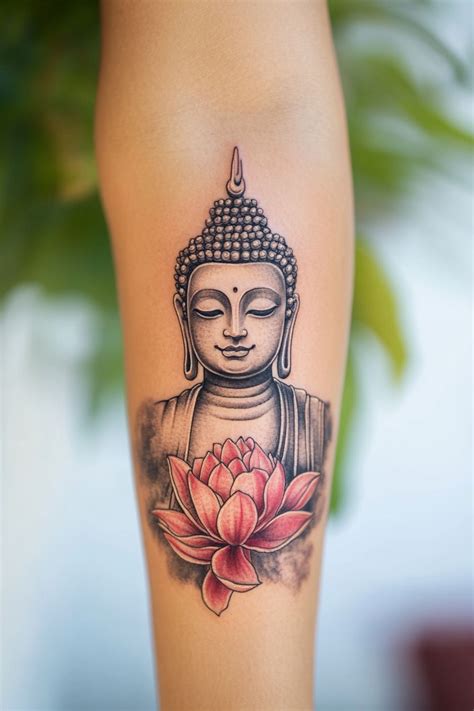
Remember, choosing a tattoo is a personal journey. Consider the cultural implications, symbolism, and your own connection to the image. Whether you opt for a female Buddha, a simple symbol, or an intricate mandala, ensure your tattoo reflects your respect and understanding of Buddhist principles.
Here is a table summarizing the acceptability of Buddha tattoos in different countries: