Human Design is a comprehensive and integrative system that combines elements from various ancient and modern disciplines to help individuals understand their unique personality, decision-making process, and life purpose. It is known as the science of differentiation; aka, the ultimate tool for self-discovery. It encompasses ancient modalities (Astrology, the Chakra System, I’Ching, and the Kabbalist Tree of Life) and modern science (Genetics, Astronomy, Biochemistry, and Quantum Mechanics) to give you a very specific guide to how your energy works. Human Design decodes how you best make decisions, how your energy is felt by others, your inherent talents and gifts, your personality archetypes, how you process, how you best interact with others, and so much more. It is truly a celebration of how we are all different.
Imagine a world where the second you are born, you have access to a road map that decodes your unique energy. This chart, called your Body Graph, lays out exactly how you are energetically different from everyone else, and it celebrates those differences rather than shaming them. It is a logical system that combines principles of The I Ching, astrology, Kabbalah, Hindu-Brahmin chakra system, and quantum physics. Your Human Design Chart, also called a BodyGraph, is calculated using your birth date, time, and place, to reveal your genetic design.
When you generate your chart, what you see is a bunch of shapes, lines, numbers, and arrows. Fortunately, there are people who absolutely nerd out on what all those shapes, lines, numbers, and arrows mean.
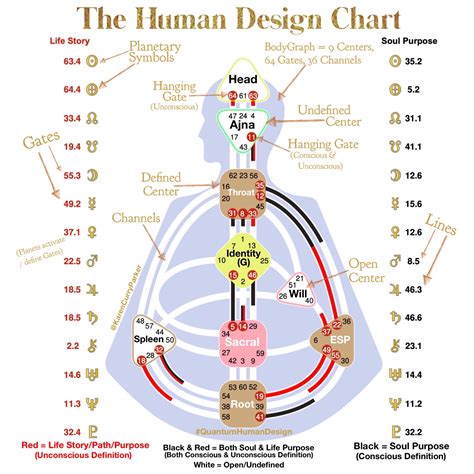
Example of a Human Design Chart
Key Components of Human Design
The key components of Human Design are:
Read also: Human Design: Triple Split Explained
- Type
- Definition
- Strategy
- Profile
- Authority
- Not-Self Theme
- Incarnation Cross
You will also see the shapes, lines, numbers and arrows. They speak to your energetic gifts/talents and contain the more layered information of your chart, as Human Design is a deeply layered modality. The deeper you go, the more ‘seen’ and honored you will feel.
Human Design Types
In the Human Design System, each person falls into one of four distinct Types: Manifestors, Generators, Projectors, and Reflectors. These Types are fundamental to understanding your Human Design as they influence your role, strategy, and purpose in life.
Manifestors are initiators, making up about 8% of the population. They are the trailblazers who have the unique ability to initiate and make things happen without needing to wait for external cues. Their strategy is to inform others before they act to prevent resistance and maintain peace. The challenge for Manifestors lies in their impact on others; they can unintentionally create waves and disruptions due to their independent and initiating nature. Historically, Manifestors ruled in monarchies. They get ‘urges,’ or inspirations, and are meant to use their energy to act on them. When they do so, they then initiate or inspire the rest of us to jump on board with their ideas or take them over completely.
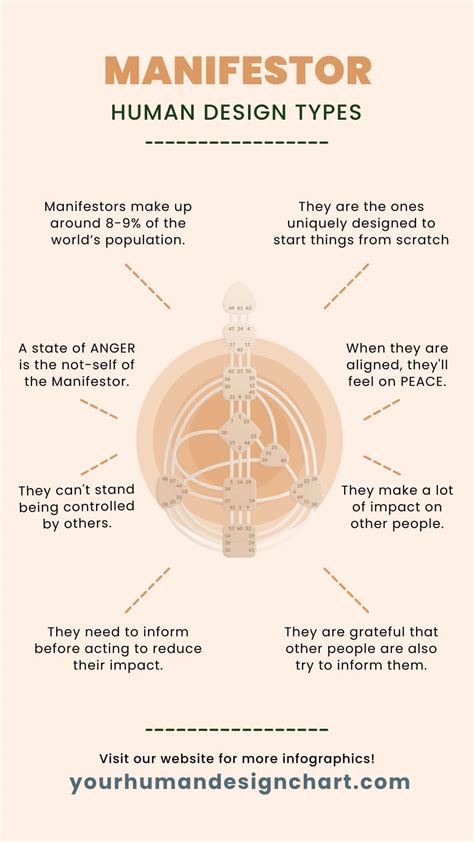
Manifestor Type
Generators, on the other hand, are the builders and represent nearly 70% of the population. This type also includes Manifesting Generators, a subtype that shares characteristics with both Generators and Manifestors. Generators have a defined Sacral center, which gives them a consistent source of life force energy to create and build. Their strategy is to wait for life to come to them and respond, which enables them to engage with opportunities that truly resonate with them and make the best use of their energy. They are here to use their energy doing what they love so that they feel fulfilled but also so they instill that passion in the rest of the population.
Read also: Human Design: Closed Taste
Generator Type
Manifesting Generators are the only hybrid of the 5 Types, and they are ~33% of the population. Some important chart characteristics of the ManGens are shared with Generators. So they are here to use their energy doing what they love, but they are also meant to inspire and initiate the rest of us while doing what they love.
Projectors, making up about 20% of the population, are the guides. They are naturally insightful, with a gift for understanding and working with systems and people. Their strategy is to wait for recognition and invitation, which ensures they share their wisdom and guidance with those who value and appreciate it. For Projectors, understanding their unique energy dynamics and ensuring they take ample rest is crucial, as they don't have the consistent energy supply of Generators or Manifesting Generators. They are here to guide the rest of us as they can see the world in a way that is different from everyone else. How they uniquely see the world is their wisdom, and when recognized for that wisdom, they can make life easier and more efficient for the rest of us.
Projector Type
Reflectors are the rarest Type, comprising just 1% of the population. They are mirrors, reflecting the health and wellbeing of their communities. With all their centers undefined, they are deeply influenced by their environment and the people around them. Their strategy is to wait a full lunar cycle before making major decisions, providing them with time to fully understand and integrate their experiences. These rare beings are here to deeply feel, amplify, and mirror the energy of others. Their unique way of feeling the energy of others gives them great discernment for what is and is not working/healthy for a person, group, or collective. This discernment is their wisdom, and when they are included into a group, and at the center of it, they are then able to mirror (reflect) that wisdom for everyone else to receive and understand.
Read also: Profile 1/3: Investigator Martyr
Reflector Type
Each Type in Human Design offers unique gifts and perspectives. Understanding your Type can provide profound insights into your life purpose, your relationships, and the best way for you to interact with the world.
Human Design Profiles
In Human Design, the Profile adds another layer of depth to our understanding of ourselves. There are 12 profiles in total, each with a unique combination of numbers ranging from 1 to 6. These numbers correspond to the lines of the I Ching, an ancient Chinese text, and they provide insight into how we interact with the world and our life's purpose.
The first number in a Profile is the 'Personality' or 'Sun' number. It represents our conscious characteristics - the traits that we are aware of in ourselves. The second number is the 'Design' or 'Earth' number, indicating our unconscious characteristics, the traits that others may notice in us before we notice them in ourselves.
Take, for example, the 1/3 Profile, also known as the Investigator/Martyr. The number 1 represents the Investigator, a person who seeks a solid foundation of knowledge and understanding. They tend to be introspective, always digging deeper to understand the world and themselves. The number 3 represents the Martyr, an experiential learner who gains wisdom through trial and error. Together, these qualities create an individual who is continually exploring and learning from their experiences.
Another example is the 4/6 Profile, or the Opportunist/Role Model. The number 4 represents the Opportunist, who excels in networking and building close relationships. They often find opportunities coming to them through their social interactions. The number 6 represents the Role Model, a three-part life process that includes a period of trial and error, a time of retreat and observation, and ultimately, becoming a role model based on the wisdom they've gathered. As a whole, these individuals may spend the first part of their life making mistakes and learning from them, then retreat, observe, and ultimately emerge as a role model for others.
Lastly, consider the 6/2 Profile, the Role Model/Hermit. The number 6, as previously described, represents the Role Model, while the number 2 represents the Hermit, who needs alone time to be productive and tends to have talents that come naturally. This combination creates individuals who alternate between needing solitude to refine their skills and emerging as role models who lead by example.
Understanding your Profile in Human Design can offer a clearer perspective on your strengths, challenges, and overall life path. It adds a layer of depth to your Type and can help you navigate life more authentically and effectively.
Human Design Centers
In Human Design, Centers are key components of the BodyGraph and represent different aspects of human consciousness and bodily functions. There are nine Centers in total, each with its unique attributes and qualities. When you look at a BodyGraph, the Centers are the geometric shapes you see, and they can either be defined (colored in) or undefined (white).
The Head Center, located at the top of the BodyGraph, represents inspiration and mental pressure to resolve questions or doubts. It's where we process doubts, confusion, and inspiration. If this center is defined, it indicates a consistent way of thinking and questioning. When it's undefined, thoughts and inspirations might be more influenced by others or the environment.
Below the Head Center is the Ajna Center, representing the mind and analytical processes. This is where concepts and beliefs are held and where you analyze information. If your Ajna Center is defined, you likely have a consistent way of processing information and making decisions. An undefined Ajna can lead to a more flexible and adaptable mindset, but also potentially more uncertainty in decision-making.
The Throat Center is about communication and expression. It's the center for manifestation and is closely related to action. When defined, there's a consistent way of communicating or taking action. When undefined, communication and action might be more inconsistent or influenced by the situation or other people.
The G Center, also known as the Identity Center, is about direction, love, and identity. This center helps guide us on our life journey. With a defined G Center, there tends to be a fixed sense of self and direction in life. An undefined G Center could lead to more flexibility in personal identity, but also potentially a lack of consistent direction.
The Heart Center, also known as the Ego Center, is about willpower, value, and worth. If defined, you may have a reliable access to willpower and a consistent sense of self-worth. If it's undefined, self-esteem and willpower might be more inconsistent or affected by external influences.
Understanding the definitions or lack thereof in your Centers is a vital part of Human Design, as it provides a deeper insight into your energy dynamics and how you interact with the world. Remember, there is no 'good' or 'bad' when it comes to having defined or undefined centers; they simply provide different experiences and ways of interacting with the world.
Digestion in Human Design
In the realm of Human Design, Digestion is not merely about the physical act of eating and digesting food; it also includes how you 'digest' life experiences and information. The system categorizes Digestion into six tonalities: Alternating, Closed, Cold, Nervous, Low, and InDirect. Similarly, there are six opposite tonalities: Consecutive, Open, Hot, Calm, High, and Direct. These tonalities represent the different ways in which people take in, process, and respond to life experiences.
The Alternating tonality suggests a need for variety, both in diet and in life experiences. These individuals thrive when they can switch between different foods, activities, or environments regularly. The opposite tonality, Consecutive, implies a preference for consistency and routine. Consecutive individuals thrive on regularity and find comfort in predictability.
The Closed tonality indicates individuals who process information or experiences best when in their own space or when focusing on one thing at a time. On the contrary, those with the Open tonality need interaction with others or multi-tasking to process effectively. The Cold tonality denotes people who respond well to cooler environments, foods, and calming experiences, while the Hot tonality signifies individuals who prefer warm environments, foods, and stimulating experiences.
The Nervous tonality represents individuals who process and 'digest' quickly, often leading to a higher energy and activity level. In contrast, those with the Calm tonality process more slowly, leading to a more relaxed and measured approach to life. The Low tonality suggests a preference for softer tones and quiet environments, while those with the High tonality are stimulated by louder sounds and vibrant surroundings.
Lastly, the InDirect tonality implies that individuals digest experiences and information best when they are not the focus, allowing for a more passive or indirect approach to life. On the other hand, those with the Direct tonality are energized when they're actively engaged or in the spotlight.
Understanding your Digestion in Human Design can guide you towards a lifestyle that best aligns with your nature, from the food you eat to the environment you thrive in.
Motivation in Human Design
In the Human Design System, the Motivation aspect helps explain the underlying drive or 'why' behind your actions and behaviors. The system suggests six types of Motivation: Fear, Hope, Desire, Need, Guilt, and Innocence. Each person carries one of these as their primary motivating force, which steers their direction and choices throughout life.
The first motivation, Fear, doesn't denote living in a constant state of terror. Rather, it signifies being motivated by the need to understand, overcome, and break down fears. Those with Fear as their Motivation may often find themselves driven to push boundaries and explore new territories. Similarly, Hope as a motivation isn't merely about optimism; individuals with this Motivation are driven by the potential for improvement and a better future.
Desire and Need Motivations are deeply connected to yearning and necessity, respectively. Those with Desire Motivation are driven by their wants and ambitions, while those with a Need Motivation are compelled by essential needs and basic necessities. Individuals with Guilt Motivation, instead of feeling perpetually guilty, are motivated by responsibilities and obligations, and Innocence Motivation often seeks simplicity and authenticity.
Understanding your Motivation in Human Design provides insight into what truly drives you. It's like an internal compass that guides your decisions and actions. By becoming aware of your Motivation, you can bring more clarity and authenticity into your life. However, like any other component of Human Design, it's not about strict definitions or limitations. Instead, it's a tool for self-discovery and growth, helping you to align more closely with your unique nature and design.
Human Design Strategies
Human Design strategies provide an essential guide for how each type can best make decisions and interact with the world. It can offer a roadmap for how to live in alignment with your true nature and find greater ease and fulfillment in life. There are four primary Human Design types, and each has a unique strategy.
- For Manifestors, the strategy is to inform others before making a decision or taking action.
- Generators and Manifesting Generators share the strategy of waiting to respond.
- Projectors have the strategy of waiting for the invitation.
- Finally, Reflectors have the strategy of waiting for a lunar cycle.
By following these strategies, each type can navigate life in a way that aligns with their authentic self, leading to greater satisfaction, success, peace, and surprise, respectively.
Signatures of Each Type
In Human Design, each of the four types is associated with a specific signature - an indicator of whether or not an individual is living true to their design. These signatures provide a measure of whether someone is on track, living their strategy and authority, and expressing their true nature.
- For Manifestors, the signature is peace.
- Generators and Manifesting Generators share the signature of satisfaction.
- The signature for Projectors is success.
- The signature for Reflectors is surprise.
These signatures provide a measure of whether someone is on track, living their strategy and authority, and expressing their true nature. It's like a barometer for self-understanding and alignment, serving as a compass in the journey of self-discovery and personal growth.