Khechari Mudra is an advanced technique of Hatha Yoga and Tantric Yoga. It is considered a powerful mudra because it unlocks the flow of internal energy.
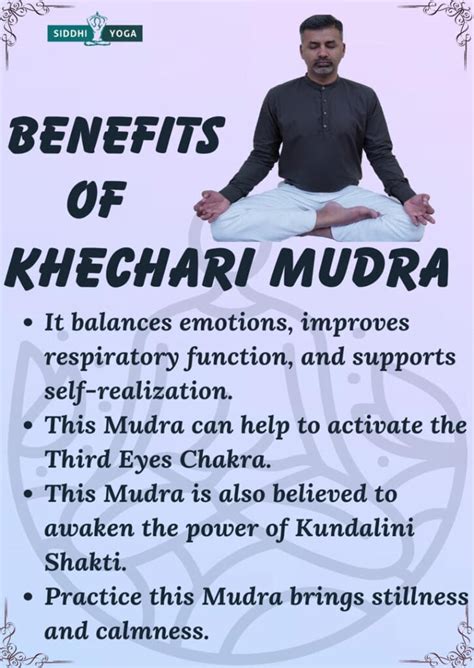
Khechari Mudra
What is Khechari Mudra?
Before considering the benefits of Khechari Mudra, we should understand the basics. So, what is Khechari Mudra? In simple terms, it is a yogic gesture where the tongue is rolled back and inserted into the nasal cavity above the soft palate. It consists of bringing the tongue to the back of the palate, trying to reach the nasal cavity.
Ancient yogis believed that Khechari Mudra helps redirect prana (life force) upward, controlling the senses, enhancing meditation, and opening the doorway to higher states of consciousness. Its name in Sanskrit means “the mudra that moves through the ether”, as it is said to allow transcending the physical plane. This doesn’t just mean the physical sky-it refers to the inner space of consciousness. By turning the tongue inward and upward, yogis symbolically and literally withdraw their senses from the external world, moving into the “inner sky” of meditation.
A regular, proficient practice of Khechari Mudra (tongue lock) is said to release the very elixir of life. This ambrosial nectar is known as amrita in Sanskrit. In other words, an ardent practice of this tongue lock mudra will propel a devotee into a state of the universal awareness of God. It is said to relieve all hunger and thirst in very advanced practitioners. For the rest of us, it clears the energetic pathways of the Sushumna Nadi. It allows the awakened Kundalini Shakti energy to continue her ascension through the seven chakras until she pierces the Crown Chakra, where the devotee’s consciousness merges into God’s consciousness.
Read also: Natural Remedies: Mudra and Yoga
Ancient texts like the Hatha Yoga Pradipika describe it as a practice capable of granting control over the senses. Additionally, it is associated with the ability to attain samadhi, a state of deep calm and enlightenment.
Understanding the Talu Chakra
The Talu Chakra is a little-known energy center in the traditions of tantric yoga and kundalini yoga. It is located in the soft palate, right where the tongue makes contact in the practice of Kechari Mudra.
This chakra is not often mentioned in classical seven chakra systems, but some traditions consider it a key point in the activation of spiritual energy. It is said to be a bridge between the pineal gland and the throat, facilitating the connection with higher planes of consciousness.
When practicing Kechari Mudra, the tongue stimulates the Talu Chakra, awakening its energy. This favors the secretion of that, according to some texts, nourish the brain and activate the pineal gland, assisting in the expansion of consciousness.
It is believed that this activation allows for easier access to deep states of meditation and experiences of samadhi. Additionally, by connecting with the energetic flow of the spine, it helps to direct the prana towards the brain, enhancing the practice of Kriya Yoga.
Read also: Mudras for Weight Loss
Benefits of Talu Chakra Stimulation
When working in this area, some practitioners experience a feeling of coolness in the head, greater mental clarity, and an increase in introspection. It is also associated with the ability to reduce hunger, improve sleep, and enhance spiritual vitality.
Kechari Mudra is not only an advanced yoga technique but also a tool to access this hidden energy center. Its constant practice can lead to a profound transformation in perception and in inner awakening.
Benefits of Khechari Mudra
Practicing this advanced mudra is said to bring a wide range of physical, mental, and spiritual benefits.
- By turning the senses inward, this mudra helps the mind become still and concentrated, making meditation more profound.
- Yogis believe it activates the pineal gland and Ajna chakra, opening the doorway to spiritual awakening and heightened intuition.
- Classical texts mention that advanced practitioners experience reduced hunger and thirst, as the practice stimulates the flow of amrita or inner nectar.
- The practice is said to redirect prana upward, revitalizing the nervous system and preserving energy.
- Some researchers suggest that stimulating the upper palate may affect the hypothalamus and pituitary gland, supporting hormonal health.
- By balancing the nervous system, Khechari Mudra promotes emotional stability and inner peace.
Several physical benefits have been associated with the practice of Khechari Mudra.
When practiced regularly, Khechari Mudra can positively affect mental health and well-being. This mudra is said to help quiet the mind and promote a sense of inner peace and calm. It is also said to improve focus and concentration and to heighten awareness and intuition. Regular practice of Khechari Mudra is said to help reduce stress and anxiety and promote happiness, tranquility, and well-being. These benefits include inducing bliss, ecstasy, and peace; improving concentration and memory; and promoting feelings of love, compassion, and kindness.
Read also: Significance of Abhaya Mudra
This mudra is said to allow prana, or life force energy, to flow freely through the body and reach the crown chakra at the top of the head. Practitioners report feeling more blissful, peaceful, and contented after performing the gesture. Practicing the Khechari Mudra also stimulates the release of “feel good” neurotransmitters such as dopamine. With the release of calming and soothing hormones, a Khechari Mudra practitioner also experiences a profound state of calmness and well-being.
Here's a summary of the benefits:
| Benefit | Description |
|---|---|
| Pineal Gland Activation | Stimulates melatonin production, regulates sleep, and potentially awakens intuition. |
| Meditation Enhancement | Facilitates inner focus, mental silence, and access to samadhi. |
| Hunger Control | May reduce hunger and thirst, potentially stimulating an inner nectar known as "amrita." |
| Nervous System Balance | Activates the parasympathetic nervous system, reducing stress and anxiety. |
| Energy Enhancement | Unlocks the Talu Chakra, allowing energy to rise along the spine and activate higher centers of consciousness. |
There are many ways to work with emotional challenges using Khechari Mudra. One way is to simply sit with the mudra for a few minutes each day. Doing this will help to calm and focus the mind, which can be helpful in dealing with challenging emotions. Another way to use the tongue lock mudra for emotional challenges is to meditate with the mudra. This can help to quiet the mind and bring about a sense of peace. It can also be helpful in gaining insights into whatever is causing the challenges.
In addition, Khechari Mudra can be used in conjunction with other techniques, such as meditation, pranayama, journaling or visualizations. At a time of emotional lows, it can be difficult to know how to cope. We may feel like we are not in control of our emotions and that they are controlling us. This is where khechari mudra can be helpful.
When we are feeling emotionally challenged, the tongue lock mudra can help us to find balance and peace. The Khechari mudra is a Siddha Yoga technique that bestows spiritual benefits upon the practitioner. The mudra involves pressing the tongue against the roof of the mouth and curling it back towards the throat. This action stimulates the pineal gland and opens the third eye, resulting in heightened spirituality and psychic abilities.
Practicing Kechari Mudra with the great art of visual Khechari Mudra (focusing on the third eye) can yield even more profound experiences.
What is kechari mudra? | Sri M | Online Interaction with Australia | Sep 2024
How to Practice Khechari Mudra
The Kechari Mudra is an advanced practice that requires patience and discipline. It is not just about moving the tongue, but training it to achieve a flexibility and strength that allows for the execution of the mudra without discomfort or risks.
Step 1: Prepare the Tongue
Before attempting Kechari Mudra, it is important to strengthen and flexibilize the tongue. A useful exercise is to press it against the palate and gradually stretch it back. It is also recommended to massage the frenulum with your fingers to increase its elasticity.
Some traditions suggest gradually cutting the lingual frenulum to allow for greater mobility. However, this is not necessary and can be risky. Constant practice and patience can achieve the same effect without resorting to invasive methods.
Step 2: Position the Tongue Correctly
The first goal is to take the tongue to the deepest part of the soft palate. This is achieved by pressing it against the roof of the mouth and sliding it backward. At first, it may feel uncomfortable, but over time it becomes easier.
Once the tongue gets used to this position, the next step is to try to introduce it into the nasopharynx, the area that connects the nose to the throat. This is the most advanced stage and can only be achieved with constant practice.
Step 3: Synchronize with Breathing and Meditation
While practicing Kechari Mudra, it is key to combine it with a deep and conscious breathing. Inhaling and exhaling in a controlled manner helps to relax the body and enhance concentration, facilitating a deeper experience in meditation.
Over time, this mudra can be integrated into practices such as Kriya Yoga, enhancing internal energy and facilitating the connection with elevated states of consciousness. The more fluid the practice, the more benefits can be experienced.
To practice Khechari Mudra, sit comfortably on a chair, blanket, or yoga mat on the floor. Close your eyes and fold your tongue back and up towards the soft spot in the middle of the roof of your mouth. Gently apply pressure to this point with the tip of your tongue. Practice Ujjayi breathing or ocean-sounding breath as you perform Khechari Mudra. Hold this mudra for several minutes.
When practicing tongue lock mudra, choose a comfortable position with your spine straight. Take a deep breath in and then exhale completely. Relax as you practice.
Beginners can start with 1-2 minutes daily and gradually extend the duration. With practice, some yogis hold the mudra for extended meditation sessions.
When is the Best Time to Practice?
There are many benefits to practicing Khechari Mudra, but when is the best time to do it? The answer may surprise you. However, it is essential to understand that there is no perfect time to practice Khechari Mudra. Everyone is different and will have their own unique needs and preferences.
This mudra can be practiced anytime during the day, although it is best to practice it when the mind is calm and relaxed.
- Firstly, if you are experiencing physical pain or emotional distress, practicing Khechari Mudra can help to ease your suffering.
- Secondly, if you are seeking spiritual guidance or insight, practicing the tongue lock mudra can help you to connect with your higher self and receive advice from the Universe.
- Thirdly, the best time to practice Khechari Mudra is whenever you feel called.
- Fourthly, trust your intuition and let it guide you to the best times for practice.
Scientific Insights
There is some scientific proof of the benefits of practicing Khechari Mudra. A study published in the International Journal of Yoga showed that people who practice Khechari Mudra had increased levels of the neurotransmitter serotonin. Serotonin is responsible for regulating mood, sleep, and appetite.
Furthermore, a study published in the Journal of Alternative and Complementary Medicine found that Khechari Mudra can help treat hypertension, migraines, allergies, and respiratory disorders.
Safety and Precautions
Final tips for safe practice:
- The progress must be gradual. Forcing the tongue beyond its capacity can cause discomfort or even injury.
- It is advisable to practice daily, but without rushing. Consistency is key to achieving the benefits of this powerful mudra.
Practice Khechari Mudra only under an experienced guru's guidance, especially in advanced stages like frenum cutting. Progress slowly to avoid strain, and stop if you notice a bitter taste or have mouth issues such as ulcers.
You should practice Khechari Mudra only for as long as it feels comfortable, beginning with 5-10 minutes and gradually extending as the tongue becomes more flexible. Always avoid pain and stop immediately if you feel discomfort.
Like any advanced yogic practice, Khechari Mudra must be performed carefully. Kechari Mudra (khecarī mudrā) is a highly advanced practice and thus approached with respect and caution. Experienced yogis recommend learning it under the guidance of an experienced teacher.
Like all powerful practices, Khechari Mudra requires patience, consistency, and proper guidance.
Note: Traditional texts describe tongue-lengthening practices to make Khechari Mudra easier.
Historical Context
There are historical anecdotes of great yogis who practiced Kechari Mudra. Swami Vivekananda, a disciple of Ramakrishna Paramahansa, was an ardent practitioner of Raja Yoga and is believed to have practiced Kechari Mudra. Swami Sivananda, a renowned great yogi and spiritual teacher, observed that Kechari Mudra leads to a state where the practitioner transcends hunger, thirst, and the fear of death.
Enhancing the Practice
Khechari Mudra is a powerful yogic practice that calms the mind, balances energy, and supports spiritual growth. To enhance its effects, pairing it with the right supplement can be highly beneficial. One of the best choices is KSM-66 Ashwagandha, a clinically studied adaptogen known for reducing stress, improving focus, and supporting emotional balance.
When combined with supportive lifestyle choices-and natural aids like KSM-66 Ashwagandha-it can create a holistic path toward mental clarity, resilience, and self-realization.
Conclusion
Khechari Mudra is not just a physical technique-it is a doorway into deeper meditation, higher consciousness, and lasting inner peace. Rooted in ancient yogic wisdom and supported by modern insights, this practice helps calm the mind, balance energy, and awaken spiritual awareness.