The Lord Jagannath Temple in Puri, Odisha, stands not only as one of Hinduism’s sacred Char Dhams but also as a marvel of Kalinga architecture, visited by millions of devotees every year.
For Hindus across the world, a pilgrimage to Puri is a spiritual milestone, ever since it has stood as a symbol of devotion and Hindu faith. The temple has a lot of importance for Hindus all over the world because this is one of the Char Dhams, the 4 sacred pilgrimage centers.
The Jagannath Temple in Puri is one of the four holy sites known collectively as the Char Dham - the four sacred abodes believed to purify the soul and help attain moksha (salvation). According to ancient scriptures and teachings by Adi Shankaracharya, every devout Hindu should visit these four corners of India at least once.
The Char Dham consist of:
- Puri in the East: Home of Lord Jagannath, an incarnation of Lord Vishnu.
- Dwarka in the West: The coastal kingdom of Lord Krishna.
- Rameshwaram in the South: Where Lord Rama built the bridge to Lanka.
- Badrinath in the North: The sacred abode of Lord Badri Vishal (Vishnu).
It is believed that visiting all these shrines at least once in a lifetime is necessary to attain salvation. The Puri temple is dedicated to Lord Jagannath who is an incarnation of Lord Vishnu, his brother Lord Balabhadra, and his sister Goddess Subhadra, and their idols are placed in the main sanctum.
Read also: Science of Chakras
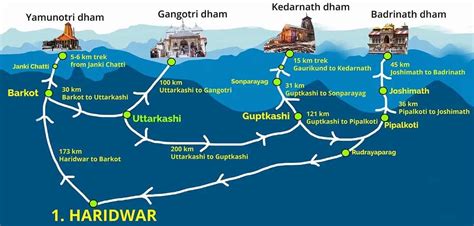
Char Dham Yatra Route Map
Architectural Splendor of the Jagannath Temple Puri
The Shri Jagannath Temple was constructed in the 12th century by King Anantavarman Chodaganga Deva from the Eastern Ganga dynasty. The Lord Jagannath temple is built over an area of 10.7 acres in the traditional Kalinga style of architecture.
Key structures include:
- Vimana: The towering sanctum, reaching a height of 190 feet.
- Jagamohana: The porch or assembly hall.
- Nata Mandira: The dance hall for rituals and performances.
- Bhoga Mandapa: The offering hall where devotees present Bhog.
There are 2 walls that enclose the temple. The outer wall is called Meghanad Pachira and the inner wall is called the Kuruma Bheda. Apart from this, there are four elaborate gates in four directions:
- Singh Dwara or the Lion Gate in the East
- Ashwa Dwara or Horse Gate in the South
- Vyaghra Dwara in the West
- Hasti Dwara in the North
There are carvings of various mythological incidents like Lord Krishna with gopis, Dhenukasura Vadha, celestial beings like the Ashtadikapalakas, celestial maidens, and many other deities and mythological creatures. The Shri Jagannath temple also houses the Aruna Stambha which is a 33 feet tall monolith pillar. It was earlier located in the Sun Temple of Konark.
Read also: Anatomy of the Sacral Chakra
The idols in the temple are made of a very sacred and specific type of wood called Daru Brahma. Every 12 to 19 years, an extraordinary ritual called Nabakalebara takes place. The old idols are buried within the temple premises in a sacred ceremony, and new ones are carved from specially chosen neem trees known as Daru Brahma. This tradition signifies rebirth and continuity a rare example of a living deity that physically renews itself, yet remains spiritually unchanged.
The Mystical Wooden Forms
The three main idols are:
- Lord Jagannath: The “Lord of the Universe,” with large round eyes, a friendly face, and no visible limbs.
- Lord Balabhadra: His elder brother, symbolizing strength and duty.
- Goddess Subhadra: Their divine sister, representing compassion and harmony.
These figures break conventional norms they appear unfinished, without hands or feet. Scholars interpret this unique form as a symbol of the formless, infinite nature of divinity.
Festivals: Rath Yatra and Other Grand Celebrations of Jagannath Temple
Festivals are the soul of Jagannath Temple transforming Puri into a sea of devotion, music, and color. Among them, the Rath Yatra stands supreme, drawing millions from across the globe to witness the divine journey of the Lord.
Jagannath Rath Yatra: The Festival That Outlived Sultans, Fanatics, and Empires
Read also: Discover Your Inner Chakra
Rath Yatra: The Festival of Chariots
The Rath Yatra, or Chariot Festival, is the world’s largest and oldest car festival.
- When: Celebrated in June or July (Ashadha Shukla Dwitiya).
- What Happens: Lord Jagannath, along with brother Balabhadra and sister Subhadra, leaves the sanctum and rides massive wooden chariots to the Gundicha Temple, 3 km away.
- Symbolism: It represents the Lord’s annual visit to his maternal aunt’s home signifying inclusiveness and accessibility to all, beyond caste and creed.
- Spectacle: Three towering chariots, pulled by lakhs of devotees chanting “Jai Jagannath”, fill the streets with unbridled devotion.
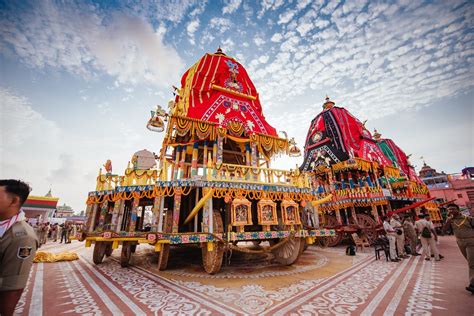
Rath Yatra Festival
Unique Facts about Rath Yatra
- Each chariot is freshly constructed every year using special neem wood (Daru Brahma).
- The chariots have specific names: Nandighosa (Jagannath), Taladhwaja (Balabhadra), and Darpadalana (Subhadra).
- No other festival allows non-Hindus to glimpse Jagannath so closely making it a truly global celebration.
Other Major Festivals at Jagannath Temple
- Snana Yatra
Snana Yatra is another important festival of the Shri Jagannath Temple. During this festival, the idols are bathed in public view with holy water from 108 pots. This happens on the full moon day of the Jyestha month. They are dressed in very beautiful clothes and are decked with fine jewels.
- Chandan Yatra
The Chandan Yatra is also very important for the Puri temple and is attended by many devotees of Lord Jagannath. It includes applying Sandalwood paste to the idols of the 3 deities.
Daily Rituals: Treating the Deities as Living Beings
The deities are treated as living beings waking, bathing, eating, resting creating an intimate bond between the divine and millions of devotees worldwide.
- The temple doors open as early as 5 AM with Mangal Arati, the first prayer welcoming Lord Jagannath to a new day.
- After the morning darshan, they are served a meal of fruits, green coconut, and curd.
- After that is done a while later a bigger and more elaborate meal is served to them along with some betel nuts.
- During the Madhyana Dhupa in the afternoon, they are served a hearty lunch after which they are put to sleep until evening.
- After this, they are woken up in the evening and served evening snacks which are followed by evening darshan.
- The final meal of the day is their dinner which is called the Badasinghar Bhoga. Post dinner they are sung to sleep with Gita Govinda being sung and the veena being played.
Mysteries Associated with the Lord Jagannath Temple
The Puri temple surely is a work of art but is also a trove of mysteries that have puzzled people even with the most scientific temperament.
Let’s take a look at some of them.
- The flag which is mounted at the top of the temple’s Shikhara blows in the opposite direction of the flow of the wind.
- The Nila Chakra at the top of the Lord Jagannath temple seems to be facing the devotees no matter where they look at it.
- Once the devotees enter the Singha Dwara, they completely stop hearing the sound of the waves from the nearby sea.
- It has been observed over the years that the Shri Jagannath temple never casts a shadow, at no time of the day and in no direction.
- The food in the temple is prepared by stacking clay pots one over the other. The food kept in the topmost vessel gets cooked first, followed by the second and so on.
The Holiest Iconic Symbol: Neela Chakra
The metal wheel which is placed at the top of the Jagannath temple is called Neela Chakra or Blue wheel. This Wheel is also called the most powerful weapon of the Lord Vishnu which is worshipped inside the Lord Jagannath temple as the name of Sudarshan Chakra.
This Chakra is called Neela Chakra due to the appearance of the whole chakra. The color of the Chakra is also changed as per the ray of the Sun. During sunrise, the chakra looks like a white color (Swetha color) and then the color became light blue and it turns to deep blue during the mid-day.
The flag (Pattita Pavana) at the top of the Neela Chakra of the Jagannath temple always floating in the opposite direction of the wind. So it is believed that there is a cosmic force that is more powerful than the rules of current science.
The birds, aeroplane, and other flying things never fly over the Neela Chakra. The devotee always sees the Neela Chakra from the front side in every direction. The engineering of Neela Chakra is also a mystery.
The Neela Chakra creates a blue color ray which is observed till thousand kilometers distance. The Neela Chakra has no shadow from any direction at any time and the Chakra is also dust & rust-free.
The Neela Chakra is made of an alloy of 08 metals (Asta-Dhatu). Every day Garuda Sevak/Dhwaja Bandtha Sevak removes the old flags from the pole and ties the new ones. The Neela Chakra is the holiest iconic symbol of the Jagannath Sanskruti of Odisha. The engineering of the Chakra is very magnificent and beautiful. There are various mysterious things inbuilt in this Chakra for which it is attracted devotees worldwide.
Atop the magnificent temple stands a massive wheel (chakra) weighing approximately one ton, which presents a fascinating optical phenomenon. No matter where observers position themselves in Puri, the chakra appears to be facing directly towards them. This creates an intriguing visual effect that has captivated visitors for centuries.
Adding to the temple's mystique is the remarkable engineering feat achieved by the 12th-century builders. They managed to hoist and secure this enormous metal wheel at such a considerable height, using technologies available nearly 900 years ago. This achievement continues to inspire wonder about the advanced architectural and engineering capabilities of medieval Indian craftsmen.
The Shikhara of the temple is very tall and towers at a height of 190 feet. At its top, the Nila Chakra is perched which is a representation of the Sudarshan Chakra of Lord Vishnu and is made from Ashtadhatu, or an alloy of 8 metals. It is believed that no matter from which corner of the city you look at the Chakra, it always seems to be facing you.
The Flag and The Wind
Spiritually speaking, we are all familiar with the general principle that objects tend to move in the same direction as the wind. However, have you ever noticed that the Sri Jagannath Flag, positioned atop the temple’s spire, defies this natural rule?
When the wind blows in one direction, the flag atop the Sri Jagannath Temple waves in the contrary direction. To this day, the strange occurrence remains unexplained by science. Each day, dedicated priests ascend the temple's towering structure to replace the 20-foot-wide triangular flag-an arduous task requiring great precision.
For the past 1,800 years, it has been the divine tradition for a saint to climb the 45-story dome of the temple and replace the flag. If this sacred practice is ever disrupted, even for a single day, the temple will be closed for 18 years in accordance with ancient customs.
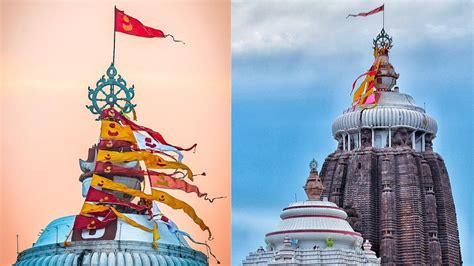
The flag atop the Jagannath Temple waves in the opposite direction of the wind
Influence on Odisha’s Culture and Society: The Living Soul of Puri
The Jagannath Temple is more than a place of worship it’s the heartbeat of Odisha’s culture, economy, art, and everyday life. Major events like the Rath Yatra transform Puri into a global spiritual hub, attracting millions and boosting local businesses, hotels, and craftsmen.
Custodian of Odisha’s Art and Crafts
- Patta Chitra Art: The temple inspired the ancient scroll painting tradition called Patta Chitra, still practiced by skilled craftsmen in Raghurajpur village near Puri.
- Odissi Dance & Music: The temple rituals gave rise to Mahari dance and temple music, which evolved into Odisha’s classical dance form Odissi.
Global Cultural Impact
The Rath Yatra of Puri has inspired Chariot Festivals across the globe from London’s Trafalgar Square to New York’s Fifth Avenue uniting the diaspora and global devotees of Lord Jagannath.
Key Takeaways
- Puri’s Jagannath Temple is a 12th-century Kalinga architectural wonder.
- It’s one of Hinduism’s four sacred Char Dham pilgrimage sites.
- The unique wooden idols are made of Daru Brahma and replaced periodically.
- The temple hosts the grand Rath Yatra festival each year.
- Daily rituals treat the deities as living beings with scheduled meals and rest.
- The Maha Kitchen feeds thousands daily with sacred Mahaprasad.
- Mysteries like the flag’s direction and shadowless structure intrigue visitors.