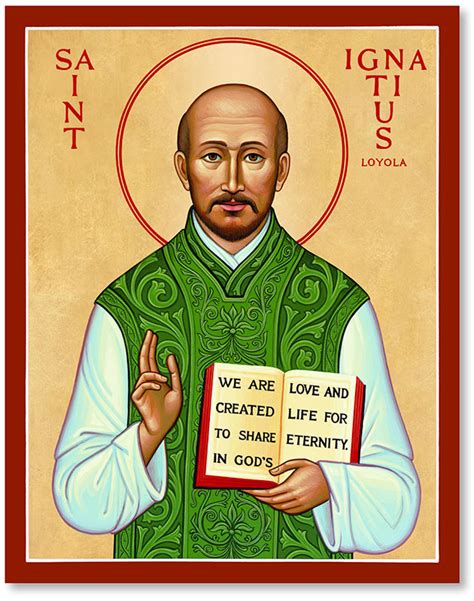
The Spiritual Exercises form the foundation of Ignatian spirituality and the worldwide mission of the Jesuit order of priests. They are rooted in the life experiences of Iñigo Loyola (1491-1556), a bold and ambition-driven Basque nobleman and soldier who underwent a profound conversion to Christian faith while recovering from battle injuries. During his recovery, he read books about the life of Christ and the lives of Christian heroes, leading him to realize that his passionate pursuit of worldly fame would be better directed in service to Christ.
After many years of prayer, self-reflection, discernment, and giving spiritual direction to others-during which he took the name Ignatius and founded the Jesuit Order-he compiled his insights into a spiritual handbook called the Spiritual Exercises.
Ignatius developed the Spiritual Exercises to be given by a spiritual director and completed by a retreatant during a thirty-day silent retreat of daily prayer and conferences with the director. The retreatant would leave behind their home and daily responsibilities to retreat at a center or monastery. Today, these Exercises are available at numerous Jesuit retreat centers around the world.
The Role of a Spiritual Director
Ignatius requires retreatants to take the Exercises with the guidance of a qualified spiritual director. An Ignatian spiritual director is a faithful Christian called to accompany others on their faith journey. The director has completed formal training in the Spiritual Exercises and has been credentialed to guide others.
Ignatian spirituality recognizes that three participants are engaged in the Exercises: God, who initiates and leads the relationship; the retreatant; and the spiritual director. The retreatant and the director meet regularly - usually weekly- in meetings called conferences. During these sessions, the director provides the retreatant with assigned scripture readings, questions, and prayer exercises to complete between conferences.
Read also: Will My iPhone Work with iOS 26?
In each conference, the retreatant shares their experiences of prayer and reflection on the readings. Through careful listening, the director helps the retreatant identify the movements of God that invite them to draw closer to God. At the conclusion of each conference, the director will provide a new set of exercises, along with questions and concrete topics for the retreatant to reflect on and pray about before their next session. The relationship between the retreatant and the director is built on trust and friendship in God. The director does not impose their personal spiritual or religious agenda on the retreatant.
Structure of the Spiritual Exercises
The Spiritual Exercises closely follow the key events in the life and ministry of Jesus, aligning with the liturgical calendar of the Church year. By engaging with scripture, prayer, and exercises of the imagination known as meditations and contemplations, the Spiritual Exercises help the retreatant reflect on who they are for God and who God is for them.
Three to four weeks before the start of the formal Four Weeks of the Exercises, there are the Preparation Days. During this time, you and your director will get to know one another, and you will establish the spiritual disciplines that will guide you throughout the retreat. You will be introduced to the Principle and Foundation, and the Examination of Conscience (also known as the Examen Prayer), which helps you begin to discern movements in your life.
The Exercises are divided into four sections called “Weeks.” These Weeks do not correspond to a typical seven-day calendar week.
These are not rigid stages for a retreatant to follow. Rather, they represent a map for identifying one’s spiritual place and progress. Typically, the Spiritual Exercises are given individually to a retreatant in one of three forms: (1) the traditional, 30-day retreat, (2) an abbreviated 8-day retreat, or (3) a retreat in daily life (also referred to as a “nineteenth annotation retreat,” in which the retreatant does not remove him or herself from the duties of daily living, but instead meets weekly with a director and incorporates the prayer of the Exercises into daily practice.
Read also: The Dark Side of Witchcraft Movies
The Four Weeks
Here's a breakdown of what each week entails:
- First Week: We reflect on our lives in light of God’s boundless love for us. We focus on who God is and how our response to God’s love may have been delayed or hindered by patterns of sin. We consider our sinfulness knowing that God desires to free us from disordered affections-those attitudes, actions, and possessions that prevent us from fully committing ourselves to God’s service.
- Second Week: Through prayers and meditations on scripture-such as Jesus' birth, baptism, the Sermon on the Mount, and his teachings and healings-we learn what it means to follow Jesus as one of his disciples. The retreatant discovers more intimately Jesus’ compassion and fundamental love of the people.
- Third Week: Focuses on meditations on the Last Supper, Christ’s passion and death, and the Eucharist.
- Fourth Week: We meditate on Jesus' resurrection and his appearances to his disciples. We walk with the risen Christ and commit to loving and serving him in concrete ways in our lives and in the world. The Holy Spirit must begin our transformation at the level of our desire.
Intro to Ignatian Spirituality: The Spiritual Exercises
The Spiritual Exercises present three methods of prayer that may be new to retreatants - meditation and contemplation. Kevin O’Brien SJ succinctly defines meditation and contemplation in his book, The Ignatian Adventure:
- Meditation: we use our intellect to wrestle with basic principles that guide our life. Reading scripture, we pray over words, images, and ideas. We engage our memory to appreciate the activity of God in our life. Such insights into who God is and who we are before God allow our hearts to be moved.
- Contemplation: is more about feeling than thinking. Contemplation often stirs the emotions and enkindles deep desires. In contemplation, we rely on our imagination to place ourselves in a setting from the Gospel readings or in a scene proposed by Ignatius. . . In the Exercises, we pray with Scripture; we do not study it.
- Application of the Senses: is a third type of prayer used throughout the Exercises. For this you “place yourself in a scene from the Gospels. Ask yourself, "What do I see? What do I hear?
Discernment of Spirits
As our intimacy with God grows, we become more aware of interior movements that influence our lives. Ignatius called these movements “motions of the soul.” They include emotions, feelings, desires and inclinations, attitudes and actions, attractions, and revulsions. Sometimes we sense them coming from within us. At other times they seem to arrive from outside us.
Discernment of spirits is a way to understand God’s will or desire for us in our life. Ignatius’s language is useful because it recognizes the reality of evil. Evil is both greater than we are and part of who we are. Our hearts are divided between good and evil impulses.
Spiritual consolation is an experience of being so deeply touched by God’s love that we feel compelled to praise, love, and serve God, and to help others as best as we can. Spiritual consolation fosters a deep sense of gratitude for God’s faithfulness, mercy, and companionship in our lives.
Read also: Pop Culture Aliens
Spiritual desolation, by contrast, is an experience of the soul in turmoil or darkness. We may feel assaulted by doubts, bombarded by temptations, and mired in self-preoccupation. These feelings are often accompanied by restlessness, anxiety, and a sense of disconnection from others.
The key question in interpreting consolation and desolation is: Where is the movement coming from, and where is it leading me? Spiritual consolation does not always equate to happiness, and spiritual desolation does not always mean sadness. Sometimes, an experience of sadness can lead to a moment of conversion or a deeper intimacy with God. Times of human suffering can also be moments of great grace.
The Essence of the Spiritual Exercises
The Spiritual Exercises of St. Ignatius Loyola are a means of opening oneself to the work of God in one’s life. Ignatius’ desire was to “help souls” and he engaged in spiritual conversation with almost anyone he met.
When we speak of Ignatius “receiving” the Exercises from God, what we really mean is that he paid close attention to the way in which God led him, like a patient teacher, to growing faith and freedom. In reflecting on and writing about his spiritual journey, Ignatius became convinced that his experiences were to be shared for the good others -- and that, in fact, particular practices of prayer, imagination, and self- abnegation would lead others along a similar spiritual road toward God and a deep sense of joy.
Usually the Exercises are given under the direction of a spiritual guide who helps the retreatant to listen for where God is leading them. No two persons will have the same experience or the same call that results from the retreat.
Spiritual Exercises List
Here are some spiritual exercises:
- Worshiping regularly with a covenant community of saints
- Serving others through speaking and working in the name of Christ
- Hearing, reading, and studying Scripture
- Confessing sin and prayerful conversing with God
- Submitting to authority
- Practicing silence and solitude
- Intentionally living a mission that includes helping others become disciples
Other Spiritual Exercises
Here are some additional spiritual exercises:
- Chopping wood - The rhythmic chopping of wood with a nice well-balanced maul can separate you from the world around you and set you free from your troubled mind. The regular action of the maul, and of your arms and back as you swing it, are a kind of meditation.
- Eating peri-peri sauce - Somehow the combination of lemon and chilli hits a centre in your brain that releases more endorphins than chilli alone. A nice peri-peri chicken and you're at one with the universe.
- Watching trees blow in the wind - There's something of the "as the spirit moved them" about a tree blowing in the wind. It's a real spiritual contact point.
- Lighting a tea light - Simple, inexpensive, traditional and reliable.
- Going downhill in a bath-tub - There is nothing like going downhill in a bath-tub to give you a spiritual experience.
- Watching water run through your hands - It reminds us that time runs away every day - that we must redeem every moment.
- Laying down and facing up into the sky on a bright summer's day - It's a true spiritual experience, as attested by Hardy's Tess of the D'Urbervilles. You can feel quite liberated.
- Meditating on a hazelnut - It worked for Mother Julian, so why not for us? Out of season, try meditating on a pack of shelled hazelnuts.
- Prayer - But be careful. It could change your way of life.
Historical Context
The Spiritual Exercises (Latin: Exercitia spiritualia), composed 1522-1524, are a set of Christian meditations, contemplations, and prayers written by Ignatius of Loyola, a 16th-century Spanish Catholic priest, theologian, and founder of the Society of Jesus (Jesuits). The first printed edition of the Spiritual Exercises was published in Latin in 1548, after being given papal approval by Pope Paul III.
After recovering from a leg wound incurred during the Siege of Pamplona in 1521, Ignatius made a retreat with the Benedictine monks at their abbey high on Montserrat in Catalonia, northern Spain, where he hung up his sword before the statue of the Virgin of Montserrat. The monks introduced him to the spiritual exercises of Garcias de Cisneros, which were based in large part on the teachings of the Brothers of the Common Life, the promoters of the "devotio moderna".
From Montserrat, he left for Barcelona but took a detour through the town of Manresa, where he eventually remained for several months, continuing his convalescence at a local hospital. During this time he discovered The Imitation of Christ of Thomas à Kempis, the crown jewel of the "devotio moderna". He also spent much of his time praying in a cave nearby, where he practiced rigorous asceticism. During this time Ignatius experienced a series of visions, and formulated the fundamentals of his Spiritual Exercises.
Adaptations and Modern Usage
Although he originally designed them to take place in the setting of a secluded retreat, during which those undergoing the exercises would be focused on nothing other than the Exercises, Ignatius also provided a model in his introductory notes for completing the Exercises over a longer period without the need of seclusion.
The Exercises were designed to be carried out while under the guidance of a spiritual director, but they were never meant only for monks or priests: Ignatius gave the Exercises for 15 years before he was ordained, and years before the Society of Jesus was founded. He saw them as an instrument for bringing about a conversion or change of heart, especially in the Reformation times in which he lived. After the Society of Jesus was formed, the Exercises became the central component of its training program.
Since the 1980s there has been a growing interest in the Spiritual Exercises among people from other Christian traditions. The Exercises are also popular among lay people both in the Catholic Church and in other denominations, and lay organizations like the Christian life community place the Exercises at the center of their spirituality. The most common way for laypersons to go through the Exercises now is a "retreat in daily life", which involves a five- to seven-month programme of daily prayer and meetings with a spiritual director.
In addition to these common forms, other adaptations have been developed over the centuries, including weekend retreats, couples’ retreats, and group retreats of many kinds. Directors of the Spiritual Exercises are men and women, religious, married, or single. The spirituality is very much in-the-world and appealing to many kinds of people.
Ignatius wrote the Spiritual Exercises as a Catholic, and the rich, imaginative approach to prayer is reflective of Catholic sacramental tradition. There are also many Christians of other denominations who find the retreat and it spirituality accessible and life-giving.
Ignatian Spirituality
Deriving from the Spiritual Exercises is what is known as “Ignatian Spirituality,” which is commonly understood to mean the ways in which we incorporate the priorities and worldview of the Spiritual Exercises into our way of living. Thus an awareness of key themes from the retreat, particularly spiritual freedom and discernment, becomes part of our consciousness and affects our decisions. Among the most central practices of Ignatian spirituality is the Examination of Consciousness or “Examen.” This daily prayer period, during which we express gratitude to God, reflect on the experiences of our day and God’s activity in them, and ask for light in the future is the “bread and butter” of Ignatian spirituality.
The Spiritual Exercises, the underpinning of all Ignatian spirituality, is a series of guided exercises of reflecting on one's experience, and of practical instructions on various ways of praying. They are based on the experiences that Ignatius of Loyola had long before he became a priest and founder of the Jesuits. The Exercises are, essentially, "spirituality for busy persons" who are actively involved in the world. They are a means of making decisions in a state of true interior freedom.
One person seeks to grow in true personal freedom so as to be able to make better choices and decisions. Another seeks a sense of peace and a connection with God, or Christ. Some desire an experience of profound growth and transformation in all spheres of life, and others seek a more conscious experience of spirituality that supports their desires to bring greater justice into the world about them.
Those who grow in a confident peace with themselves become better persons at work, at home - everywhere.