Mami Wata, also known as Mamba Muntu, Water Mother, and La Sirene, is a revered water spirit celebrated in West, Central, and Southern Africa, as well as Santeria and other Afro-American religions. Mami Wata (Mother Water) is an African spiritual tradition that encompasses worship of a pantheon of water spirits.
Especially popular in South East Nigeria among the Efik, Ibibio, Igbo and Annang people, trading routes expanded Mami Wata's influence across a region stretching from Senegal to Zambia. Though often perceived as a singular figure, Mami Wata represents a broader spectrum of African water deity traditions across various cultures. These cultures, frequently led by women, have traditionally seen "Mami Wata" as mostly feminine. This complex nature of Mami Wata, spanning different cultures and forms, highlights her significance as a symbol of water, beauty, and spiritual might.
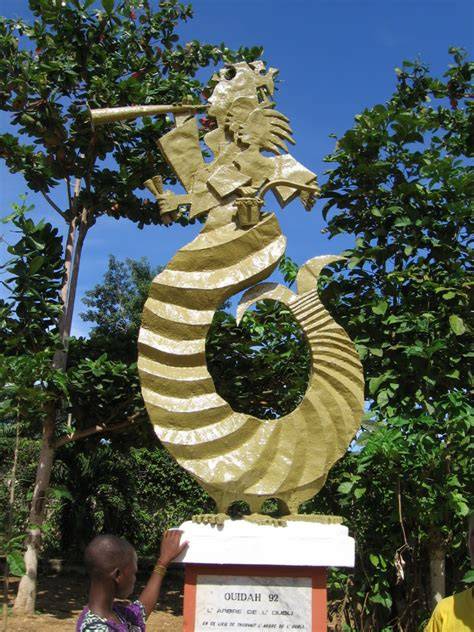
Mami Wata Shrine
Origins and Spread
The name Mami Wata does not precisely refer to a single deity or mythological figure but more accurately refers to a family of water spirits, collectively known as mami wata, found in both modern Africa and in the art and artifacts of ancient African civilization from at least 4500 BCE. Through the Atlantic slave trade, descendants of the Igbo, Ibibio, and other African tribes spread throughout the globe, resulting in an African diaspora.
The tradition of honoring the ancient water spirits, often in the form of Mami Wata as a single deity, was carried to the New World by enslaved Africans and now occurs in many locations around the globe, including parts of South America and the Caribbean. She is a water spirit widely known across Africa and the African diaspora, her origins are said to lie ‘overseas,’ although she has been thoroughly incorporated into local beliefs and practices.
Read also: Heartbreak and the Three of Swords
Symbolism and Appearance
Mami Wata is characterized by a unique and vibrant appearance that encompasses a variety of colors and symbols, deeply rooted in cultural significance. Typically depicted with a female human upper body and a fish or serpent lower half, Mami Wata symbolizes a rich tapestry of life aspects including good fortune, wealth, and healing. She is sometimes depicted with a snake around her neck, which represents both divinity and the art of divination.
The primary colors associated with Mami Wata are red and white. These colors are not only striking but also carry profound meanings. In Nigerian traditions, devotees of Mami Wata often wear red and white clothing to represent her dual nature and to honor her. Beyond her colors, Mami Wata is often associated with certain symbols. She is known for her enchanting beauty and is frequently depicted with mirrors and combs, signifying self-awareness and vanity. In many versions of the story, Mami Wata is described as possessing clothing and valuables of incomparable worth and beauty, far beyond any that could be produced by human effort.
Mami Wata, often portrayed with the head and torso of a woman and the tail of a fish, is at once beautiful, jealous, generous, seductive, and potentially deadly. Half-fish and half-human, Mami Wata straddles earth and water, culture and nature.
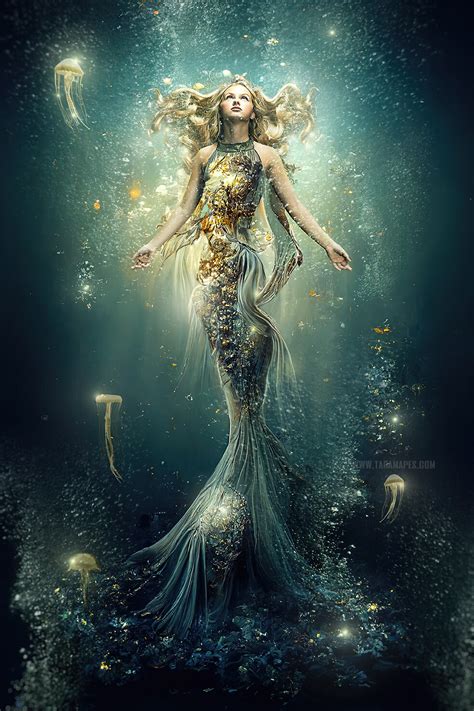
Mami Wata Mermaid Art
Mami Wata's Attributes
Mami Wata is a complex symbol with so many resonances that she feeds the imagination, generating, rather than limiting, meanings and significances. She is at once a nurturing mother; sexy mama; provider of riches; healer of physical and spiritual ills; and embodiment of dangers and desires, risks and challenges, dreams and aspirations, fears and forebodings. People are attracted to the seemingly limitless possibilities she represents, and at the same time, they are frightened by her destructive potential. She inspires a vast array of emotions, attitudes, and actions among those who worship her, those who fear her, those who study her, and those who create works of art about her.
Read also: The Meaning of Tarot Suits
Powers and Influence
Mami’s powers, however, extend far beyond economic gain. Although for some she bestows good fortune and status through monetary wealth, for others, she aids in concerns related to procreation-infertility, impotence, or infant mortality. Some are drawn to her as an irresistible seductive presence who offers the pleasures and powers that accompany devotion to a spiritual force. Yet she also represents danger, for a liaison with Mami Wata often requires a substantial sacrifice, such as the life of a family member or celibacy in the realm of mortals. Despite this, she is capable of helping women and men negotiate their sexual desires and preferences.
Mami also provides a spiritual and professional avenue for women to become powerful priestesses and healers of both psycho-spiritual and physical ailments and to assert female agency in generally male-dominated societies.
Connections to Other Deities
Mami Wata embodies attributes that resonate deeply with those of various other deities and saints. She is closely akin to the Orishas-Oshun, the goddess of love and fertility, and Yemaya, the queen of the sea.
- Oshun: A Yoruba goddess of love, fertility, and abundance, bears a striking resemblance to Mami Wata in several aspects. Both are intrinsically connected to water, symbolizing purity, fertility, and love. Oshun is revered as the river orisha in Yoruba religion, paralleling Mami Wata's connection with water bodies.
- Yemaya: Like Mami Wata, Yemaya is a mother figure and a protector, often depicted as a mermaid or a woman of the sea.
- Santa Marta: Although not directly linked to water like Mami Wata and Oshun, shares the attribute of being a powerful female figure in spirituality.
These connections highlight the universality of certain themes in goddess worship, such as fertility, protection, and the central role of water, across different cultures and religions.
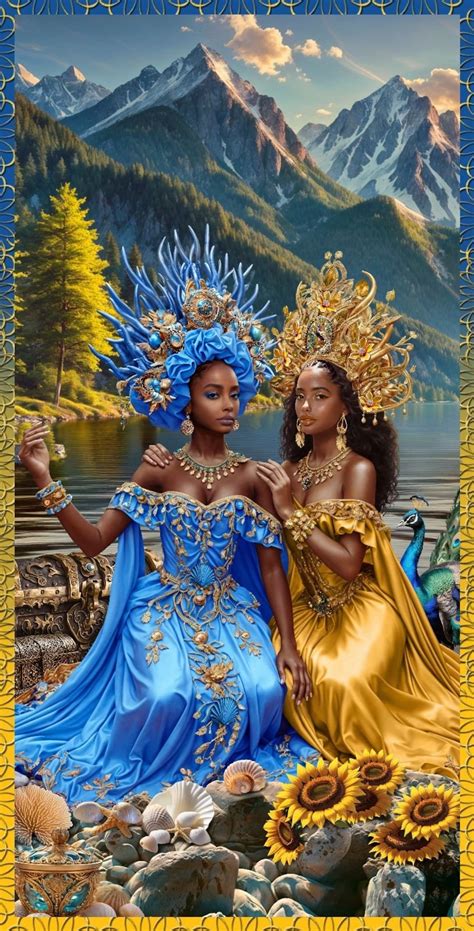
Oshun and Yemaya
Read also: The Symbolism of Bad Bunny's Super Bowl Stage
Mami Wata in Religion and Spirituality
Mami Wata's influence in Santeria and West African religions is profound and complex. Worshiped as a deity of water and beauty, she is a divine figure associated with the sea, rivers, and other bodies of water, signifying life and healing. Devotees, often from communities that are intimately connected with the natural world, especially bodies of water, turn to her for blessings and protection.
In West African religions, Mami Wata is revered for her power over both the physical and spiritual realms. In Santeria, a religion with West African roots that evolved in the Caribbean, Mami Wata is syncretized with similar water deities, such as Yemaya.
Spiritual practitioners, healers, and followers seek Mami Wata's assistance for various reasons, including personal transformation, healing, and spiritual growth.
Rituals and Offerings
Mami Wata, a revered water spirit, is an embodiment of various aspects of life such as fortune, wealth, and healing. In the diverse cultures of Africa and its diasporas, she is approached with rituals and offerings for spiritual guidance and protection.
Here are some examples of rituals used to honor Mami Wata:
Ritual for Wealth and Prosperity
This ritual is performed to seek Mami Wata's blessings for abundance and prosperity in one's life.
- Begin by placing the mirror at the center of your altar.
- Form a triangle with the blue and white candles around the mirror.
- Light the candles to represent Mami Wata's presence.
- Sprinkle sea salt in a circle around the candles and mirror, creating a purified space for the ritual.
- As you gaze into the mirror, focus on your financial goals and ask Mami Wata for her assistance in achieving them.
- Visualize yourself surrounded by the prosperity you desire.
Ritual for Healing and Cleansing
This ritual aims to cleanse the spirit and body, inviting healing energy from Mami Wata.
- Anoint your clear quartz crystals with lavender oil for their healing properties.
- Place these crystals around a bowl filled with fresh water.
- As you touch the water, anoint your forehead, heart, and wrists, calling upon Mami Wata's healing powers.
- Reflect on the purity and restorative essence of water, and meditate on your intention for health and cleansing.
Ritual for Insight and Guidance
This ritual is conducted to gain insight and guidance from Mami Wata.
- Lay the large blue handkerchief on a flat surface to represent the depths of the ocean.
- Light the incense sticks to cleanse the area and invite spiritual clarity.
- Gently cast the divination shells or stones onto the fabric.
- Study the patterns they form, and ask Mami Wata to grant you the wisdom to make the right choices in life.
Mami Wata in Art and Culture
Images of Mami Wata recur throughout a variety of artworks and media-masks and headdresses, sculptures, paintings, African pop music, and contemporary installation art-and in a number of cultures and religious systems across Africa and the African diaspora (showing up most prominently within the networks of the trans-Atlantic slave trade). She is celebrated near to and in water through communal transformative rituals of music and dance that transferred history and memories from the African continent.
The Mami Wata tradition survived the centuries-long Transatlantic slave system and, entwined with elements of Indigenous Caribbean worship, continued to express itself in a variety of ways across the Americas. That children were snatched from their mothers in their home communities in Africa or later in the Americas, makes Mami Water’s role as protector of mothers and children especially poignant. Her worship created a sense of strength and unity to fight against enslavement and retained respect for women as healers and leaders.
Henry John Drewal says about the significances of Mami Wata: she is like a ‘river that never rests.’
Table: Attributes and Symbolism of Mami Wata
| Attribute | Symbolism |
|---|---|
| Water | Life, purity, fertility, healing |
| Mermaid Form | Duality of nature and culture |
| Snake | Divinity, divination, power |
| Red and White Colors | Dual nature, balance, spiritual power |
| Mirrors and Combs | Beauty, self-awareness, vanity |
| Wealth and Fortune | Prosperity, abundance, success |
| Roles | Nurturing mother, seductive figure, healer, provider, spiritual guide |