Have you ever seen a five-pointed star and felt a little… conflicted? In Hollywood and pop culture, the pentagram is often portrayed as something sinister, a symbol of evil or dark magic. Those on a Pagan, Wiccan, or Occult Path, know the truth: this is a modern misunderstanding. The five-pointed star is a foundational symbol in countless spiritual traditions, from ancient philosophy to modern magical practice.
From ancient Sumerian clay tablets to the Hollywood Walk of Fame, the pentagram has captivated humanity for over 5,000 years. The story begins in ancient Sumer, where archaeologists discovered pentagram markings on clay tablets dating back 5,500 years.
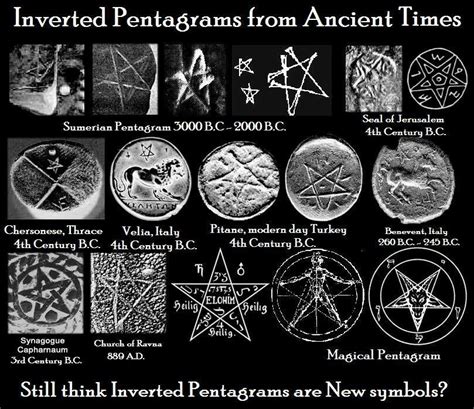
Sumerian pentagram
Pentagram vs. Pentacle
First, let’s clear up the most common point of confusion. A pentagram is simply the five-pointed star itself. A pentacle is the same five-pointed star but enclosed within a circle. In many magical systems, the pentacle is a physical object-a disc or talisman-upon which the pentagram is inscribed.
The circle is incredibly significant, as it represents unity and wholeness, containing and connecting all the star’s points into a harmonious whole.
Read also: Differences Between Pentagram and Pentacle
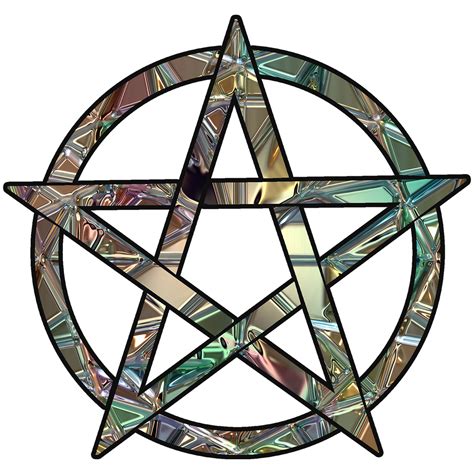
Pentacle
Historical Significance
The pentacle's history is overwhelmingly positive and dates back thousands of years. Its negative reputation is a modern invention. The earliest known use of the pentagram was around 3500 BCE in ancient Mesopotamia, where it was found on pottery fragments. The Liangzhu culture used pentagram-like diagrams to represent the Wu Xing (five elements: earth, water, wood, fire, metal) and musical scales.
The ancient Egyptians saw it as a symbol of the "underground womb" and rebirth , while the ancient Greeks, particularly the followers of Pythagoras, considered it a symbol of mathematical perfection and health. Pythagoreans called it "Hygieia" (Health) and used it as a secret sign of recognition. The Pythagoreans' discovery of the golden ratio within the pentagram was revolutionary. For the Pythagoreans, this wasn't coincidence but proof of a divine blueprint underlying all creation.
The symbol's positive associations continued for centuries. It was known as the "Endless Knot" in the medieval era and was believed to be a powerful protective amulet against evil and demons. Used as the seal of Jerusalem, with five points corresponding to the five Hebrew letters of the city's name. Known as the "Endless Knot," it represented Christ's five wounds from crucifixion.
In Japan, the pentagram known as seiman was adopted in esoteric Onmyodo practices to represent five elemental forces and ward off evil spirits. This protective use paralleled developments in other cultures, showing the universal human intuition about the star's power.
Read also: Pentacle Ring Symbolism
Heinrich Cornelius Agrippa's 1533 masterwork De Occulta Philosophia transformed the pentagram into the ultimate symbol of the human microcosm. The upright pentagram, with one point ascending, symbolizes the triumph of spirit over the four material elements. This configuration represents a higher spiritual reality governing material existence - a concept that resonated across cultures.
Eastern Parallels: In Chinese philosophy, the pentagram represents the Wu Xing (five phases), while Japanese traditions use it in the godai system.
The Shift in Meaning
The negative association with the pentagram is a modern phenomenon, one that practitioners have had to navigate. The shift in the symbol's public perception began during the Inquisition, when the Church, feeling threatened by the knowledge held by certain groups, framed the pentagram as a symbol of heresy. It became associated with witchcraft and horned gods, and its public perception was slowly shifted to be seen as evil.
The meaning of an upside-down pentagram dramatically shifted in the 19th century. Éliphas Lévi suggested that while an upright pentagram symbolizes the divine human (the microcosm), an inverted pentagram signifies "the goat of lust" - carnal, material forces triumphing over spiritual ones. Aleister Crowley's Alternative View: The controversial occultist acknowledged the inverted pentagram in his Thelemic tradition but explained it differently - as the descent of spirit into matter. Some Wiccan traditions have even used an inverted pentacle to signify specific ritual initiations or degrees of advancement, though many avoid it to prevent misunderstanding.
This negative connotation was solidified in more recent history by its negative portrayal in popular culture and sensationalized media. Hollywood horror movies used the symbol for shock value.
Read also: The Pentacle: History and Meaning
The REAL Meaning of the Pentagram: Ancient Secret Finally Revealed (Not What You Think!)
Modern Wiccan and Pagan Interpretations
For modern Wiccans, Pagans, and Witches, the pentacle is a profoundly positive symbol of faith, balance, and the interconnectedness of all things. This interpretation synthesizes ancient philosophical concepts with modern spiritual principles.
The topmost point of an upright pentacle represents Spirit. This position signifies the supremacy of the spirit or mind over the material world, a principle often summarized as "mind over matter". The other four points correspond to the classical elements:
- Air: representing intellect, communication, and inspiration.
- Water: associated with emotions, intuition, and reflection.
- Earth: symbolizing stability, grounding, and physical reality.
- Fire: symbolizing energy, passion, and transformation.
The symbolism extends beyond the elements. In some traditions, the five points can also represent the human form-head, outstretched arms, and legs-connecting the individual to the microcosm of the universe. This concept of "as above, so below" is a central tenet of many mystical traditions.
The circle that contains the pentagram represents unity, wholeness, and the perpetual cycle of the universe.
Choosing and Using a Pentacle
Selecting a pentacle necklace or a piece of Pagan jewelry is a personal and powerful act.
- Follow Your Intuition: The most important step is to let your intuition guide you.
- Consider the Materials: The metals and gemstones used can add another layer of meaning. Silver is a lunar metal associated with intuition and the divine feminine, making it ideal for moon rituals. Bronze, conversely, is a solar, masculine metal that symbolizes grounding, stability, and strength, and was often used for protective amulets in ancient times.
Once you've chosen your piece, remember that spiritual jewelry is an active tool that absorbs energy from its surroundings.
- Cleansing: This removes any stale or negative energy.
- Charging: This infuses the piece with your desired intention.
Here's a table summarizing the elemental associations with the pentacle:
| Point | Element | Meaning |
|---|---|---|
| Top | Spirit | Supremacy of mind over matter |
| Right | Air | Intellect, communication, inspiration |
| Bottom Right | Fire | Energy, passion, transformation |
| Bottom Left | Water | Emotions, intuition, reflection |
| Left | Earth | Stability, grounding, physical reality |
Pentacle in Magical Practices
A pentacle (also spelled and pronounced as pantacle in Thelema, following Aleister Crowley, though that spelling ultimately derived from Éliphas Lévi) is a talisman that is used in magical evocation, and is usually made of parchment, paper, cloth, or metal (although it can be of other materials), upon which a magical design is drawn. Pentacles may be sewn to the chest of one's garment, or may be flat objects that hang from one's neck or are placed flat upon the ground or altar.
Pentacles are almost always shaped as disks or flat circles. Many varieties of pentacle can be found in the grimoire called the Key of Solomon. Pentacles are also used in Wicca, alongside other magical tools. In the Hermetic Order of the Golden Dawn and Wicca, pentacles symbolize the classical element earth.
In the 1909 Rider-Waite-Smith tarot deck (the pentacles of which were designed by Arthur Edward Waite), and subsequent tarot decks that are based upon it, and in Wicca, pentacles prominently incorporate a pentagram in their design.
The first documents to depict pentacles were the 16th-century grimoires called the Heptameron by pseudo-Pietro d'Abano, and the Key of Solomon. In the Heptaméron, there is only one pentacle, whereas in the Key of Solomon, there are dozens of different pentacles. The Heptameron's pentacle is a hexagram that is embellished by patee crosses and letters, whereas the Key of Solomon's pentacles have a very broad variety of designs, only two of which are pentagrammic.
Gerald Gardner, known by some as the 'Father of Wicca', got his concept of pentacles in large part from the 1909 Rider-Waite-Smith tarot deck, in which the pentacles are disks that are covered with a pentagram. In Gardner's 1949 book High Magic's Aid and 1954 book Witchcraft Today, Gardner defined a pentacle as a "five-pointed star", intending to mean a pentagram.
The word is first recorded in English usage in 1561, from earlier French use. The French word had the meaning of "talisman". ...it seems most likely that it comes through Italian and French from the root pend- "to hang", and so is equivalent to a pendant or charm hung about the neck. Pentacles, despite the sound of the word, often had no connotation of "five" in the old magical texts, but were, rather, magical talismans inscribed with any symbol or character.
In the Golden Dawn magical system, the Earth Pentacle is one of four elemental "weapons" or tools of an Adept. There is, therefore, nothing movable or immovable under the whole firmament of heaven which is not included in this pantacle, though it be but "eight inches in diameter, and in thickness half an inch." Fire is not matter at all; water is a combination of elements; air almost entirely a mixture of elements; earth contains all both in admixture and in combination.
In many old grimoires dealing with magical evocation, the pentacle is described as being hung about the neck, providing protection and authority to the operator. The pentacle is of central importance in the evocation of spirits. Here be the symbols of secret things, the standards, the ensigns, and the banners, of God the conqueror; and the arms of the almighty One, to compel the aerial potencies. I command ye absolutely by their power and virtue that ye come near unto us, into our presence, from whatsoever part of the world ye may be in, and that ye delay not to obey us in all things wherein we shall command ye by the virtue of God the mighty One.
In the Golden Dawn system, the pentacles are not suspended from the neck, but wrapped in a cloth covering.
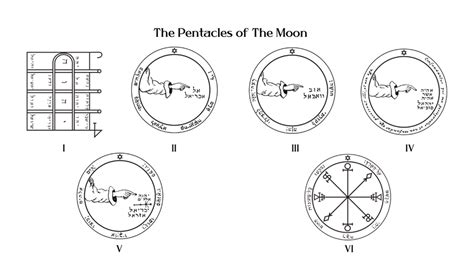
The "First Pentacle of the Moon" from the Key of Solomon.
These uses trace back to ancient symbolic ideas - the star as a mark of excellence, divine guidance, and perfection in nature. From Sumerian potters to Silicon Valley designers, the pentagram has journeyed through 5,000 years as humanity's most adaptable symbol. Today, whether gracing a nation's flag, protecting a Wiccan's altar, or simply rating your favorite restaurant, the five-pointed star continues to evolve.
The pentacle is more than just a symbol; it's a profound tool for spiritual connection, personal protection, and aligning with the natural world. It’s a testament to the fact that true power comes not from fear, but from knowledge, harmony, and balance.
Looking for your perfect Pentacle? Look no further! Our online witchcraft store offers hundreds of unique designs, each one crafted to be a personal symbol of your faith and connection to the elements. Find the one that truly resonates with you and your spiritual path.