Robert Eggers' 2016 film, "The Witch," is not merely a horror movie; it's a complex exploration of religious extremism, misogyny, and the psychological toll of oppression. Re-watching the film reveals deeper, more radical implications than initially perceived, making it an extremely bleak and unsettling experience.
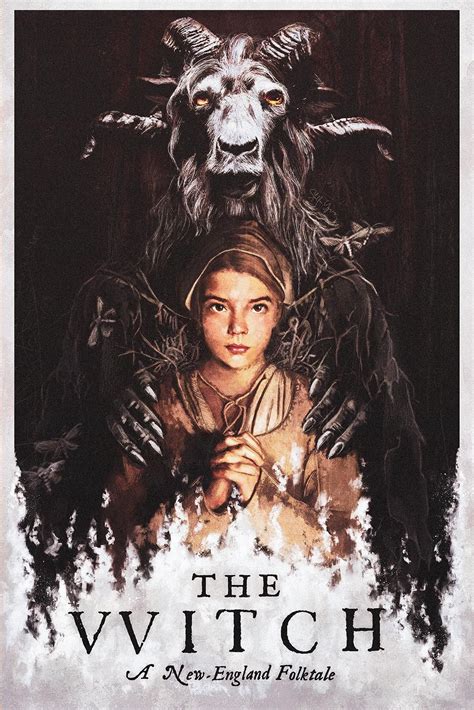
The Misogyny Within Christianity
One of the most palpable threads in "The Witch" is its exposure of the deep misogyny within Christianity. While the film focuses on Puritanism, an extreme branch of English Protestant Christianity, its commentary resonates with broader Christian beliefs. The built-in sexism and misogyny are undeniable, shaping the fates of the characters, particularly Thomasin.
From the outset, director Robert Eggers establishes that Thomasin (Anya Taylor-Joy) is no ordinary passive and obedient Puritan girl. This is evident in the opening scene when she hesitates before leaving the space where her father is banished from the congregation. This moment suggests that an avenue has been closed to her, limiting her opportunities for self-determination.
Eggers gives us her distinct point of view as she leaves the Puritan community, the gates swinging shut suggesting that an avenue has been closed to her, the community perhaps giving her more outlets for her free spirit self had she had that opportunity. In the top image, Thomasin immediately stands out from the family as she doesn’t immediately leave with the family when her father orders them to leave, suggesting already that she will not immediately fall in line with her patriarch father.
We get other such moments, as when Eggers strikingly focuses on her praying, her confession seeming to suggest both normalcy - human beings are forever fallible and will “sin,” e.g., exhibit natural human failings - and, in the context of becoming a good Puritan woman, hints of her growing resistance to such an oppressive way of being. Many have read this moment as the moment when the Devil will mark Thomasin as a target for bringing her to the dark side, and I suppose in the context of what may seem like a focused contest between good and “evil,” that is true, but for me this is just a moment, like moments to follow, where we begin to see Thomasin as ostensibly wanting to be a good Puritan woman but also that part of her (free spirit) self who wants something else out of life.
Read also: The Dark Side of Taurus
In her prayer, she says, “I here confess I’ve lived in sin. And broken every one of thy commandments in thought. Followed the desires of mine own will and not the Holy Spirit. I know I deserve more shame and misery in this life and everlasting hellfire.” Again, this part of the prayer is striking; ostensibly it is Thomasin wishing she could be a better, more devout, Puritan, but if we think of her sentiments as logging her “return of the repressed” - that which she suppresses but really desires - then we can see how her “thoughts” belie her true desires to self-determine herself.
Eggers gives us this motif of Thomasin alone, stressing her singularity in the family. In these next three images, we see how Eggers also codes Thomasin as both self-aware of her oppressed existence and indomitable. In these three images we see yet another facet of Thomasin, her simple desire to have the unconditional love and acceptance of her parents.
Also striking is the ending sequence when the mother, Katherine (Kate Dickie), has a complete melt down and lashes out at Thomasin, suggesting that Thomasin is a “proud slut,” tempting both her brother Caleb (Harvey Scrimshaw) and even her father, William (Ralph Ineson), with her maturing womanhood.
More pointedly, that it is Caleb who visibly expresses sexual desire and not Thomasin - and that it is Thomasin who is attacked for it, not Caleb - also speaks to the built in sexism of Christianity. More generally, that’s why the mother’s accusations are so startling because Thomasin is the epitome of “pure” and innocent before this moment.
But then that’s in large part how Eggers gets at the irrational view of women by a Christian belief system, who, beginning with Eve, have been seen as a symbol of “sin” and temptation. Women are seen in this belief system as lacking the ability to control their sexual desires and thus need patriarchal reins to keep these sexual desires under control or negate them altogether.
Read also: A Journey Through Witchcraft
That the “witch” archetype is historically seen as represented solely by women is no accident, since this figure was created as a symbol of women who refuse social order (Christian) constraints, both in terms of refusing patriarchal ownership and in terms of actualizing their sexual desires. They are coded as “evil” - linked to the Devil - as a way to code these free spirit, agentic attributes as abnormal and against God and thus needing to be reined back into the control of their patriarchal (Christian) masters.
In this way, we can see where the mother’s irrational diatribe - and both parents’ all too easy ready acceptance of Thomasin as a witch - comes from, not from actual reality but from what she believes from her own Christian indoctrination and thus so readily projects onto Thomasin.
Though the mother has lost it at this point, her accusations in this moment are very much an allegorical “return of the repressed” sensibility. What she says so ragingly here is clearly what she has thought previously, her Puritan indoctrination becoming the seed of what she sees in Thomasin’s blossoming womanhood.
The Crucible Scenario
In some ways, the film could also be seen as a kind of prequel to The Crucible (both the seminal Arthur Miller play and the underrated film adaptation of it), spectators getting a micro narrative of a singular “crucible” scenario, with first the twins then the parents believing pure - purely good - Thomasin is a witch, when of course she isn’t.
But by seeming to make the witch real, and the Devil real, and Thomasin’s slide into becoming a witch real, isn’t the film then suggesting that perhaps at least some women condemned in the Salem witch trials were real witches? For me, what has changed is that I now understand the value of making the witch real while also still wanting to make this “crucible” scenario manifest as well.
Read also: Understanding Witchcraft in Scripture
Driving Women to Witchcraft
The other thing that the film does, and to my mind this is one way in which the film is truly radical and bold, is in condemning Puritans/Christians for not just murdering innocent women but in perhaps driving some of them, perhaps many (most?) of them, to witchcraft. For me, less talked about is how the film’s bleakness stems not just from the truly disturbing fall of this entire family, and we must not forget that an innocent baby is slaughtered and three young children are horribly killed (yes, the twins are thoroughly annoying, but then they are just children who don’t seem to have any boundaries placed on them!) but from another crucial focus in the film.
That is, the other bleak and truly despairing element in the film is how the film leaves Thomasin with no place to go. She is in effect caught between two evils, not just the temptation of going to the dark side and sign her soul away to the Devil and become a witch, but she is also facing a life of oppression with her Puritan family and Puritan way of being, a life where she will never be able to self-determine or self-actualize herself, a truly oppressive way of being.
In this way, the film boldly stresses that, well, at least in this extreme (Puritan) form, Puritanism/Christianity is an “evil” way of being, robbing women (and people in general) of a natural and healthy way of being. And I would argue that though the film focuses on a particular time period of extreme Christian (Puritan) beliefs, I don’t think this means we should see that Christianity has evolved since then. Even today, women who are indoctrinated into toxic Christian belief systems are severely limited in self-determining and self-actualizing their selves.
One of the most mind blowing possibilities of The Witch is something that is rarely addressed in mainstream film. To digress for a second, there is a great film called The Rapture (1991, Michael Tolkin), that rare film that addresses more blatantly what I think The Witch is also boldly (though more subtly) revealing.
Eggers does a great job getting at a fundamental coda of Christianity, how, at least in its Puritanical or Evangelical (fundamentalist) rendition, it doesn’t matter if one suffers in the real world, all that matters is earning one’s way to the afterlife/heaven. In other words, suffering is actually part of what God intends, suffering then becoming the adversity that tests one’s devoutness, one’s faith.
Even more palpable and I think symbolic is the fact that in this world of the film, the Devil and the witch are real and so the attack and killing of the family speaks to what I think the film might be saying, that God is not a benevolent entity.
In terms of thinking about how God is not benevolent but actually cruel and even sadistic, one could cite many examples, such as God asking Abraham to kill his own son or God’s encouragement of genocide and capital punishment or, for that matter, God’s devastation of whole cities and civilizations, children and all, but I think the story that best fits, indeed almost seems like an influence for this film, is the story of Job.
Here is how Wikipedia sums up this story: “[The Book of Job] addresses theodicy, why God permits evil in the world, through the experiences of the eponymous protagonist. Job is a wealthy and God-fearing man with a comfortable life and a large family; God, having asked Satan for his opinion of Job’s piety, decides to take away Job’s wealth, family and material comforts, following Satan’s accusation that if Job were rendered penniless and without his family, he would turn away from God and die.”
The point of the story, of course, is to try and understand why God lets the most pious suffer, a way to make sense of God’s inaction in the world.
One of the most disturbing moments in the film is when Caleb, who is suffering from some kind of illness or possession brought on presumably by the witch, seems to have at one point an apple lodged in his mouth. The father manages to pry open Caleb’s mouth and dislodge the apple. When we see the blackened apple roll to a stand still, we see that it has a bite taken out of it. After that, Caleb recites all the language that would suggest his devoutness.
Perhaps more so than any character in The Witch, Caleb is the most tempted by his desires, again, represented by his desirous looks at his sister’s Thomasin’s breasts. In his evocative conversation with his father on original sin, Caleb clearly has anxiety about the whole conception of original sin, for both his brother’s Sam’s sake (Sam the baby has never been baptized and thus would seem destined for Hell) and for his own natural (“sinful”) desires.
This moment is a powerful one, because it clearly calls out Christianity for its contradictions (an innocent baby is going to Hell; a young boy who has natural desires is a sinner) and how that creates in people - especially young people - a deeply felt anxiety over one’s apparently sinful self.
This thread in the film is indeed another telling commentary on what seems like the cruel and sadistic-masochistic nature of at least one facet of Christianity. One of the original (Augustine) key tenets of Christianity is that people are born into “original sin,” this idea that people are born “sinners.”
Again, the film touches on just how traumatic such a way of being can be for children, who then struggle with those natural (childish, immature) desires and choices all children have.
The Plot Unveiled
The film begins with the family being banished into the woods when the father calls out the leaders of the town. As they settle on their new farm, Thomasin (the eldest daughter) is asked to watch Samuel (newborn) where she ends up losing him to "The Witch". Right away you see what happens to Samuel; The Witch takes him back to her home within the woods where she kills him, rubs his blood over her skin, and eats him.
The mother, Katherine, becomes very hostile towards Thomasin after this. She blames her for Samuel's disappearance. The father, William, and the eldest son, Caleb, venture into the woods (in secret) to try to capture the wolf that they believe did this but are unsuccessful.
Meanwhile, the twins, Jonas and Mercy, constantly play with the black horned goat on the farm named Black Phillip. They also play tricks on Thomasin throughout so when Mercy tells her that she saw Samuel get taken into the woods by a witch Thomasin doesn't believe her and instead tells her that she herself is a witch, just to scare her and make her stop telling lies.
As the family starts to suffer from a drought in crops, we see the family start to deteriorate as well. Thomasin struggles with her growing adolescence and guilt she carries, Caleb starts to notice his sister’s physical presence, William admits to his pride, and the mother is just ticking away.
When Thomasin discovers what Caleb and William were doing in the woods she asks him to take her out to see the trap. In the woods, Caleb and Thomasin end up getting lost when a small rabbit scares off their horse and dog. Caleb runs after the dog while Thomasin gets knocked out after falling off of the horse. When she wakes up, she is able to make her way back home while Caleb discovers the witch's house where she seduces him as a young temptress.
Once again Thomasin is blamed for Caleb's disappearance until Caleb returns naked and very sick during a storm. Mercy calls out Thomasin for calling her a witch, to which Thomasin explains that she was only joking in order to have her stop lying about the witch and the evil talking goat. Caleb ends up dying, and William decides to lock up the three remaining children in the animal shed, believing one of them to be the reason behind all of this.
While locked up, The Witch appears in the shed in the middle of the night and kidnaps the twins, leaving Thomasin behind. When William discovers her the next morning alone he is suddenly rammed to death by the horned goat as Thomasin watches in horror. Katherine attacks Thomasin out of despair and Thomasin, in self-defence, is forced to kill her mother.
As the only survivor, Thomasin returns to the animal shed and demands the goat speak. He makes her sign a deal and Thomasin goes off naked into the woods to join a coven of witches that have been living there all along.
Of course amidst all of that you have the creepy blood-milk, the goat doing more jacked up stuff, and probably the worse scene involving a raven you’ll ever see.
Themes and Interpretations
The interpretation of "The Witch" hinges on whether one sides with the supernatural or the metaphorical. Eggers deliberately leaves the film open to interpretation, refusing to provide a concrete answer.
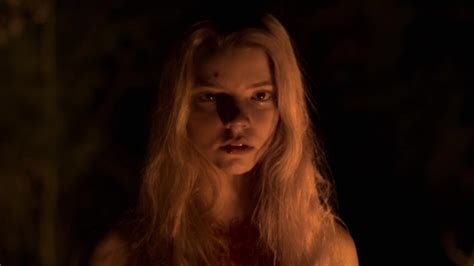
Religious/Evil
Eggers does a fantastic job with this, being straightforward in interviews that the film is open for interpretation refusing to give one concrete answer but allowing many. There’s no worry whether there is a witch or not because he chooses to reveal her right away in the film, thus allowing the audience to feel her presence throughout.
Now you can then see the consequences in the film as the result of witchcraft. With the goat being the devil that dwelt with the family waiting for her to sign that contract. The witches feeling intruded upon their land, seeking out to take Thomasin as their own by the end. Going out and disguising themselves as animals, seducing, and picking apart the family one by one. And for those who want that, you get it 100%.
But for me, I saw it more-so as a family drama where they were losing their religion and I believe that’s backed up with not only the actors’ descriptions but even the editor’s. It builds upon this paranoia that becomes an over the top game of supernatural Clue at a point.
Internal vs. External Horror
John Carpenter once said, “There are two different stories in horror: internal and external. In external horror films, the evil comes from the outside, the other tribe, this thing in the darkness that we don't understand.
So, what or who is the witch? Well, it’s what we fear the most. In the film, we saw it be God or the lack of faith to God. We saw the family suffer from pride, lust, and the fears of growing up.
In those times, the witch embodied men’s fears and fantasies about women which ironically, to some extent, are still around today. We also see that the witch feeds off of despair and that the witch can be anyone of us.
So, The Witch, it strives to bring out our internal terrors, our guilt, the things we can’t control, the things we can’t explain, and ultimately may give a false interpretation to. That’s what makes The Witch so scary.
The series begins when Grace Churchill discovers her husband and mother-in-law's plan to use her newborn child, William, as a means to bring about the end of the world. The husband and mother-in-law are evil witches, who worship Satan. While Grace prevents this from happening, it is thought that only William and his mother survives the first film.
In the second movie, 18 year old William, unaware of his heritage, and having been adopted by the Adams family, finds that his next door neighbor, the witch who survived from the first film, attempts to seduce him to use his powers for darkness. William (with Spanner as his last name) resists the temptation, and in between the second and third movie, becomes a lawyer, getting a job in the district attorney's office.
After being fired from the district attorney's office (a move which later movies reveal was caused by his black magic roots being discovered) he opens his own law office. Spanner resists his heritage, preferring a normal life, but events conspire to force him to use his powers, often with the fate of the world at stake. Spanner later becomes more comfortable with his powers and his role in protecting the world against the dark powers.
While Spanner is the main character of the series, he is not in movies 8 and 10, and is only an infant in the first film. He dies at the end of the seventh movie, and remains dead during the eighth movie, but is resurrected in the ninth movie. He does not appear during the tenth movie, which is set in London, England and follows Lt.
All movies have been produced by Vista Street Entertainment. Despite its longevity, the series is not well regarded, and the AV Club notes that the series "Witchcraft continually relies on the same stock story lines, most often involving a good warlock struggling against trashy temptresses sent by evil warlocks to seduce him to the dark side."
tags: #scary #witchcraft #movies