Taylor Swift, the global pop sensation, has found herself at the center of various controversies, including accusations of witchcraft and Satanism. These allegations have sparked debates among fans, religious groups, and cultural commentators. This article delves into the origins of these claims, examining Swift's references to witches in her music, her public responses, and the broader cultural context surrounding these accusations.
Taylor Swift has been accused of being a witch in the past - she's even referenced this in a 2017 song, "I Did Something Bad," in which she sings, "They're burning all the witches even if you aren't one."
The "Sorcery Allegations" and On-Stage Coincidences
On Monday, Swift played into that storyline again, joking that a bizarre moment from her Eras Tour concert was evidence that she actually is a sorceress. While performing her song "Labyrinth" in Argentina on Thursday, an airplane descended over the stadium just as she sang, "I thought the plane was going down, how'd you turn it right around."
Fans marveled at the coincidence on social media before Swift acknowledged it in her own post. She shared a video of the moment to her Instagram, writing, "Never beating the sorcery allegations."
References in Music and Performances
Since her sixth studio album reputation (2017), Taylor Swift has referenced various times to witches and the witch-hunt(s) in her songs, music videos, and stage performances. More recently, the performance of “willow” from the Eras Tour gained some needless traction from a few Christians, accusing Swift of performing witchcraft on stage.
Read also: A Journey Through Witchcraft
In “I Did Something Bad” from reputation, Taylor sings in the pre-chorus “I can feel the flames on my skin / Crimson red paint on my lips / If a man talks shit, then I owe him nothing / I don’t regret it one bit ’cause he had it coming”. The lines allude to wanting to take revenge after being wronged by a man.
Here, the speaker also seeks power from her burning-red body (flames on skin, red lipstick) to do her bidding because “he had it coming” as they sing it in Chicago. I am particularly intrigued by the imagery of the flames of her skin, which prefigures her burning (as a witch) on the bridge.
However, it also alludes to her innate (magical) power as a witch figure who can create fire and use it against her persecutors. These lines are also highly evocative of Sylvia Plath’s poem “Witch Burning”:” “In the month of red leaves I climb to a bed of fire.”; “My ankles brighten. Brightness ascends my thighs.”
“I Did Something Bad”, nevertheless, acknowledges some form of wrongdoing, whether that is a (metaphorical) performance of a spell. The speaker is not afraid of the consequences of her action but feels a new-found empowerment in her agency.
Like Plath and many female artists, the fiery flames function as vivid images and seek empathy from the audience. Accused witches, however, were rarely burnt, particularly in New England, they were hanged.
Read also: Understanding Witchcraft in Scripture
Only some European countries, like Germany and Scotland, used burning as an extreme form of torture during the witch trials. In her Reputation Stadium Tour performance of the song, Swift glances at her flaming hand, feeling disconnected from others, who are trying to escape her touch.
Finally, her dancers lift her up, forming a bonfire under her. In the line (“They’re burning all the witches even if you aren’t one”), Swift evokes the power dynamics of the witch accusations, from neighbourly feuds to speaking up against authorities.
The majority of people accused of witchcraft were women, particularly older women who were socially and economically outsiders, nonconformists with unusual physical characteristics, and midwives who got accused when the newborn died. Even, widows who were left with a large sum of money found themselves being accused of witches just because they broke gender roles.
(There is an interesting link here to Rebekah Harkness from “the last great american dynasty” where Taylor Swift sings “There goes the maddest woman this town has ever seen”.) “I Did Something Bad” is not only a feminist reclaim of female power and the witch figure but it also draws on the historical and cultural references of the witch-hunt and interrogates what makes a “good witch” in the twenty-first century.
Swift parallels the crime of witchcraft with the “crime” the media and the general public accused her of committing. While folklore (2020) includes several fictional stories, no other song on the album carries the energy of reputation.
Read also: Urdu Article: Understanding Witchcraft
In the sombre piano song “mad woman”, Taylor Swift alludes again to the witch-hunt period, perhaps as a call-back to “I Did Something Bad”. For the people who are familiar with Swift’s lore, it is evident that she is referencing the Kim Kardashian-Kanye West phone call from 2016, accusing Kim of a lack of female solidarity by helping her ex-husband to trick her and lie to the public.
The first line of the verse “And women like hunting witches, too” brings us closer again to the witch accusations. Here, Swift references an overlooked element of the witch-hunt that is often framed as a gendered struggle of women in a patriarchal society: in smaller communities, women (particularly mothers) accused other women of being witches.
In, for example, the Salem witch trials, a couple of adolescent girls accused first the Indian slave Tituba of performing witchcraft. The accusations continued to soar: Of the twenty-five who died during the Salem witch trials, seventeen were women.
Taylor Swift’s “mad woman” is a reminder that (perceived) nonconformism of women, particularly if it is associated with the expression of negative emotions always meets with criticism, scrutiny, and even public shaming.
In folklore’s sister album evermore (2020) - my personal favourite of all Taylor’s albums -, the lead single “willow” includes no lyrics on witches and witchcraft, yet Swift chose a “witchy” aesthetic for the music video, the performance, and remixed of the song.
“Willow” has three remixes: the dancing witch version, the lonely witch version, and the moonlit witch version appealing to the Tumblr-Pinterest autumn aesthetic. In my opinion, the remixes do not add an extra layer to the song, it is an important marketing element of the “witchification” of “willow”.
The music video for “willow” starts where “cardigan” left off. We see the wet Taylor hugging her cardigan. What differentiates the most the two projects is the communities of people found in “willow” that surround Taylor, whilst in “cardigan” she was alone with her piano, fighting not to get drowned.
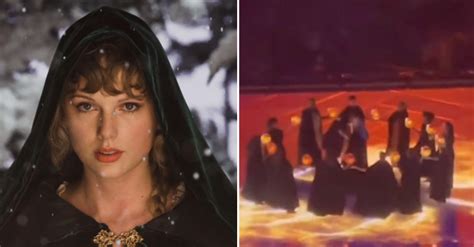
“Willow” is a journey not only of self-discovery but of finding her long-lost partner with the help of the guiding magical light and the golden string alluding to the song “invisible string”. In the last part of the music video of “willow”, Taylor discovers the hooded figures - possibly witches - dancing in a circle in the snowy moonlight, worshipping the magical lights.
Taylor Swift’s character finds the golden string again, leaving the ritual behind, where, it turns out, her man was, under a mask. Unmasking himself, the love interest follows her to the attic where the music video began: they found each other thanks to the magical string.
The performance of ritualistic dancing functions as a way to tie the lovers. The dancing of the witches also reminds us of a love/fertility ritual. Modern witches (Wiccans) often perform their ceremonies in a circle to keep the spirits under control.
Gerald Gardner, the founder of Wicca in the 1950s, often described the fertility rituals, which ought to be performed in a circle with naked participants. In the previously mentioned Eras tour performance of “willow”, Swift focused on the magical elements of the songs, completely erasing the love interest from the narrative, which is not surprising due to the breakup between Joe Alwyn and Taylor Swift.
In the live performance, Swift recreates the ritualistic dancing worshipping the magical lights. The swift and hushing movements performed in the dark with stage fog give an additional eeriness to the witchy song. Even, Swift commented under the video “is this the new 123 let’s go bitch be honest”, alluding to the chant that fans shout on tour during the beginning of a song from the reputation “Delicate”.
While of course, there is no summoning of spirits and demons during the Eras tour, Taylor Swift chose a choreography and visuals for “willow” that utilise the elements of ritual magic.
For example, in Marlowe’s Doctor Faustus, the black magician conjures Mephistopheles with an incantation, whilst he draws a circle in which the demon appears. In the painting of John William Waterhouse titled The Magic Circle, the witch Medea is portrayed next to a boiling cauldron whilst drawing a circle in the sand, alluding to ritual magic.
Literary magicians and necromancers are frequently described as employing ritualistic elements, including a shape, objects, magical aids, and reading spells from their grimoires or signing chants to complete the magical act. Taylor Swift’s “willow” utilised well-recognised elements from literature and popular culture to allude to the performance of ritual magic.
This writing is not a complete study, but an inquiry into Taylor Swift’s imagery of witches and magic. The lyrics and visuals aiding her songs demonstrate her knowledge of popular ideas of witches and the witch-hunt.
Examples of Accusations and Defenses
During her Eras Tour, Swift posted to her fans, "I've been watching videos of you guys in the theaters dancing and prancing and recreating choreography, creating inside jokes, casting spells, getting engaged, and just generally creating the exact type of joyful chaos we're known for."
Casting spells? That reference set off a storm of accusations that she was "celebrating Satanism," even though as rock star antics go, Swift appears to be on the extremely tame side. Could “casting spells” simply refer to flirtatious enticements to romance? Although she never directly answered these accusations, she did caption a video on X, "Never beating the sorcery allegations." I almost hear a sigh of resignation. She probably realized that people who believe you’re a Satan worshiper would not be dissuaded by a denial.
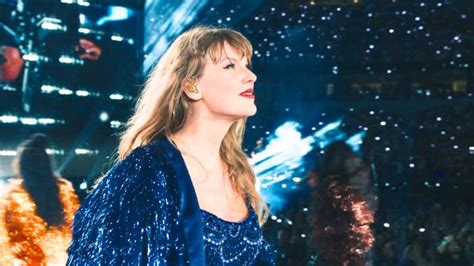
The whole Taylor Swift controversy has become extremely silly. An article in Forbes noted that she was accused of flashing a Satanic hand gesture during a concert in 2023. Turns out it was probably the American Sign Language sign for "I Love You."
A number of videos have been circulating in Christian circles accusing Taylor Swift of worshipping the Devil. The mega pop star just passed the Beatles’ record for most cumulative weeks in the Top 10. So, agreed, that does look like some kind of Faustian bargain has been struck.
The "Karma" Music Video and Its Interpretations
But the criticism has focused on her music video for the song Karma. In the video, she is shown in the popular depiction of hell, wearing a horned, demonic-looking mask. It sure looks bad.
But Taylor Swift is no more worshipping the Devil than Hieronymus Bosch was. No, I don’t mean the TV detective Bosch (great show) but the 16th-century artist who painted macabre and nightmarish depictions of hell. Or for that matter, Dante, who wrote about traipsing down into the lower levels of hell and purgatory.
There are actually two music videos. One that was released with the original song. It's the other one featuring a "duet" with Ice Spice that is receiving the criticism. The first video is all about the boyfriend. In the second, the director apparently took the “hell” theme and just ran with it. There is an easy way to clarify the meaning of those scenes of hell. Look at the song lyrics.
“Karma” here is not the principle as strictly defined by several schools of Hindu religion. It is merely the adapted western concept of "what goes around comes around." And the music video's “hell” is not the theological conception of the Hebrew sheol or gehenna or the Greek hades or Tartarus where the unbelieving dead suffer in unquenchable fire. It's the cartoon version of hell that has emerged in popular culture.
Swift is using concepts like Karma and hell outside of their original settings as artists have always done. They illustrate the message of her song - that her old boyfriend is experiencing the Karma he deserves for his betrayal. His suffering is depicted as being in hell, while in contrast Swift is happy with her life, receiving good from the universe for good works she has done.
In the first scene, Swift holds a pair of scales posing as Nemesis, the Greek goddess of retribution and divine justice. Then the stage flips, with the underworld coming to the surface showing the retribution enacted.
The horrors of hell are depicted as the proper payback for evil deeds - something many evangelicals would ascribe to. She takes off the horned mask and laughs, enjoying her boyfriend’s predicament. Later she is in her perfect Barbie world, and mockingly blows a kiss to a coterie of demons or possibly Grim Reapers who “give her the finger.” She is an interloper, not one of them. The scene actually takes up only a fraction of the video.
In the song she oddly portrays Karma as her real “boyfriend,” as her "god," (because it’s powerful?) as “sweet like honey” and a "cat purring in my lap." (I couldn’t really make heads nor tails of this, and neither could a Buddhist scholar. The original video is even sillier. But hey, it’s a pop song). Then she tells her old boyfriend, "I keep my side of the street clean, You wouldn't know what I mean" as she sweeps a broom over the path.
“Karma” seems to be an all-purpose word. In a recent concert she changed the lyrics to reference her new boyfriend Travis Kelce: "Karma is the guy on the Chiefs, coming straight home to me."
Taylor Swift's Faith and Political Views
My first question when I heard these accusations was, what religion does Swift actually claim to adhere to, if any? Google is there to help. Turns out she is a follower of Santaria Zoroaster Muhammad Aleister Crowley Buddha Jesus. That's right - Jesus.
In a Netflix documentary, Swift said: "I can't see another commercial and see Marsha Blackburn disguising these policies behind the words 'Tennessee Christian values.' Those aren't 'Tennessee Christian values.' I live in Tennessee. I'm a Christian. That's not what we stand for." She went on to endorse Joe Biden in 2020.
And this seems to be the real problem conservative evangelicals have with Taylor Swift. She's a mega star but not a MAGA star. Whether or not her policy opinions make or break her as a “genuine” Christian is not for me to say. That's God's department. At worst she's merely mistaken.
Swift sprinkles religious references in some of her other songs. In the evocative song Soon You’ll Get Better, Swift talks about praying to Jesus when her mother was diagnosed with cancer: “Holy orange bottles, each night I pray to you / Desperate people find faith, so now I pray to Jesus too.”
With ups and downs in her private life, good boyfriends and bad, perhaps her journey of faith has evolved. But in which direction? Until she decides to reveal more, that's all we know about the faith of Taylor Swift.
Table: Summary of Accusations and Rebuttals
| Accusation | Rebuttal/Context |
|---|---|
| Performing witchcraft during "willow" performance | The performance uses elements of ritual magic from literature and popular culture but does not involve summoning spirits or demons. |
| Displaying Satanic hand gestures | The gesture is likely the American Sign Language sign for "I Love You." |
| Wearing a "devil" mask in the "Karma" music video | The mask represents the Greek God Hades and symbolizes being "demonized" by the media and public. |
| Celebrating Satanism through lyrics and visuals | The lyrics and visuals are artistic expressions that draw on various cultural and religious concepts, including karma and hell. |
Christian Perspectives
There are many Christians who think careful consumption of Swift’s music is acceptable, or even a good thing. “Like many a country music star who comes through in her early years, there’s a real Christian influence to a lot of what Taylor Swift released in the late 2000s,” he said.
tags: #taylor #swift #witchcraft