Sacred Geometry is centered on the symbol made up of 7 intertwined circles, called the Seed of Life. It is a representation that signifies the 7 days in which the world was created, and that appears in many buildings and religious texts. The mathematical structures used in Sacred Geometry can be found in the arts, architecture and even in our DNA. Learning the fundamentals of sacred geometry can deepen our understand of the world we live in and the natural laws that govern it. Sacred geometry is essentially the study of the spiritual meaning of various shapes.
It can be applied to the forms, numbers, and patterns seen throughout the natural world. The spiral of a snail's shell, the captivating pattern of a single snowflake, and the branches of a tree can all be examples of sacred geometry. Sacred geometry is also thought to exist beyond the naked eye, both on a cellular level and in the stars and orbiting planets. The idea that the universe follows an intricate equation dates as far back as ancient Egyptian and Mesopotamian cultures. It received more attention centuries later in ancient Greece, popularized by philosophers like Pythagoras and Plato.
Sacred geometry espouses the idea that everything is connected. As author of The Soul Searcher's Handbook Emma Mildon explains to mbg, "sacred geometry is all about this sense of natural alignment." And simply watching those patterns play out in our lives can be very comforting. To more actively introduce this principle into your life, you can also work with sacred geometry talismans and symbols. "Different patterns formed from sacred geometry offer focal points for meditative states, such as mandalas and Sri Yantras," Mildon adds. To activate these states, you can wear sacred geometric symbols as jewelry or arrange your crystals in geometric patterns on a crystal grid.
In Sacred Geometry, the pentagram (five-pointed star) represents the union of the five elements: air, fire, water, earth and spirit. This symbol is also linked to the golden ratio and is considered a symbol of balance, harmony and spiritual mastery. The golden ratio is believed to represent a divine proportion and a harmonious relationship between different parts of a whole. In Sacred Geometry, the hexagram (six-pointed star) symbolizes the union of opposites and cosmic balance.
It’s formed by two interlocking equilateral triangles, one pointing up and the other down, often representing the masculine and feminine, or earth and sky, in harmonious balance. The hexagram is found in various religious traditions, including Jewish, Islamic, and Indic (Hindu, Buddhist, Jain). The heptagram, or seven-pointed star, has many sacred meanings in various belief systems, including Christianity, Judaism, Islam, alchemy, and paganism. In Christianity, the heptagram symbolizes the seven days of creation, perfection, and God, and is considered a traditional symbol for warding off evil.
Read also: Robert J. Gilbert's Work
In Judaism, the heptagram represents the seventh sphere of the Tree of Life of Kabbalistic Judaism. In Sacred Geometry, the octagon and the star-shaped octogram symbolize the union of the circle and the square, which represent heaven and earth, respectively. These shapes are believed to balance and unify the two entities. The octagon symbolizes protection, good fortune, and rebirth. The eight-pointed star symbolizes celestial entities such as the moon, sun, planets, stars, and comets.
The enneagram is a symbol often considered Sacred Geometry. The awareness and study of geometric shapes and patterns goes back to our most ancient civilizations. We can use sacred geometry in our practice as a tool for reflection and meditation, to support our intentions. These geometric symbols can help us to build self-awareness and to look deeper into our inner worlds. And they are also a way to expand outwards and connect to something greater than ourselves.
Common Shapes and Their Meanings: Focusing on the Triangle
Let’s look at the triangle. Triangles in sacred geometry are thought to symbolize balance and harmony. The three-sided shape can also be related to the body, mind, and spirit, and with an upward-facing point, it indicates raising consciousness. When pointing downward, it has also been associated with feminine energy and reproduction, as it resembles the womb space.
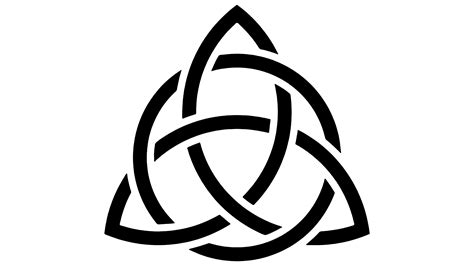
The triquetra is a geometric symbol that represents eternity, trinity and unity. It is made up of three intertwined arches, with no beginning or end. The word triquetra comes from the Latin triquætra (three points). The symbol is similar to a triskelion (a Celtic symbol that represents the three worlds: the celestial, physical and spiritual). The triquetra is used in Christianity, magic and the occult in general.
This symbol is associated with trinity concepts, such as life, death and rebirth, or earth, sea and sky. The Lily has been used in Sacred Geometry to symbolize purity, fertility, motherhood, and sexuality. The petals and stamens of the lily create an organic geometry that can be seen in mandalas. The symbol for the Lily represents the flower of the same name, placed within a triangle, with its petals extending toward three points.
Read also: The Seed of Life Meaning
The Equilateral Triangle
The most common triangle that we see appear in spiritual and sacred context is the equilateral triangle - a triangle made of three sides of equal length. Most who study the occult will quickly note that this simple symbol was adopted by the Alchemists who used it to symbolize each of the four basic elements that comprise all things within the universe. The upward triangle with its phallic point represents the masculine, the elements fire and air.
Conversely the womb shaped downward pointing triangle represents the feminine, and elements of water and earth. The upward pointed triangle also represents the ascent into the heavens, or ascension to another plane of existence and the transformation of something basic to something more. Conversely the downward pointed triangle represents a descent into earth, a grounding, or reduction of complex substances into their basic constituents. When you combine the these two basic concepts you are met with the Hexagram.
The Hexagram
A sacred symbol representing the union of the masculine and feminine and a representation of all four of the elements in one, or ether.The most common representation of the Hexagram is that of the Star of David, a symbol used to represent the Jewish faith, people, and is even found on the flag of Israel. Although the origin of this symbol goes back in time long before it was adopted by the Jewish peoples in the middle Ages when it was widely known as the Seal of Solomon, a symbol worn by King Solomon which granted him powers unlike what we consider magick today, including the ability to summon and control the Jinn, speak with animals, and control demons.
It was later adopted Alchemists and by Kabbalistic traditions for various occult meanings. Also adopted by Astrologers to represent the earth and the original planets that rotated around it. In the 19th century the Zionist movement also adopted it as their organization symbol. Some of these reasons are why many orthodox Jewish people today no longer use the Star of David to represent their faith. Later Levi, the prolific oculist and writer of the 19th Century further expounded upon the power of this symbol associating it with the concept of 'As above, so below.'
The symbol can even be found in use in Masonic symbols and writings. The symbol even appears on Moroccan coinage from the late 19th century.
Read also: Unveiling the Power of Sacred Geometry Rings
The Tetrahedron, Octahedron, & Pyramid
In the third dimension three equilateral triangles form the most basic of pyramidal shapes, the tetrahedron. Although many people are familiar with the 4 equilateral triangle set on the base of a square such as the famous Great Pyramid at Giza in Egypt. This architectural shape can be found at sacred sites all over the world. If we remember our lessons from the chapter on Platonic Solids the tetrahedron is one of the fundamental building blocks of life.
It represents the element Fire and is heavily associated with manifestation. Likewise, the octahedron, which is basically two pyramids glued together at the base, represents the element of air and is associated with integration magicks. If you overlap two tetrahedrons in a similar fashion to the hexagram the resulting geometric shape is known as the star tetrahedron, or merkaba - the vehicle of life. One of the many symbols found within Metatron's Cube.
The word Merkaba is actually composed of three separate words: Mer, which means light, Ka, which means spirit and Ba, which means Body. Together this word and symbol is the embodiment of mind, body, and spirit. The star shaped symbol is believed to be a divine vehicle made entirely of light and designed to transport or connect the spirit to the heavens. Jewish texts reveal that the word is also the Hebrew for a chariot, and one can even find the Merkaba mentioned indirectly in the Old Testament of the a total of 44 times according to some scholars.
Interestingly enough, the tetrahedron never saw much use as a shape in the ancient architecture, but half of the octahedron became on of the most instantly recognizable landmarks in the world. The pyramid. The pyramids found on the Giza Plateau are some of the most instantly recognizable architectural monuments today, and is the only remaining Seven Wonders of the World left standing today. The three pyramids including what is known as Khufu's Great Pyramid are perfectly aligned to the cardinal directions.
They align with the stars of Orion's belt, and most interestingly, they are geographically in what is considered to be the center of the world. Although in the past many academics thought the Pyramids were built as tombs of the kings of Egypt, no body or reliable inscription (Yes, Khufu's name was found in graffiti in the Great Pyramid. Yes, there is tons of reliable research that proves its from the time the pyramid opened, and no, we will not go into details here.) The Pyramids however did play a significant role in the Egyptian culture although what role and purpose they had is still shrouded in much mystery - obviously though these shapes and what they represented where important enough to build colossal monuments out of.
If you are interested in the Pyramids and their mysteries I would highly recommend the documentary The Pyramid Code that is available in North America on Netflix. Pyramids however are not localized to Egypt. They can be found on every major content in the world. Even in the United States of America right in Illinois you can find one of the largest pre-columbian earth works that is known as the Monk's Mound built in the shape of a pyramid. From the USA all the way to China you can find Pyramids overgrown with lush vegetation.
Of course, Central America is also dotted with pyramids built by the Mayan and Aztec civilizations. The one thing all these structures have in common is that they are all built as a part of some kind of temple complex and often are sites associated with archeoastronomy - the study of the use of astronomy in prehistoric sites. In modern metaphysical practices pyramids are believed to be able to cleanse and purify energy, much like a filter of sort. By sitting inside of a pyramid one can ground and center your energies and heighten your intuition and psychic abilities.
It is also thought that by placing food and herbs inside of a pyramid that their natural properties will become enhanced and more effective. Crystals also can be charged inside a pyramid structure, and one can meditate inside a pyramid to enhance their meditative practice. Many other sacred geometric shapes are comprised of the triangle, and today we have explored just a few to wet your appetite, spark your intuition, and light the proverbial flame under your ass to get out there and research and explore this topic to find what resonates for you and your own highest good.
Sacred Geometry in Yoga: Triangle Pose
Among the archetypal forms of modern yoga, few are as enduring or as evocative as the Triangle Pose and its Revolved counterpart. These asanas are not only shapes of physical discipline but also living symbols of stability, transformation, and sacred geometry. The very names of these postures are teachings in themselves. Trikoṇa is formed from tri (three) and koṇa (angle), meaning triangle, the simplest and most stable of all geometries. Āsana means seat or posture, the foundation of embodied practice. Utthita means extended, outstretched, a word that hints at the expansive reach of the limbs in classic Triangle. Parivr̥tta comes from pari (around, surrounding) and vṛt (to turn, revolve), signifying not just rotation of the torso but the alchemy of transformation.
Though they feel timeless, neither Triangle nor Revolved Triangle appear in the medieval Haṭha Yoga Pradīpikā or Gheraṇḍa Saṃhitā. These texts focus on seated forms and a handful of other postures. Standing poses such as Triangle emerge much later, shaped in the late 19th and early 20th centuries in the Mysore palace tradition under Sri T. Krishnamacharya. The illustrated Śrītattvanidhi foreshadows this development, showing over a hundred postures, though under different names and contexts. It was through Krishnamacharya’s teaching-and later, the works of B.K.S. Iyengar and K. Unlike the seated meditative shapes of haṭha’s early manuals, Triangle and its revolved partner combine inner meditative focus with strength and mobility.
Different traditions interpret the Triangle in their own ways. In Ashtanga Vinyasa Yoga, Utthita Trikoṇāsana A is the extended form, while B refers to the revolved variation, both practiced with a precise vinyasa count, dr̥ṣṭi (gazing point), and five steady breaths. Iyengar Yoga distinguishes between Utthita Trikoṇāsana and Parivr̥tta Trikoṇāsana, teaching them with props, walls, and ropes to refine alignment and therapeutic application. In Sivananda Yoga, “Trikonasana” refers instead to a side bend, taught as one of twelve core postures.
Physically, Utthita Trikoṇāsana B strengthens the legs, stretches the hamstrings and adductors, and decompresses the spine through lateral extension and rotational elongation. It expands the ribs, releases the diaphragm and encourages deeper breathing. Energetically, the two asanas awaken maṇipūra cakra, the solar plexus center of vitality and will. The expansive opening of Triangle brushes against anāhata cakra, the heart center, encouraging receptivity and openness. The revolving motion of Parivr̥tta Trikoṇāsana is traditionally described as wringing out stagnant prāṇa, like squeezing water from a cloth, leaving the channels clear and the perception sharpened.
This alchemy of steadiness and transformation must be practiced wisely. Students with sacroiliac instability, slipped discs, or acute lower back pain should be cautious, as twists can misdirect force into vulnerable areas. Pregnant practitioners are advised to avoid deep revolved variations that compress the abdomen. Those with low blood pressure may feel dizzy, and those with neck sensitivity should keep the gaze neutral instead of upward.
The essence of Triangle does not lie in depth of fold but in steadiness of foundation. A block or chair beneath the lower hand allows the posture to unfold safely without sacrificing alignment. Practicing against a wall provides feedback for the spine and protects against over-rotation. In the revolved variation, finding an appropriate positioning of the back heel helps redirect the twist into the thoracic spine instead of straining the sacrum. For those with mobility challenges, seated versions in chair yoga open the chest and extend the spine, carrying the same symbolic resonance of rooting, lengthening, and revolving.
Beyond alignment and anatomy, Triangle carries a mythic charge. The upward-pointing triangle symbolizes fire and aspiration, often associated with Śiva; the downward triangle symbolizes water and receptivity, linked with Śakti. Together, their union in the Śrī Yantra represents the cosmic balance of opposites. In Vedic ritual, the triangular altar (vedi) was the site of the sacred fire where offerings were transformed into merit. To stand in Utthita Trikoṇāsana is to embody this sacred fire altar, steady and clear. To revolve the triangle is to set that altar into motion, fanning the flame into a wheel of transformation. What was stable becomes dynamic, what was external turns inward, and what was familiar reveals its hidden side.
Begin in samasthitiḥ, steady at the front of the mat. Step the feet apart, a little less than the length of one leg, and extend the arms wide. Engage the pelvic floor and lower belly, lengthen the spine, and root through the bases of the big toes, drawing energy up through the thighs into the pelvis. For the revolved variation, turn the back foot slightly out (between 45 and 90 degrees) and align the pelvis forward. As you exhale, fold forward, aligning sternum, navel, and pubic bone toward the front knee. Place the opposite hand outside the foot or onto a block, keeping the legs steady and the spine long. With each inhale, lengthen; with each exhale, revolve. Avoid collapsing or torquing the pelvis; let the twist arise from the thoracic spine.
Taken together, Utthita and Parivr̥tta Trikoṇāsana form a sacred pair. One is the still temple of fire, rooted and clear. The other is the turning flame, restless and revelatory. Practiced with awareness, they strengthen and cleanse the body, awaken the chakras, and embody the eternal principle of yoga: steadiness amidst movement, clarity amidst change.
Each time you practice, remember to ground yourself in the main purpose and benefit of yoga: connection. The word “yoga” is derived from the Sanskrit word “yuj” which means to unite, to yoke together, to join, to connect. Mindfulness is an essential aspect of this. As we practice (either on the yoga mat, on the meditation cushion or in our daily life) we begin by observing the breath and its life-giving flow in and out. We then extend this to awareness of our movements and our body as a whole, observing how the breath affects the movements and vice versa, we can let our breath set the pace of the practice, we can coordinate the movement with the flow of the breath.
Stepping back from Mountain pose, settle into the wide stance of Triangle Pose, with the front foot pointing forward and the back foot turned at about a 45 degree angle. You can really be aware of your foundation. From this solid foundation, extend both arms out to the side, palms facing down. Close your eyes and visualize an equal sided triangle. Begin at the lower left corner of the triangle. Side 3 = exhale for 3 counts.
The Number Three and Its Symbolism
The number three comes up in occult practices, spiritual systems, religions, and esoteric traditions often. Three has often been considered a sacred number associated with many different trinities:
- Mind, Body, Spirit
- Past, Present, Future
- Maiden, Mother, Crone
- Father, Son, Holy Spirit
- Mother, Father, Child
With three playing such an important role in humanities exploration of itself its no wonder that the geometric shape of the triangle plays such an important role.
Sacred Geometry Practices to Try
So many spiritual practices can be amplified by sacred geometry. Even certain yoga poses themselves allow us to get our bodies into geometrical forms that allow for energy flow.
For a simple practice to get you started, try any of the following ideas from Mildon and Foster:
Create a crystal grid:
Gather any of your favorite crystals you want to work with, and take some time reflecting on what you're seeking. Refer to the aforementioned sacred geometry shapes for ideas such as higher consciousness, or safety.
Arrange your crystals to form the shape you want to use. A triangle would be best for elevating your consciousness, while a square would be best for security and stability. Arranging your crystals in a circle would represent oneness.
Meditate in front of your crystal grid, place it on an altar where it can regularly amplify your space, and switch it up as needed depending on what you want more of.
Do a Sri Yantra Gaze Meditation:
Place a Sri Yantra at eye level in a place you can sit quietly, comfortably, and undisturbed.
Focus your eyes on the center of the Sri Yantra.
Let your eyes slightly relax and allow the energy symbol to carry you.
Do a Pyramid Power Meditation:
Sit cross-legged with a hand rested on each knee so that you form a pyramid with your body. Take a moment to settle into this shape.
Take six deep breaths in through your nose, drawing the breath down through your spine and up through your solar plexus and heart, out through your mouth.
In your mind's eye, draw a square on the ground around you. This will form the base of your pyramid. As you do so, acknowledge the four directions, north, south, east, west, and the four elements, earth, air, fire, and water.
Set the intention that this square represents the anchor to your physical reality, which will serve to ground the higher frequencies that you are calling in. Breathe into it.
Draw (in your mind's eye) four triangles up from the base of your square to complete your pyramid. Do this by drawing a line from each corner of the square to just above your crown. The apex where these points join represents the ether.
Take another six breaths as before. Visualize a channel of white light piercing the tip of the pyramid and flowing into the space that you have created. Remember that you are made of light. Allow it to wash over you and be absorbed into your organs and every cell in your body.
Once you feel the alignment and expansion of this activation, visualize a circle within the square. Spin it first counterclockwise to discharge any stagnant or blocked energy, then spin it clockwise to charge your energy centers.