The case of the Zodiac Killer remains one of the most infamous unsolved serial killer cases in American history. Active in the San Francisco Bay Area between December 1968 and October 1969, the unidentified killer murdered at least five people and terrorized the state of California through his communications with the press and law enforcement. Besides his murders, Zodiac was known for his use of ciphers, adding another layer of complexity to the investigation.
The Zodiac attacked three couples and a cab driver in Benicia, Vallejo, unincorporated Napa County, and the city of San Francisco. Despite several theories about the Zodiac's true identity, the only suspect police named was Arthur Leigh Allen, a former elementary school teacher and convicted sex offender who died in 1992. In 2004, the San Francisco Police Department marked the case "inactive," but subsequently re-opened the case in 2006.
The Zodiac's murders, cryptograms, and letters to newspapers have made the case one of the most famous unsolved cases in American history. From 1969 to 1974, the Zodiac sent over twenty letters to newspapers, police, Chronicle writer Paul Avery, and attorney Melvin Belli.
Here's a list of dates the letters were sent:
- July 31st 1969: San Francisco Chronicle, San Francisco Examiner, and Vallejo Times.
- August 4th 1969: Examiner.
- October 13th 1969: Chronicle.
- November 8th 1969: Chronicle.
- November 9th 1969: Chronicle.
- December 20th 1969: Melvin Belli.
- April 20th 1970: Chronicle.
- April 28th 1970: Chronicle.
- June 26th 1970: Chronicle.
- July 24th 1970: Chronicle.
- July 26th 1970: Chronicle.
- October 5th 1970: Chronicle.
- October 27th 1970: Paul Avery at Chronicle.
- March 13th 1971: Los Angeles Times.
- January 29th 1974: Chronicle.
Let's delve into the details of the Zodiac's confirmed victims:
Read also: The Enigmatic Ciphers
- Betty Lou Jensen (16) and David Arthur Faraday (17): Shot on December 20, 1968, near Lake Herman Road.
- Darlene Ferrin (22) and Michael Mageau (19): Shot on July 4, 1969, at Blue Rock Springs Park in Vallejo. Mageau survived.
- Bryan Calvin Hartnell (20) and Cecelia Ann Shepard (22): Stabbed on September 27, 1969, at Lake Berryessa in Napa County. Shepard died.
- Paul Stine: A cab driver shot on October 11, 1969, in San Francisco.
Police and investigators concur The Zodiac attacked seven people on four occasions in California. Michael Renault Mageau (19) and Darlene Elizabeth Ferrin (22) were shot around midnight between July 4 and 5, 1969, in the parking lot of Blue Rock Springs Park in Vallejo. Bryan Calvin Hartnell (20) and Cecelia Ann Shepard (22) were stabbed on September 27, 1969, at Lake Berryessa in Napa County.
The First Murders: Jensen and Faraday
The first murders retroactively attributed to the Zodiac were the shootings of high school students Betty Lou Jensen (16) and David Arthur Faraday (17) on December 20, 1968. Faraday was a student at Vallejo High School, while Jensen was a student at Hogan High School. Faraday picked up Jensen, and the couple visited one of Jensen's friends.
Police determined that their assailant parked his vehicle about ten feet alongside the passenger side of Faraday's car. He fired several shots at Faraday's car as he walked around to the driver's side. None of the shots hit Faraday and Jensen. The couple scrambled to get out through the passenger door; Jensen succeeded. As Faraday was exiting, the killer shot him in the head with a .22-caliber pistol. The assailant chased Jensen as she fled, firing six shots at her back. Only one missed. Jensen was dead. Faraday was still breathing. He died at the hospital. There were no witnesses and no usable tire or foot prints. The only motive the police could deduce was a "madman" wanting to kill.
The Shooting of Ferrin and Mageau
Darlene Ferrin (22) and Michael Mageau (19) were shot shortly after midnight on July 4, 1969. Ferrin was popular in Vallejo due to her job at a local restaurant, where she met Mageau. On July 4, they went on a date despite the fact that Ferrin was married. Immediately after leaving Mageau's house, the couple noticed they were being followed by a man in a light-colored car.
Ferrin drove out of Vallejo in the direction of Lake Herman Road. Shortly before midnight, she turned her car into an empty parking lot at Blue Rock Springs Park. This was another lover's lane, located just two miles from Lake Herman Road. Ferrin either parked or stalled 70 feet from the lot entrance. Another vehicle parked about 80 feet to their left. The driver turned his headlights off and sat motionless. Mageau asked who the driver was. Ferrin told him not to worry. Five minutes later, the stranger returned, parked a few feet next to Mageau's side of the car and got out. He shone a flashlight into Ferrin's car as he approached. Assuming he was a police officer, the couple rolled down Mageau's window. Without speaking, the stranger fired a 9mm pistol into the car.
Read also: Understanding Lucifer's Role
One bullet hit Mageau in the right arm, and the other hit Ferrin in the neck. Mageau tried to leave the car, but his door handle was missing or removed. The assailant returned to his car, opened the door, and did something Mageau could not see. As Mageau struggled to exit the vehicle, the stranger shot him and Ferrin two more times each. The killer hurried into his car and drove off. Three teenagers drove into the parking lot, saw the wounded couple, and got help. Twenty minutes later, Ferrin was pronounced dead at the hospital. Mageau survived and described the attacker as a heavyset white man, around 5'8" tall. He estimated the assailant's weight as 195-200 pounds, with a large face and curly light brown hair. The killer wore dark clothes and no glasses.
Shortly after the attack, the Vallejo Police Department received a call where the caller stated: "I want to report a double murder. If you go one mile east on Columbus Parkway to the public park you will find kids in a brown car. They were shot with a 9-millimeter Luger. I also killed those kids last year."
Many have speculated that Darlene Ferrin knew her killer. Kelleher and Nuys credit the origin of the theory to Robert Graysmith's 1986 book Zodiac. Mageau gave conflicting accounts on whether Ferrin knew her killer. At the hospital, he stated he did not know the murderer. At another point, he said the assailant's name was "Richard". In Graysmith's telling, Ferrin and Mageau were chased. They only stopped when their car hit a log and stalled. Ferrin did know Betty Lou Jensen and David Faraday. She lived less than two blocks from Jensen and attended Hogan High School. She was also familiar with Lake Herman Road's status as a lover's lane.
There is a picture of Ferrin and an unknown man who closely resembles a composite sketch of the Zodiac.
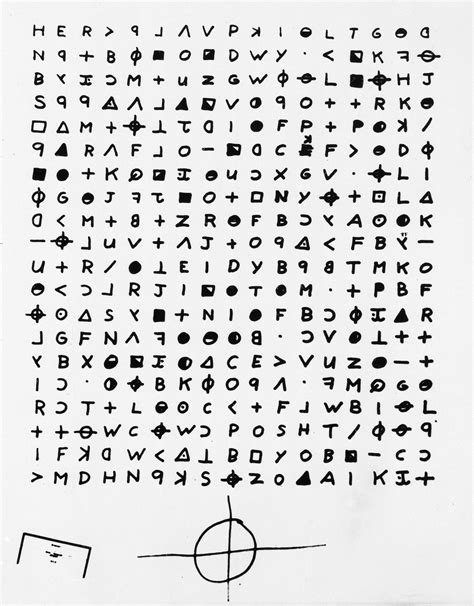
The First Cipher: Z408
On August 1, 1969, the Vallejo Times, San Francisco Chronicle and San Francisco Examiner all received letters written by someone taking credit for the attacks in Vallejo. Enclosed in all three letters was a different cryptogram. They combined to form a 408-symbol cipher (Z408). The writer claimed, "In this cipher is my idenity [sic]." He demanded the codes be printed on each newspaper's front page. If they were not, he threatened to "cruise around all weekend killing lone people in the night then move on to kill again, until I end up with a dozen people over the weekend."
Read also: The Meaning of Aries Zodiac Flowers
The Chronicle published its third of the cryptogram inside the August 2 edition. In the accompanying article, Vallejo Police Chief Jack E. Stiltz said, "We're not satisfied that the letter was written by the murderer". In this second letter to the media, the killer wrote at much greater length. He happily obliged Chief Stiltz's request for more information about both murders. He provided minute details about how he shot Michael Mageau. He described the golf course caretaker. Regarding the Lake Herman Road attack, he revealed that he had taped a flashlight to his gun in order to aim easily in the dark. The August 4 letter also referred investigators back to the Z408 cipher.
Part 1 of Z408 cipher and its decryption by Donald and Bettye Harden. The decoded message did not reveal the Zodiac's identity. Both the Federal Bureau of Investigation (FBI) and Central Intelligence Agency (CIA) attempted to decrypt the Z408 cipher. On August 5, it was cracked by Donald and Bettye Harden, a couple in Salinas. Neither was a cryptologist. The message was rife with misspellings and referred to Richard Connell's 1924 short story "The Most Dangerous Game". The Zodiac explained killing was a way of collecting slaves for his afterlife.
VPD asked a psychiatrist at the California Medical Facility in Vacaville to analyze the Zodiac's message. The doctor concluded the writer felt omnipotent based on his fantasy about collecting spiritual slaves. The analysis described the Zodiac as "someone you would expect to be brooding and isolated".
Attack at Lake Berryessa
On September 27, 1969, Pacific Union College students Bryan Hartnell (20) and Cecelia Shepard (22) were picnicking at Lake Berryessa on a small island connected by a sand spit to Twin Oak Ridge. Sometime later, Shepard noticed a man watching them. When he emerged from behind a tree, he put on a black executioner's hood with clip-on sunglasses. He wore a bib with a white 3x3" symbol on it. He brandished a gun, which Hartnell believed was a .45. Before tying up Shepard, the Zodiac made Shepard bind Hartnell with precut lengths of plastic clothesline. He tightened Hartnell's bonds because Shepard's knots were too loose. Hartnell still believed they were being robbed when the Zodiac drew a knife and stabbed them.
The Zodiac hiked 500 yards to Knoxville Road, leaving several footprints for investigators to study. After hearing the victims' screams, a fisherman and his son sought help. Hartnell untied Shepard's ropes with his teeth, and she freed him. Two park rangers arrived and tended to the stricken couple until the ambulance arrived. Napa County deputies Dave Collins and Ray Land responded to the report of the attack. Shepard was conscious and gave a detailed description of their attacker. She and Hartnell were taken to a hospital in Napa. Shepard lapsed into a coma during transport; she never regained consciousness and died two days later.
Earlier that day, a suspicious man had been seen around Lake Berryessa by several people. A dentist and his son saw a heavyset man looking at them from a distance before he hurried off. After they had arrived to sunbathe, they noticed the man again. Since they had potentially seen the Zodiac without his hood, the women worked with Napa Valley Register photographer Robert McKenzie to create a composite sketch using an Identi-Kit facial compositing device.
The Zodiac drove 27 miles from the crime scene to a car wash in downtown Napa. He told the dispatcher he wished to "report a murder - no, a double murder" and confessed to the crime. He did not hang up the phone. KVON radio reporter Pat Stanley found the phone off the hook a few minutes later. The payphone was located a few blocks from the sheriff's office.
The Murder of Paul Stine
The last confirmed Zodiac murder took place two weeks after the Lake Berryessa attacks. On October 11 in downtown San Francisco, the Zodiac hailed a cab which was driven by a doctoral student named Paul Stine. The killer gave a destination in Presidio Heights. When the taxi arrived at Washington and Maple streets, the killer asked to be driven another block. Three teenagers witnessed the crime from a house directly across the street from Stine's cab. The Zodiac's face was clearly visible by streetlight. The teenagers watched as the Zodiac wiped down the vehicle and rifled through Stine's clothes. He left behind two partial fingerprints from his right hand.
While the Zodiac was tending to the cab, the kids called the San Francisco Police Department (SFPD). They described the criminal as a "husky" white man in a "dark or black jacket". Just two minutes after the call to SFPD, two nearby patrol officers responded to the radio dispatch. They encountered a white man in dark clothes walking north towards the Presidio army base. They pulled alongside the man and asked if he had seen anything suspicious. The man confirmed he had seen someone waving a gun and heading east. The officers hurried away. The Zodiac later claimed he was the witness that spoke to the two officers.
When police arrived at the scene, Stine was declared dead. SFPD canvassed the area, including the Presidio.
October 1969 SFPD poster featuring initial sketch made from the teenagers' description (left), and one based on the officers' description of the man they encountered (right).
Police assumed the murder was a result of the robbery. The teenage witnesses helped a police artist make a composite sketch of the man they saw at Stine's cab. The two patrol officers who questioned the witness near the scene realized it may have been the Zodiac. SFPD detectives Bill Armstrong and Dave Toschi were assigned to the case. Toschi ended up working on the case by himself and filled eight filing cabinets with potential suspects. In 1976 he told the Associated Press that Zodiac's letters were an "ego game". He believed the killer lived in the San Francisco Bay Area, "He's a weekend killer. Why can't he get away Monday through Thursday? Does his job keep him close to home?
After working on the Zodiac case for seven years, Toschi started writing anonymous letters praising his own investigative work to Chronicle columnist Armistead Maupin. Two years later in 1978, Toschi was removed from the case and demoted to pawn shop detail. He expressed regret for the hoax. That same year, Maupin also received a purported Zodiac letter.
Let's Crack Zodiac - Episode 5 - The 340 Is Solved!
Ciphers and Communications
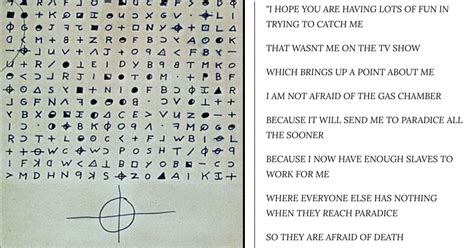
The first Zodiac cipher was solved within a week of its publication, while the second cipher was solved by the authors after 51 years, when it was discovered to be a transposition and homophonic substitution cipher with unusual qualities. Two of the Zodiac's four cryptograms were decrypted in 1969 and 2020, and the other two remain unsolved.
In a letter to the San Francisco Chronicle postmarked April 20, he wrote, "My name is-". The cryptologist Craig P. Bauer proposed the solution "Alfred E. Neuman", the mascot of humor magazine Mad. Ryan Garlick, a University of North Texas computer science and engineering professor, used the key to the Z340 to get the solution "Dr. Eat a Torpedo". Garlick believes that this is an insult directed at D. C. B. In the same letter, the Zodiac denied responsibility for the fatal bombing of an SFPD police station in Golden Gate Park. He added, "there is more glory to killing a cop than a cid because a cop can shoot back." He also included a diagram of another school bus bomb.
The 340 Cipher Solved
The first letters were sent to three papers in the Bay Area, each containing a different part of the cipher. The cipher, which was simpler than later efforts, was solved a week later by hand on August 8, 1969, by Donald Gene and Bettye June Harden.
After the first message, the killer’s ciphers became more complicated. One such cipher was the Z340. It remained unsolved for 51 years. Z340 was deciphered by an international team of private citizens on December 5, 2020.
David Oranchak, Sam Blake, and Jarl Van Eycke used software to help them break the cipher, first by finding the many possible reading directions that could be used if the cipher was transpositional. By starting in the top left hand corner, then moving down one line and across two spaces to get the next letter, a key which could be translated into letters and then words emerged. The letter “B” for instance, was represented by “?7”, “c” by a simple “9” and “A” by a whole load of symbols unavailable on a keyboard.
“Of all the things that stood out was the line ‘that wasn’t me on the TV show’,” Oranchak explained in the video. “At this point I jumped out of my chair because I knew the cipher was received on November 8, 1969, which is about two weeks after someone calling themselves Zodiac called into a TV talk show hosted by Jim Dunbar. This for Oranchak made the solution seem real, as it fit with the events around the time it was received.
In a letter to the Chronicle postmarked June 26, 1970, the killer was upset no one was wearing Zodiac buttons. He claimed, "...I punished them in another way. I shot a man sitting in a parked car with a .38." This may have been a reference to the murder of SFPD Sergeant Richard Radetich.