The Triskelion or Triskele is one of the most well-known Celtic symbols in Irish culture. This particular triple spiral symbol goes by many different names that you might recognise. These include the Triskelion, the Triskele, the Spiral Triskele, the Triple Spiral, and the Celtic Spiral Knot.
Let’s take a look at the meaning and history behind the symbol. In this article, we delve into the origin of the word "triskelion," its cultural and spiritual significance, and the varied meanings and interpretations associated with it.
The triskelion, an ancient and captivating symbol, has been adopted by diverse cultures throughout history, including the Celts and the Bretons. If you've visited Brittany or other Celtic nations, chances are you've encountered the triskelion adorning buildings, monuments, or jewelry. But do you truly grasp the history and depth of meaning behind this symbol? This article aims to offer an in-depth exploration of the triskelion, providing valuable insights into its origin, evolution, and cultural relevance.
The origins of the triple spiral date back to the Neolithic era, while the name derives from the Greek word ‘Triskeles’, meaning ‘three legs’, represented in its form. Let’s take a deeper dive into the origin of this symbol, what it means, and where it comes from.
The Triskelion is a symbol of triplicity, as it is made up of three spirals or three legs joined at the centre. This idea of ‘threes’ is central to Celtic symbolism. The Triskelion has been associated with different forms of trinities as a result. These include earth, water and sky, or life, death and rebirth, to reflect their interconnectedness.
Read also: Understanding anemia spiritually
The Celtic symbol dates back to the Neolithic area and so has an ancient origin. It is considered to be a sacred symbol representing cycles, continuity and the journey of life. Furthermore, in Celtic mythology the Triskelion has at times been associated with the triple goddess, representing the maiden, mother and crone aspects of femininity. The Triskelion is still used in Irish and celtic jewellery today. In fact, it is said to be one of the oldest symbols on earth.
The word itself derives from the Greek word ‘Triskeles’, which means ‘three legs’. The earliest recognition of the symbol dates back to Neolithic times. This is reflected in its etching at the entrance of one of the most famous ancient sites in Ireland, the 5,000-year-old Newgrange Passage Tomb in the Boyne Valley.
The Triskele is of Celtic origin and gained popularity within Celtic culture from 500 BC onwards. It is one of the most convoluted symbols to uncover as it reflects many different cultural areas around the world. Furthermore, history often changes little by little with time, which doesn’t help the confusion!
The triskelion comprises three intertwined spirals or legs converging at a central point. The term "triskelion" derives from ancient Greek, combining "tri-" meaning "three" and "skelos" meaning "leg." This symbol and its name have been embraced and adapted by various cultures over time, notably the Celts and the Bretons.
The triskelion holds a complex array of meanings. Commonly, its three spiraling branches are seen to symbolize water, earth, and fire, unifying the three Celtic realms. Some believe it signifies sky, earth, and water. Others interpret the branches as representative of the three principal gods in Celtic lore: Lug, Ogme, and Dagda. There are also associations with sleep, dream, and awakening, or the stages of life: childhood, adulthood, and old age.
Read also: Light Blue: Calmness and Healing
Furthermore, the triskelion may symbolize time: past, present, and future. Some speculate it might draw inspiration from the shamrock, although this theory isn't widely accepted.
The triskelion is a captivating symbol steeped in history, open to diverse interpretations across cultures and belief systems. The triskelion traces back over 4000 years, extensively used by the Celts in their art and culture. Its oldest depictions are found on Malta's megalithic temples from the Neolithic era and Ireland's Newgrange tomb dating back to 3200 BC.
This symbol also appeared in ancient Greece and became prominent in Celtic art during the La Tène period, spanning the 5th to 7th centuries BC. It subsequently spread to the Gothic West, reaching the Isle of Man in the 13th century and adorning coats of arms, art, and military gear across Europe and the Balkans. Its prevalence on Celtic military equipment suggests a belief in its magical protective properties.
The triskelion also intersected with Pythagorean mystical thought, where the number three symbolized perfection and harmony, alongside the golden ratio.
In the Christian context, the triskelion found its place in Celtic and Catholic art and sculpture, co-opted by both Christianity and ancient pagan beliefs as it evolved through successive migrations.
Read also: Explained: Spiritual Blessings
Today, the triskelion is closely linked with Brittany, considered one of its enduring symbols. Contemporary Bretons and tourists view it as emblematic, and it's commonly featured on Breton souvenirs. However, its substantial prominence as a Celtic symbol in Armorica appears relatively recent. During the Celtic revival of the 1970s, figures like Alan Stivell popularized the triskelion, making it inseparable from Brittany's identity. Brands, recognizing its significance, integrated it into their imagery. The "Paysan Breton" brand adopted it as an emblem, and the Lancelot brewery stamped it on bottles of their organic beer "Telenn Du."
The triskelion proliferates on merchandise like mugs, keychains, or T-shirts, and even in cuisine. While its meaning is subjective, some view it as a Breton good luck charm.
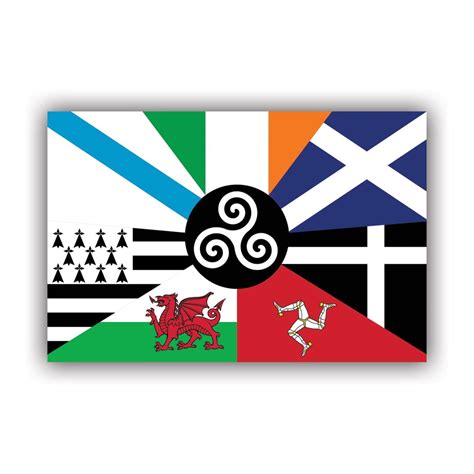
While rooted in Celtic origins, the triskelion has gained popularity in many cultures, notably in flags. Noteworthy flags include those of the Isle of Man, Sicily, and the flags representing Celtic nations.
Flags Featuring the Triskelion
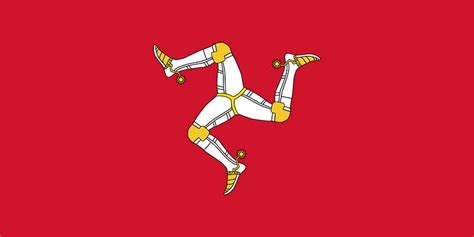
The Isle of Man Flag
The flag of the Isle of Man, or Mann flag (Manx: brattagh Vannin), prominently displays a triskelion composed of three armed legs with golden spurs on a red background. This banner became the Isle of Man's official flag in 1932, based on the island's centuries-old coat of arms. The symbol's origins remain uncertain, possibly linked to Celtic or Nordic mythology.
The Sicilian Triskelion
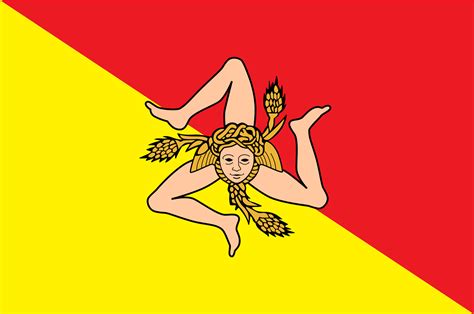
Sicily, known for its captivating history and rich culture, features the triskelion on its flag. The triskelion is an ancient motif utilized by various cultures, including the Greeks, Romans, and Celts.
Crafted in 1943 by Italian politician Andrea Finnochiaro Aprile, the flag features the Trinacria, an ancient symbol dating back to the 3rd century BC. The Trinacria, found on Syracusan coins from the 4th century BC, represents Sicily's triangular shape. Comprising three bent legs forming a triangle, it symbolizes Sicily's three capes: Peloro, Passero, and Lilibeo, framing the island's triangular perimeter. The legs belong to a female figure, metaphorically representing Sicily's stunning coastal beauty. Foliage adorning the legs signifies the island's agricultural abundance. In ancient Rome, Sicily was a major grain producer, deemed the Empire's granary.
The central Medusa's head symbolizes protection and resilience.
The Inter-Celtic Flag
The inter-Celtic flag is used by Celtic communities and enthusiasts worldwide, prominently featuring in events, both cultural and political, and in sports gatherings involving teams representing Celtic regions.
Out of the many ancient Celtic symbols, the Celtic Triskelion (also known as a ‘Triskele’ or ‘Triple Spiral’ is one of the only with such a wide variety of names. With that being said, there are currently six names that are frequently used in reference to the Celtic Triskele.
Many historians state that the Triskele, or Triple Spiral is the oldest symbol of spirituality. Ever heard the phrase "3rd times the charm"?
If you visit Boyne Valley, one of the cultural highlights in ‘Ireland’s Ancient East’, you're likely to find the Celtic Triskele symbol at the entrance of the 5,000-year-old Newgrange Passage Tomb. It dates back to the Neolithic era, and boasts true beauty in a serene location. Markings and artifacts have been located in various ancient sites, which also show us that the Celtic Triskele became popular with the Celtic culture from 500 B.C. onwards.
The Celtic Triskele was a symbol that had various meanings for the early Pagans. One of them was linked to the sun, triadic Gods, and the three domains of land, sea, and sky. For instance, the Celtic Christians used the symbol to represent the Holy Trinity.
But that's not all. Many people look for the Triskelion because they love the meaning behind it. Can the Triskelion meaning represent strength? Of course it can. Sure, the Dara Knot or the Ailm are more appropriate ancient Celtic symbols for strength.
Will the meaning behind the Triskelion change if used for a tattoo? To put it simply, the meaning behind the Triskelion doesn't change. There isn't really a straight ‘yes’ or ‘no’ answer to this question. Honestly? It really doesn't matter as long as you don't get it tattooed on your forehead!
Believe it or not, our first introduction to the magic of "three" often happens in classic fairy tales like those of the Three Little Pigs, Goldilocks, Cinderella, and many others. The Celtic Triskele was driven by a quest for a deeper meaning in life.
The triskele is an ancient symbol, and although it isn’t uniquely Irish, it features in some of the oldest artwork found on the island of Ireland. Used in Ireland for thousands of years, the elemental and enduring form of the triskele is apparent in other beloved Irish symbols like the Trinity Knot or Brigid’s Cross.
Confusion can crop up as this symbol goes by several names besides triskele! Triskelion, a Celtic Triskele, a Celtic Triskelion, a Celtic Spiral, a Triple or Tri spiral, or even a Celtic Spiral Knot are just a few of the names for this ancient symbol. Despite the many names and although the design may vary, at its simplest, the triskele is a repeating spiral, with three “limbs” that radiate out from a common center.
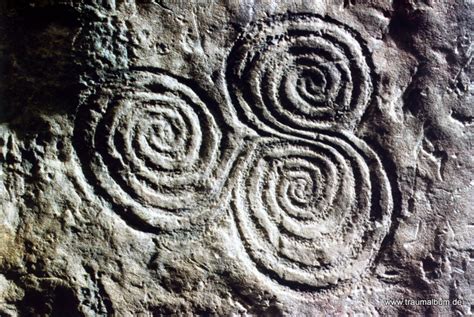
Contrary to some of the names above, the triskele is much much older than Celtic culture. The oldest surviving examples of the triskele in Ireland can be found at Neolithic wonders like Newgrange that are over 5000 years old, older than Stonehenge or the pyramids of Giza! The imposing entrance stone of this neolithic structure is famously decorated with numerous painstakingly hand carved triskeles.
It is also present at the similarly aged Cairn T at Loughcrew, an imposing structure built on the top of a hill in Co. Meath in alignment with the rising sun at the spring and autumn equinox. This design crops up thousands of years later in the 1st century BC on a nearby dolmen, and was enthusiastically adopted in Celtic La Tène' culture, adorning the Turoe Stone in Co Galway and numerous ancient monuments and artefacts. This is perhaps why many associate the symbol with the Celts - this enigmatic and enduring motif was adopted and used in a variety of ways. It adorns ancient pottery and jewelry, as well as early Christian treasures like the Book of Kells.
Given the huge expanse of time over which it was used, and the diverse applications, it is impossible that the triskele could have just one meaning!
Motion, Movement and Progress
For many, the triskele is a representation of perpetual motion or movement. This could extend to the cyclicity of life, astronomical cycles, eternity and interconnectedness. The prevalence of the triskele at Newgrange, a monument built in alignment with the rising solstice sun has led some to suggest these spirals, at least in this instance, represent solar movements.
Interconnectedness and Spirituality
Given its association with astronomical sites like Newgrange, some view the triskele as a representation of three interconnected states or realms: birth, life and death, or the earth, the heavens, and underworld. This is a theme that is shared with another beloved ancient symbol, the Trinity Knot. The three interlocking leaves of the Trinity Knot mirrors the tripartite design of the triskele, both symbols sharing overlapping meaning.
Celtic Culture
This would seem to chime with this symbol appearing in association with the Celtic God of the Sea and ruler of the Underworld in the Tuatha De Dannan, Manannán mac Lir. And this tripartite form can also be seen in the triple deities of Celtic mythology like the goddess Brigid. Indeed many pre-christian versions of the Brigid’s Cross have three legs rather than four, mirroring the form of the Triskele.
The Triskele Today
With a beautiful form and a symbolism that bends in the eye of the beholder, its not surprising to find that this 5000 year old + design, the so-called first spiritual symbol, is still popular in Ireland to this day. You will find it used in pottery and fine jewelry, even cropping up as inspiration for designs of logos and symbols for diverse organizations like the Irish Air Corps and the Heritage Council of Ireland.
The most common representation of the symbol is that it represents three, as it depicts three interlocked spirals. This is much like the ancient Celtic Trinity Knot, which also denotes three.
In Celtic culture, it is a common idea that everything important in life comes in threes. However, it is often disputed, or rather challenged, which three it actually represents. Some of the connotations include life-death-rebirth, mother-father-child, past-present-future, spirit-mind-body, and power-intellect-love, to name but a few.
The endless lines in the Celtic Triskele have no apparent ending or beginning. These worlds include the spiritual world, which is the world of our past ancestors. Then we have the present world, the present, physical world we inhabit. Finally, the celestial world, which includes the sun, the moon, the stars, and the planets.
Much like most Celtic symbols, artefacts, knots, or whatever it may be, the meaning and history can be very complex, varied, and diverse. There is simply never a simple answer!
As an ancient symbol, the Celtic Triskele appears in many places. It is used throughout popular culture, including jewellery and a Breton football club. An abstracted triskele appears on the seal of the United States Department of Transportation.
The triskelion is used as an end-of-life symbol in the Irish healthcare system.
Other Forms of the Triskelion
Buddhist symbol: In Buddhism, it is a meditation symbol.
Paganism: The Triskelion is one of the primary symbols of Celtic Reconstructionist Paganism.
tags: #triskelion #spiritual #meaning