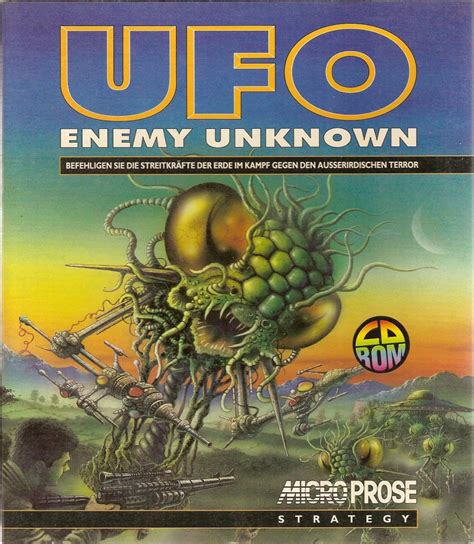
UFO: Enemy Unknown, originally released in 1994 and known as X-COM: UFO Defense in North America, is a science fiction strategy video game developed by Mythos Games and MicroProse. Published by MicroProse for DOS, Amiga computers, the Amiga CD32 console, and the PlayStation, it stands as a cornerstone in the strategy game genre and a defining title in the alien invasion theme.
Genesis and Development
The game was initially conceived by Julian Gollop as a sequel to Mythos Games' 1988 title, Laser Squad. It masterfully blends real-time management simulation with turn-based tactics. The player assumes the role of the commander of X-COM, an international paramilitary and scientific organization tasked with secretly defending Earth from an alien invasion. Through the game, the player issues orders to individual X-COM troops in a series of turn-based tactical missions.
UFO: Enemy Unknown (OpenXCom) Longplay - Part 1
Despite a development process fraught with challenges, including near-cancellations, the game garnered strong reviews and achieved commercial success. It became a sleeper hit, cultivating a dedicated cult following among strategy game enthusiasts. Numerous publications have lauded Enemy Unknown as one of the best video games ever created, with IGN ranking it as the best PC game of all time in 2007.
Story and Setting
The story of UFO: Enemy Unknown unfolds in the near future, commencing in 1998. The narrative centers on escalating reports of UFO sightings, accompanied by tales of abductions and rumors of attacks by mysterious aliens. Recognizing the growing threat, nations worldwide attempt to establish their own forces to combat the crisis, but these efforts prove futile. On December 11, 1998, representatives from the world's most powerful nations convene in Geneva to address the issue in secret.
Read also: Unveiling the Mystery of Space Aliens

Geoscape View
The game begins on January 1, 1999, with the player selecting a location for their first base on the Geoscape screen. This global view represents Earth from space, displaying X-COM bases and aircraft, detected UFOs, alien bases, and sites of alien activity. Simultaneously, the aliens undertake various activities, ranging from research missions to gather data about Earth and its inhabitants, to attacking X-COM bases, establishing their own bases, and launching terror attacks on cities to pressure governments into reducing X-COM's funding. Funding is provided by the 16 founding nations of X-COM.
Initially, the player has access only to conventional weapons, but as the game progresses, they learn more about the enemy. It is ultimately revealed that the "leaders" behind the alien invasion are a race known as Ethereals, who possess powerful mind control abilities and enslave other alien races to do their bidding. Their main base in the Solar System is located in the Cydonia region of Mars.
Gameplay Mechanics
Gameplay switches to the tactical combat phase whenever X-COM ground forces encounter aliens. Each ground mission occurs within a procedurally-generated, voxel-based 3D map, divided into square-bottom cubes and vertical layers. However, the actual game world is used internally for line of sight and firing calculations and is hidden from the player. Instead, it is presented in a symbolic form using isometric-view 2D bitmap graphics.

Battlescape View
Read also: Pop Culture Aliens
The Battlescape's turn-based system uses action points, known as Time Units (TUs), that are distributed among individual soldiers based on their statistics. Each turn, TUs can be spent on movement and actions via an icon-based GUI, such as firing weapons, managing equipment, picking up or throwing objects, kneeling down, using items, reloading weapons, and priming explosives. Shooting options include snap shots, aimed shots, and burst fire if the weapon has an autofire mode. Some weapons can also be loaded with non-standard ammunition, and some are non-lethal for capturing aliens alive.
The combat is unpredictable and challenging, especially for new players. Soldiers are vulnerable to alien attacks even when armored, and features like night-time combat, fog of war, and Opportunity Fire allow for alien sniper attacks and ambushes. The enemy comes in numerous forms, and new players will encounter new kinds of aliens without foreknowledge of their characteristics and capabilities. The course of skirmishes is also dictated by the fatigue and morale levels of participants on both sides; low morale can cause soldiers to flee or go berserk. Smoke obscures vision, and fires are a hazard for both sides.
One of three mission outcomes is possible: the human forces are eliminated, the alien forces are neutralized, or the player chooses to withdraw. The mission's score and result are based on the number of X-COM operatives lost, civilians saved or perished, aliens killed or captured, and the number and quality of alien artifacts obtained. Troops may also increase in rank or abilities if they made successful use of their primary attributes.
Instead of gaining experience points, surviving human combatants might get an automatic rise to their attributes, such as Psi or Accuracy. Soldiers killed on a mission remain dead but can be replaced with recruits back at base. Recovered alien artifacts can then be researched and possibly reproduced. Captured live aliens may produce information, potentially leading to new technologies and even access to psionic warfare. Some aliens possess mind control abilities that can be used to temporarily take control of human soldiers or cause them to panic.
Development and Release
When we first got the contract with MicroProse we were very pleased but concerned about what they might require us to do. We did have a few arguments in the beginning because they didn’t understand the game design I had written. Although supportive of the project, the publisher expressed concerns that the demo lacked a grand scale in keeping with MicroProse's hit strategy game Civilization. The Civilopedia feature of Civilization also inspired an addition of the in-game encyclopaedia, called the UFOpaedia. All that and the UFO theme was suggested by the MicroProse UK head of development Pete Moreland.
Read also: Alleged Alien Species
Julian Gollop's personal inspirations included several traditional games, in particular, the board wargame Sniper! MicroProse UK graphics artists John Reitze and Martin Smillie provided what MicroProse described as "popular 'manga' look and feel" visuals. Julian Gollop credited Reitze, who also designed the alien races, with "a distinctive comic book style", and Smillie with "very detailed environment graphics". MicroProse musician John Broomhall, inspired by Bernard Herrmann's score in the film Psycho, composed the original soundtrack of the PC version while Andrew Parton handled the sound effects.
The original contract was for the game be completed within 18 months, granting the Gollops £3,000 per month. In the course of its development, the game was nearly canceled twice: in the first instance due to the company's financial difficulties, and the second time under the pressure from the American combat flight simulator company Spectrum HoloByte after it had acquired Bill Stealey’s shares in MicroProse in 1993.
Julian Gollop said the MicroProse quality assurance team (testers Andrew Lucket, Phil McDonnel and Jason Thompson) helped save the game from its first would-be cancellation; their enthusiastic feedback also helped to polish the game. At one point, the game was officially ordered to be cancelled by Spectrum HoloByte. According to Moreland, Spectrum head Gilman Louie personally insisted on this order and rejected Moreland's objections. However, Moreland held a meeting with other MicroProse UK bosses Adrian Parr and Paul Hibbard, where they decided to ignore it and would simply not inform the Gollop brothers and others involved in the project about any of that. During the final three months, after Spectrum HoloByte was eventually informed of the game still being in production, the Gollop brothers were forced to work 7-12 in order to finish it before the end of the fiscal year.
The game was completed in March 1994, after 30 months in development since the initial contract and 12 months behind the schedule. The Amiga conversion in multiple version was quickly created by Julian Gollop's brother Nick and "it was quite tough because the Amiga wasn’t quite as fast as PCs were becoming at that time." The Amiga OCS/ECS version displays lower quality graphics than the PC version and is missing light source shading during combat missions, but their sound quality is improved. The graphics are better in the AGA Amiga versions, including a CD-ROM variant for the Amiga CD32 that features new music composed by Matthew Simmonds.
The 1995 PlayStation port, released in Europe as X-COM: Enemy Unknown, has retained most of the original PC graphics due to time restraints (adding only some textured 3D models as illustrations for the UFOpaedia) but features much higher quality music than the 8-bit MIDI music of the PC version, replacing it 55 minutes of CD-quality tracks and 8 minutes of 16-bit tracks. The new soundtrack was composed by Allister Brimble, who later also created the music for the first sequel, X-COM: Terror from the Deep.
The game was re-released as part of the compilations X-COM: Unknown Terror by MicroProse and Prima Games in 1996, X-COM (Collector's Edition) by MicroProse in 1998, X-COM Collection by Hasbro Interactive in 1999, X-COM: Complete Pack by 2K Games in 2008 and 2K Huge Games Pack in 2009, as well as in the "Classic Games Collection" CD featured with the July 2000 issue of PC Gamer.
Another novelisation of the game, Враг неизвестен ("Enemy Unknown") written by Vladimir Vasilyev, was published in Russia in 1997.
Fan-made patches fix a notorious bug which results in the game always resetting to the easiest difficulty level ("Beginner") after completing the first Battlescape mission, no matter what difficulty level has been selected. This glitch was not noticed by MicroProse and was not fixed in the official patches, resulting in the very high difficulty of the sequel due to many complaints from veteran players who believed that the original game was still too easy even on seemingly higher levels. The original release also contained many other bugs such as civilians appearing in inappropriate places, units being placed outside of the playable map area, and players being assigned alien and civilian units as playable.
Reception and Legacy
The game was released to very positive reviews and commercial success, selling more than 600,000 units (a large number at the time) on the PC DOS platform, not counting the later ports-for the Amiga platforms and the PlayStation-and re-releases. Half of the game's net sales were in the United States, a rarity for a European title at the time. Computer Gaming World rated the PC version of UFO: Enemy Unknown five stars out of five.
Amiga ports received lower ratings than the PC original, according to Amiga HOL database having averaged scores of 79% on the ECS/OCS Amigas, 82% on the AGA Amigas and 73% for the Amiga CD32 version. A common point of criticism for the floppy disk version was the need to frequently swap the disks in the Amiga systems not equipped with a hard disk drive, while the CD-ROM based CD32 version does not allow the users to save the progress of any other game without wiping out the save game of UFO.
Electronic Gaming Monthly stated of the PlayStation version that "any person who likes strategy games will fall in love with this title ... if you could afford to buy one game for the PS over the next year, X-COM would be it. It has it all and then some!" A reviewer for Next Generation criticised the PlayStation version for being little more than a straight port, arguing that the game could have been improved if the console's capabilities were used.
James V. Trunzo reviewed X-COM: UFO Defense in White Wolf Inphobia #51 (Jan., 1995), rating it a 5 out of 5 and stated that "X-Com is being blamed for broken marriages because of its addictive qualities, ballyhooed for Computer Game of the Year and praised by gamers, reviewers and even competitors. It deserves all the glory heaped upon it. Computer Gaming World gave UFO: Enemy Unknown its Game of the Year award.
PC Gamer US presented Enemy Unknown with its 1994 Best Strategy Game award. Enemy Unknown has often appeared in top video game lists by various publications.
The success of the game resulted in several sequels and spin-off games, as well as many unofficial remake and spiritual successor titles, both fan-made and commercial, such as UFO: Alien Invasion and UFO: Extraterrestrials. Julian Gollop himself designed the third game in the X-COM series, 1997's X-COM: Apocalypse, which was also developed together by Mythos Games and MicroProse.
UFO: Alien Invasion - A Spiritual Successor
Mythos Games' and Julian Gollop's own original spiritual successor project, T... UFO: Alien Invasion is a Quake II engine-based open source freeware strategy game that is effectively a direct remake of X-COM, though it adds several new mechanics, changes up many of the old ones, and adds a completely new (and really rather good) story.
The game takes a lot of inspiration from the X-COM series by Mythos and Microprose. However, it's neither a sequel nor a remake of any X-COM or other commercial title. Ancient equipment is dusted off, some of it more than a century old, and the long-defunct anti-extraterrestrial agency of the former United States - PHALANX - is resurrected under a new UN banner. Its sworn duty is to combat the alien threat, and to ensure the survival of the human race at all costs.