Despite the incredible success of Supermarionation shows like Thunderbirds, Captain Scarlet, and Stingray, Gerry Anderson was obsessed with the idea of moving into live action. Eventually, at the end of the 1960s, he moved into live action with the darker series UFO. This was the first live-action television series created by Gerry and Sylvia Anderson and produced by Century 21 Television Productions.
UFO was inspired during the making of Doppelgänger and aimed at an adult audience, showing relationship difficulties, drug use, and a rather macabre alien intention. This initially led to airing times being set at 11:00 pm. The series' premise is that in 1980, Earth is being visited by aliens from a dying planet, who are abducting humans and harvesting their organs for their own bodies. The alien incursions may also be a prelude to a possible full-scale invasion.
UFOs were becoming a more and more popular topic in the 1960s, and in the mid-1960s the first heart transplants were taking place. The timing was perfect to design and produce a brand new series concerned with Earth defending itself from aliens intent on harvesting human organs.
From Earth to the Moon | Making of UFO Documentary
Here's a look at the key personnel behind the series:
- Executive Producer: Gerry Anderson
- Producer: Reg Hill
- Production Supervisor: Norman Foster
- Directors: Gerry Anderson, David Lane, Ken Turner, Alan Perry, Ron Appleton, David Tomblin, Jeremy Summers & Cyril Frankel
- Century 21 Fashions: Sylvia Anderson
- Director of Photography: Brendan J.
The Premise of UFO
Set ten years into what was then the future (1980), a race of aliens from a dying planet make individual attacks on Earth to harvest human organs. SHADO continuously attempts to thwart the alien invasions, and their various strategies to disable SHADO; while maintaining SHADO's security, funding and maintaining operatives's general well being.
Supported by an off-world "Moonbase" and a fleet of "SkyDiver" submarines, the approaching UFOs are initially detected by an Earth-orbiting satellite, with an artificial intelligence, referred to as "SID," for Space Intruder Detector. The first attempts to stop UFOs are made in space with three Interceptors launched from Moonbase. A second attempt is made in Earth's atmosphere with a fighter plane, "Sky One," launched from SkyDiver.
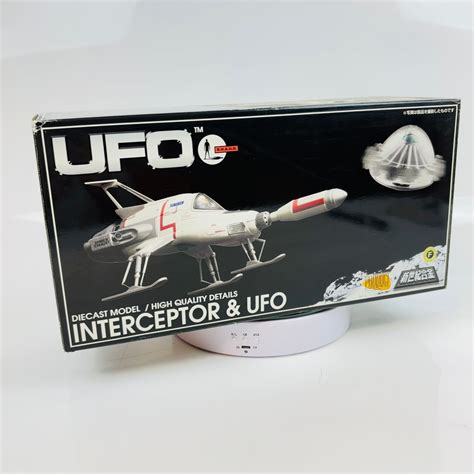
UFO Interceptor
SHADO: Supreme Headquarters Alien Defence Organisation
SHADO (Supreme Headquarters Alien Defence Organisation) is located beneath a supposed film studio in the English countryside and run by Commander Straker, who poses as a film producer.
Commander Straker's seconds in command are Col. Alec Freeman, Col. Paul Foster, and Col. Virginia Lake. Moonbase is often commanded by Lt. Dr.
SHADO has a variety of high-tech hardware and vehicles at its disposal to implement a layered defence of Earth. Early warnings of alien attack came from SID, the Space Intruder Detector, an unmanned computerised tracking satellite that constantly scans for UFO incursions. On Earth, SHADO also uses two SHADAIR aircraft, a Seagull X-ray supersonic jet (e.g., in the episode "Identified") and a transport plane (e.g., in "A Question of Priorities"); a transatlantic Lunar Carrier with a separating Lunar Module (e.g., in "Computer Affair"); a helicopter (actually, a small VTOL aeroplane with large rotating propellers (e.g., in the episode "Ordeal"); and a radio-controlled Space Dumper (e.g., in "The Long Sleep").
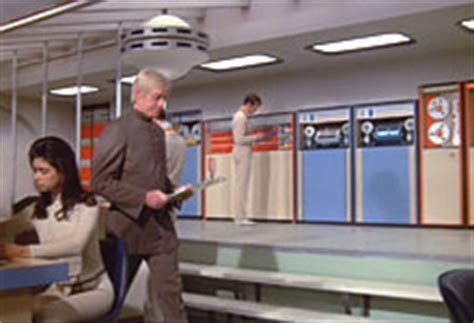
SHADO Headquarters
Key Characters
UFO had a large ensemble cast; many of its members came and went during the course of the series, with some actors leaving midway through the series, during the production break necessitated by the change of studio facilities. It is established early on that SHADO personnel rotate between positions, so the occasional disappearance of characters fits the concept of the series.
Here are some of the key characters in the series:
- Colonel Edward "Ed" Straker (Ed Bishop): Commander-in-chief of SHADO, a former American Air Force colonel, pilot and astronaut.
- Colonel Paul Foster (Michael Billington): A former test pilot who joins SHADO after his plane is damaged in a UFO encounter.
- Lieutenant Gay Ellis (Gabrielle Drake): Moonbase commander during the first half of the series.
- Colonel Alec Freeman (George Sewell): Second-in-command of SHADO.
- General James Henderson (Grant Taylor): Straker's superior officer and president of the International Astrophysical Commission.
- Colonel Virginia Lake (Wanda Ventham): Chief designer for Westbrook Electronics, the contractor for SHADO's Utronics tracking system.
- Captain Peter Carlin (Peter Gordeno): Commander of the submarine Skydiver and pilot of Sky One.
- Lieutenant Nina Barry (Dolores Mantez): Space tracker at Moonbase and later its commanding officer.
- Lieutenant Keith Ford (Keith Alexander): Founding member of SHADO and its main communications officer.
- Doctor Douglas Jackson (Vladek Sheybal): SHADO psychiatrist and science officer.
- Miss Ealand (Norma Ronald): SHADO operative who masquerades as Straker's movie studio secretary.
- Lieutenant Mark Bradley (Harry Baird): Caribbean-born interceptor pilot based on the Moon.
One of the female Moonbase operatives, Joanna, was played by Shakira Baksh, who later married Michael Caine. Interceptor pilot Steve Minto was played by Steven Berkoff.
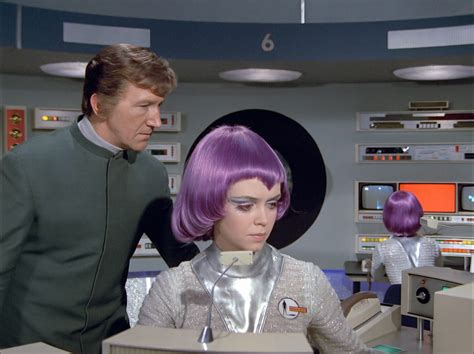
UFO SHADO Personnel
The Aliens
The alien race is never given a proper name; they are simply referred to as "the aliens". They are humanoid in appearance, and the autopsy of the first alien captured reveals that they are harvesting organs from the bodies of abducted humans to prolong their lifespans. However, the later episode "The Cat with Ten Lives" suggests that these "humanoids" are actually beings subject to alien mind control, and one "alien" body recovered was suspected of being completely Homo sapiens, "possessed" by one of the alien minds.
Their faces are stained green by the hue of a green oxygenated liquid, which is believed to cushion their lungs against the extreme acceleration of interstellar flight; this liquid is contained in their helmets. To protect their eyes, the aliens wear opaque sclera contact lenses with small pinholes for vision.
The aliens' spacecraft can readily cross the vast distances between their planet and Earth at many times the speed of light, but are too small to carry more than a few crew members. Their time on station is limited: UFOs can only survive for a couple of days in Earth's atmosphere before they deteriorate and finally explode. The UFOs can survive far longer underwater.
Production Details and Special Effects
Following lukewarm ratings for Joe 90 (1968-1969) and the cancellation of children's espionage television series The Secret Service (1969) after only 13 episodes, Lew Grade approached Gerry Anderson to look into creating his first live-action TV series. Anderson worked with his wife, Sylvia, and producer Reg Hill to create a science fiction adventure series based on UFOs. Many of the props and actors that had appeared in the Anderson-produced 1969 movie Doppelgänger were used in the series. The creators looked ten years ahead and placed the series in a 1980s future.
Establishing the main character and principal location as the chief executive of a movie studio was a cost-saving move by the producers: the Harlington-Straker Studio was the actual studio where the series was being filmed, originally the MGM-British Studios in Borehamwood (later moved to Pinewood Studios)-although the exterior of the Harlington-Straker studio office block seen throughout the series was actually Neptune House, an office building at ATV Elstree Studios, also in Borehamwood.
Principal photography commenced in April 1969 with production based at MGM-British Studios. Seventeen episodes were filmed at these studios before they closed at the end of 1969. Production resumed at Pinewood Studios when studio space became available in June 1970, making UFO a 17-month-long production by the time the final nine episodes were completed. Harry Baird, who played interceptor pilot Mark Bradley, had left the series after just four episodes, citing contractual problems.
The Andersons never explained at the time why female Moonbase personnel uniformly wore mauve or purple wigs, silver catsuits, and extensive eye make-up, and their unusual apparel is never discussed in the series. Gerry Anderson has since commented that it made them look more futuristic and that it filmed better under the bright lights, while Sylvia Anderson said she believed wigs would become accepted components of military uniforms by the 1980s.
Ed Bishop, who had naturally dark hair, initially bleached his hair for Straker's unique white-haired look. After the break in production he began wearing a white wig. Other male characters in the series also wore wigs, again because the Andersons felt that they would become fashionable by the 1980s.
Only two of the alien suits were made, so at no point in the series are more than two of the aliens seen on screen at any one time. The alien spacesuit costumes were made of red spandex. At the start of production, the alien spacesuits were ornamented with brass chain mesh, as seen in the episode "Survival". Later, this was replaced by silvery panels.
The special effects, supervised by Derek Meddings, were produced with limited resources. In a refinement of the underwater effect developed for Stingray, Meddings' team devised a disconcerting effect - a double-walled visor for the alien space helmets, which could be gradually filled from the bottom up with green-dyed water. When filmed from the appropriate angle it produced an illusion of the helmet filling up and submerging the wearer's head.
The vehicles were designed by Meddings and his assistant Mike Trim. The futuristic gull-winged cars driven by Straker and Foster were originally built for Doppelgänger. The cast found Straker's car, which was adapted from a Ford, hard to drive. The blue SHADO Jeeps - six-wheeled light-utility vehicles - were also originally supplied for Doppelgänger. The bodies were made of marine ply, fibreglass and perspex, built on a Mini Moke chassis incorporating an extra rear axle and modified by re-positioning the windscreen rearwards.
Here's a table summarizing the key people and their roles in the production:
| Role | Name |
|---|---|
| Executive Producer | Gerry Anderson |
| Producer | Reg Hill |
| Production Supervisor | Norman Foster |
| Directors | Gerry Anderson, David Lane, Ken Turner, Alan Perry, Ron Appleton, David Tomblin, Jeremy Summers & Cyril Frankel |
| Century 21 Fashions | Sylvia Anderson |
| Director of Photography | Brendan J. |
| Special Effects Supervisor | Derek Meddings |
Episode Broadcast Order
Owing to the fragmented nature of the ITV network in the UK at the time, the 26 episodes of UFO were broadcast out of production order, and every broadcaster showed the episodes in a different sequence.
The broadcast order is the premiere transmissions of each individual episode as shown around the various ITV regions, rather than the first transmission of ATV Midlands, Tyne-Tees and Border regions, who started their first transmission on September 16th 1970 (as usually listed in reference works). Previously published broadcast dates from only a single region has led to widely published statements that certain episodes (The Responsibility Seat and The Long Sleep) were not transmitted until 1973 because of their 'adult' content, yet both episodes were shown as part of Anglia's first run of the series in 1971.