Throughout history, religious symbols have been widely used in works of art to communicate messages of faith and bring the worshiper closer to God. Today, these symbols still resonate and can be found in many faith-inspired designs. Let's explore some of the most significant symbols and their meanings.
“I spent my late teens and twenties as an agnostic. I returned to the Church in 1951, not only to find a new meaning for my own life, but also to discover a vast treasure of Christian symbols which I previously ignored.
Common Christian Symbols and Their Meanings
Often the first symbols we relate to faith are the cross, angel, or Star of David; however, there are many lesser known symbols.
- Anchor: Originally, the anchor symbol was not used by seafarers, but by early Christians facing persecution by the Romans. To show their religion to other practicing Christians, they would wear anchor jewelry and even tattoo anchors on themselves. The anchor is seen as a symbol of strength and steadfastness. The source for this symbol is Hebrews 6:19, “Which hope we have as an anchor of the soul, both sure and steadfast.” Anchors are found in many inscriptions in the catacombs of Rome.
- Angel: “Angel” comes from the Greek word angelos, meaning “messenger.” Angels are spiritual beings who interact with people on earth at God's direction. They bring us news, such as the birth of Jesus, and watch over and protect us from harm. Wings are also a symbol or nod to angels as well as the evolution of the soul and spiritual mobility.
- Butterflies: Butterflies are deep and powerful representations of life. Many cultures associate the butterfly with our souls. Because the butterfly metamorphoses from a caterpillar to a chrysalis and finally becomes a butterfly, it is a strong resurrection symbol. The butterfly is viewed as representing endurance, change, hope, and life.
- Celtic Cross: The original Celtic Crosses were found throughout Ireland and Britain, where they were erected as crosses in cemeteries. Handsomely carved in local stone, and depicting various Passion scenes, the circle motif in these crosses have been said to be an emblem of eternity. The Celtic cross bears strong resemblance to the Christian cross; however, the Celtic cross motif predates Christianity by at least 3,000 years.
- Circle: The circle represents the symbol of eternity and never-ending existence. It represents the notions of totality and wholeness. It also symbolizes Heaven because of its perfect symmetry and its perfect balance. As an emblem for God, it suggests not only the perfection but the everlasting nature of God.
- Descending Dove: The Holy Spirit in the form of a dove descended upon Jesus at His baptism in the river Jordan. In Christian art, doves are used to symbolize purity, peace, and reconciliation.
- Fleur-de-lis: The fleur-de-lis means "lily" in French and is a popular symbol of the Resurrection. The three flourishing petals are also known as symbols for the Holy Trinity. The fleur-de-lis, or lily, is also a popular symbol of the Resurrection.
- Fleuree Cross: The arms of a Fleuree Cross end in three graceful petals, each resembling the fleur-de-lis. These three petals symbolize the Holy Trinity and because of this, the Fleuree Cross has been widely used on altar and pulpit vestments during the Trinity season.
- Heart: The heart symbolizes God's love, humanity, and charity. "For man looks on the outward appearance, but the Lord looks on the heart," says 1 Samuel 16:7. It is also considered to be the source of understanding, love, courage, devotion, sorrow, and joy.
- Ichthus: In Greek, the first letters of the words, "Jesus Christ, Son of God, Savior" spell Ichthus, meaning "fish". When the early Christians were persecuted, they used the Ichthus as a secret sign to identify themselves to each other. This is one of the most widely recognized symbols of Christianity.
- Latin Cross: Few other signs or symbols exist that are as widely recognized or hold as much meaning as the Latin cross. It is the form of the cross on which Christ died and is used worldwide to symbolize Christianity.
- Star of David: While there is no reference to the six-pointed Star of David in the Old Testament, the symbol did emerge as early as the 3rd Century A.D. It represents the shield of King David and is accepted by Jews worldwide as a symbol of their faith. Since Christianity has its roots in Judaism, the Star of David also has significance for many Christians.
- Infinity & Eternity: Mentioned in Christianity, Daoism, Hinduism, and many more, it seems in every faith a similar concept is found. Life is infinite. Our time on earth may be finite but our souls exist forever.
Symbols of the Holy Trinity
While examples representing many categories of Christian belief adorn the walls of tiny, ancient churches and appear on the walls of the catacombs - always for catechetical purposes - this article is devoted only to symbols illustrating belief in the Holy Trinity. A number of symbols came to be used that easily could be seen as symbolically representing this glorious dogma, if one does not press the imagery too strongly, since, in this life, it remains impossible to know God as He really is.
Jesus revealed that the One God is, at the same time, Three Divine Persons: Father, Son and Holy Spirit. Since God is Love, God must Love, and that Love is God. This concept defies precise explanation in human terms.
Read also: Interpreting Blood Dreams
Looking for an original way to express Three Divine Persons as one God, Tertullian came up with a compound word, tri-une (“three [in] one”) which he expressed as Trinity.
Here are some symbols illustrating belief in the Holy Trinity:
- The EQUILATERAL TRIANGLE: the simplest form representing the Trinity, with the name of God (I AM WHO AM) in its Hebrew form, YHWH. In art, the triangular halo is seen behind the head of God the Father when shown in human form, to denote His Tri-unity.
- The SIGN of the SPIRIT hovering over the Father’s Triangle crowned with the Cross of Christ: forms this ancient Trinity symbol known from the mid-200s.
- The TRIQUETRA: a stylized symbol dating to the early medieval era.
- THREE FISHES: is an ancient ideogram depicting high spiritual dignity, in use some 3,000 years before Christ. Early Christians saw it as a fitting symbol of the Holy Trinity, using the fish symbol of Christ. The triangle formed by the gills surrounding the single eye denotes the tri-unity of God.
- The TRIANGLE with HEMISPHERES: is composed of signs for divinity, power, fire, holiness and prosperity. Moreover, each side of the ideogram depicts a sign in Christian symbolism for the Holy Ghost.
- The TREFOIL: is a stylized form suggesting the shamrock, the little flower with which St. Patrick illustrated the Trinity in his preaching. He would hold up a shamrock, and ask if it was one leaf, or three. The answer, of course, was that it is both. Traditionally, the shamrock is said to have been used by Saint Patrick to illustrate the Christian doctrine of the Holy Trinity when Christianising Ireland in the 5th century.
- TRIANGLE within a CIRCLE: is not as common in modern ideography for the Trinity as it once was. The triangle within a circle demonstrates the eternal essence of the One God encompassing the Three Divine Persons. Before its use as a symbol for the Christian belief in the Triune Deity, this symbol represented the elements in an alchemical context.
- TRIANGLE INTERLACED with a TREFOIL: is a rare symbolic representation of God, emphasizing the divine, eternal aspect of the Holy Trinity. The same shape as the Triangle with Hemispheres with the addition of interior interlaced lines.
- The TRIQUETRA: is often seen in art, Catholics understanding the form to demonstrate the equality of the Three Divine Persons; the circle exemplifying the unity and eternal life of the One God.
- THREE FISHES arranged in a Trinitarian form: suggests the Ichthys sign used by early Christians to identify themselves to each other, as well as the miraculous multiplication of fishes.
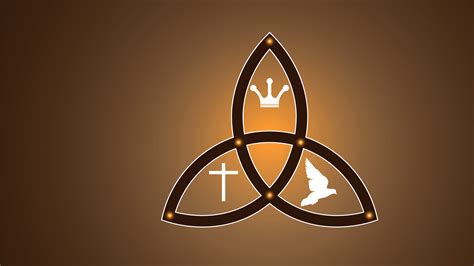
- A FORM of the TREFOIL: depicts the Father with a crown, the Son with a nail-pierced hand, and the Holy Spirit dove.
- The FLEUR DE LYS or FLOWER of the LILY: is an ancient, stylization of the lily. The symbol has also been used in Egyptian architecture and has been found in India, Babylonia and Rome. Christians found its three petals as a sign of the Blessed Trinity.
Here's a table summarizing the symbols of the Holy Trinity:
| Symbol | Description | Meaning |
|---|---|---|
| Equilateral Triangle | Simple triangle with YHWH in Hebrew | Represents the Trinity and God's name |
| Sign of the Spirit | Triangle crowned with the Cross of Christ and the Holy Spirit | Ancient Trinity symbol |
| Triquetra | Stylized symbol dating to the early medieval era | Equality of the Three Divine Persons |
| Three Fishes | Three fish forming a triangle | Tri-unity of God and the fish symbol of Christ |
| Triangle with Hemispheres | Triangle with signs for divinity, power, fire, holiness, and prosperity | Symbol for the Holy Ghost |
| Trefoil | Stylized form suggesting the shamrock | Trinity illustration by St. Patrick |
| Triangle within a Circle | Triangle inside a circle | Eternal essence of the One God encompassing the Three Divine Persons |
| Triangle Interlaced with a Trefoil | Triangle with interior interlaced lines | Divine, eternal aspect of the Holy Trinity |
| Three Fishes (Trinitarian Form) | Three fishes arranged in a Trinitarian form | Ichthys sign used by early Christians |
| Trefoil Depiction | Father with a crown, Son with a nail-pierced hand, and Holy Spirit dove | Representation of the Father, Son, and Holy Spirit |
| Fleur de Lys | Stylization of the lily | Sign of the Blessed Trinity |
Other Notable Christian Symbols
- Alpha and Omega: In Revelation, Jesus called Himself the Alpha and the Omega, meaning He existed before anything else and will exist after all else ceases. He is the First and the Last, the Beginning and the End.
- Dove: The dove is a widely recognized symbol of peace, but within Christianity, it also represents the Holy Spirit.
- Lamb of God: The Lamb of God represents both sacrifice and victory.
- Trinity Knot (Triquetra): The Trinity Knot, or Triquetra, is a symbol that captures the mystery of the Christian doctrine of the Trinity-God as Father, Son, and Holy Spirit.
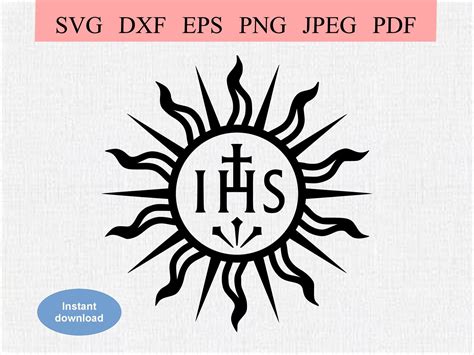
- IHS: The three letters “IHS” are an abbreviation for Jesus’ name in Greek.
- Jerusalem Cross: The Jerusalem Cross is more than a symbol; it’s a story of courage, pilgrimage, and the spread of the Gospel. With its large central cross and four smaller crosses, it represents Christ’s passion and the expansion of Christianity across the globe.
- Chi Rho: Simple yet powerful, the Chi Rho combines the first two Greek letters of “Christos” and serves as one of the earliest Christian symbols.
Christian Symbols - Volume 1
These Christian symbols are more than just visual representations-they are profound reminders of God’s presence, Christ’s sacrifice, and the eternal nature of faith.
Read also: Decoding Common Dreams
Read also: Understanding Mercy as a Gift