Among the 88 constellations recognized by the International Astronomical Union (IAU), Virgo stands out due to its historical significance, rich array of celestial bodies, and connection to the zodiac. This article explores the location, main characteristics, significant stars, deep-sky objects, and how to observe this fascinating constellation.
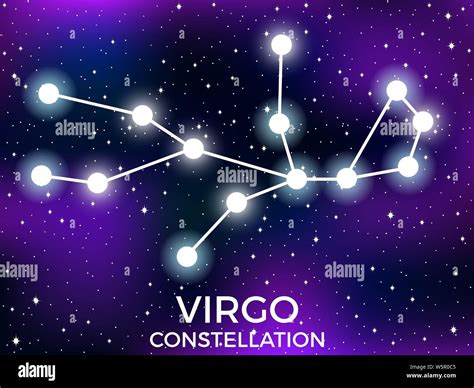
Historical Overview
The Virgo constellation has a long history in human culture and mythology, dating back to ancient civilizations. In Greek mythology, it is often associated with Demeter, the goddess of harvest, or her daughter Persephone, the goddess of spring. In Roman mythology, Virgo is linked to Astraea, the virgin goddess of Justice. The constellation is also linked to the myth of Demeter, the harvest goddess, and her daughter Persephone.
According to the myth, it once was always springtime on Earth. But then the god of the underworld, Hades, kidnapped Persephone. Demeter, overcome with grief, abandoned her role as an Earth goddess, and the world’s fruitfulness and fertility suffered. So Zeus insisted that Hades return Persephone to Demeter, but set a condition: Persephone must not eat until she returned to her home. That’s when Hades gave Persephone a pomegranate. So Persephone returned to her mother, but because of the pomegranate, she has to return to the underworld for six months every year.
To this day, spring returns to the Northern Hemisphere when Persephone reunites with Demeter. Then the winter season reigns when Persephone dwells in the underworld. Considering this, from the perspective of the Northern Hemisphere, Virgo is absent from early evening sky in late autumn, winter and early spring. In the Babylonian MUL.APIN (c. 10th century BC), part of this constellation was known as "The Furrow", representing the goddess Shala and her ear of grain.
One star in this constellation, Spica, retains this tradition as it is Latin for "ear of grain", one of the major products of the Mesopotamian furrow. The constellation of Virgo in Hipparchus corresponds to two Babylonian constellations: the "Furrow" in the eastern sector of Virgo and the "Frond of Erua" in the western sector.
Read also: Unveiling Skinwalker Ranch: How to Watch
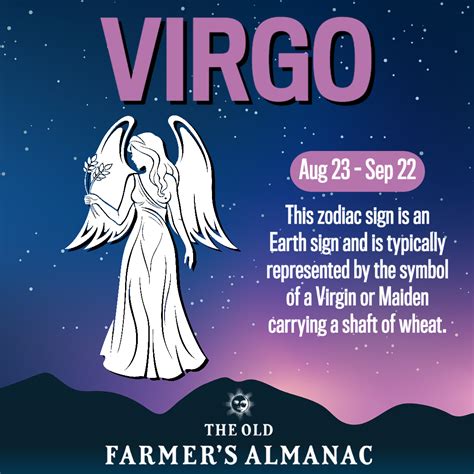
Virgo (virgin), watercolor and ink on paper, from a manuscript created in Ulm or Augsburg, Germany, c. 1464; in the J. Paul Getty Museum, Los Angeles.
Location and Main Characteristics
Virgo is located in the third quadrant of the southern hemisphere (SQ3), yet it is observable in both hemispheres. It's surrounded by the constellations Boötes, Coma Berenices, Corvus, Crater, Hydra, Leo, Libra, and Serpens Caput. Being the second-largest constellation in the sky, it covers an impressive area of 1294 square degrees.
Virgo is an equatorial constellation, which means its bulk intersects the celestial equator or comes within 10-15 degrees of doing so. Virgo is visible from most places on Earth. The best time to observe Virgo is during culmination in May. From the Northern Hemisphere, Virgo the Maiden appears high above the southern horizon on May evenings. And this is the best time of year to view this constellation, which is the largest constellation of the zodiac.
As the largest zodiac constellation, the Sun takes 44 days to pass through it, longer than any other. From 1990 and until 2062, this will take place from September 16 to October 30. Due to the effects of precession, the autumn equinox point lies within the boundaries of Virgo very close to β Virginis. This is one of the two points in the sky where the celestial equator crosses the ecliptic (the other being the vernal equinox point in the constellation of Pisces).
The constellation Virgo the Maiden is easy to find by using the handle of the Big Dipper to arc to Arcturus in Boötes, then speeding on (or spiking down) to Spica, Virgo’s brightest star. So, to find Virgo, remember this handy mnemonic device: Arc to Arcturus and speed on (spike) to Spica. What does that mean? Using the readily identifiable Big Dipper, you can follow the curve of its handle as you arc to a bright orangish star named Arcturus in the constellation Boötes. First, follow the curve in the Big Dipper’s handle to the bright orange star Arcturus. Then extend that line to Spica. To be sure you’ve found Spica, look for a lopsided square pattern nearby: that’s Corvus the Crow.
Read also: Unveiling Skinwalker Invasion
Key Facts about Virgo:
- Pronunciation: VER-go
- Meaning: Virgin
- Genitive: Virginis
- Abbreviation: Vir
- Constellation Family: Zodiacal
- Hemisphere: Southern
- Quadrant: SQ3
- Visibility: 80° N - 80° S
- Best viewing month*: May
- Area: 1294 sq. deg.
* Constellation shown for northern hemisphere skies. For the southern hemisphere, constellations appear rotated 180 degrees (upside-down and left-right reversed) from what is shown.
Significant Stars in Virgo
Ориентация на звездном небе. Как можно ориентироваться по звездам?
Spica, Alpha Virginis, is the brightest star in the constellation Virgo, and the 15th brightest star in the night sky. Spica, which marks a bundle of wheat that the Maiden is holding, is the 15th brightest star in the sky. It's a spectroscopic binary and rotates rapidly, with a period of four days. The primary star is a blue giant, about 2,300 times more luminous than our Sun.
Then the next brightest star in Virgo is the binary star Gamma Virginis, or Porrima. Porrima is magnitude 2.74 and lies near the center of the constellation, above (northwest of) Spica. It lies 38 light-years away. Next, the 3rd brightest star is at the northern reaches of the constellation. Besides Spica, other bright stars in Virgo include β Virginis (Zavijava), γ Virginis (Porrima), δ Virginis (Auva) and ε Virginis (Vindemiatrix).
Read also: "Poltergeist" House Legacy
Virgo is also home to many other bright stars, including Porrima (Gamma Virginis), a binary star system that was named after an ancient Roman goddess, and Zavijava (Beta Virginis), a spectral class F9 V yellow-white dwarf located relatively close to our solar system, only 35.65 light-years away.
The 7 main stars of Virgo form 2 distinct star patterns: Beta, Gamma, Delta, Epsilon and Eta Virginis; form an asterism known as "The Bowl of Virgo". SS Virginis is a variable star with a noticeable red color.
Deep-Sky Objects in Virgo
Virgo is famous for its thousands of galaxies. Virgo is most renowned for the Virgo Cluster, a massive galaxy cluster that contains up to 2,000 galaxies. This makes it a treasure trove for amateur and professional astronomers alike. One grouping - the Virgo Cluster - is near the border with Coma Berenices, west of Vindemiatrix. The Virgo Cluster is the nearest large group of galaxies to the Milky Way. The Virgo Cluster lies at the center of the Local Supercluster, a massive group containing clusters of galaxies. Additionally, the gravitational pull from the Virgo Cluster in the Local Supercluster is slowing the escape velocity of the Milky Way and our Local Group. So the Virgo cluster is one of the few places in the universe we are speeding toward. Therefore, the galaxies in the Virgo Cluster are some of the few we see with a blueshift instead of a redshift.
In fact, the galaxy with one of the highest blueshifts lies right on the border of Virgo and Coma Berenices. This galaxy, M90, is moving rapidly among the other objects in the Virgo Cluster. That’s because it’s also being stripped of gas and dust due to its close quarters with the other galaxies. In addition, other galaxies between 8th and 9th magnitude in this location are M49, M58, M59, M60, M84, M86, M87, and M89.
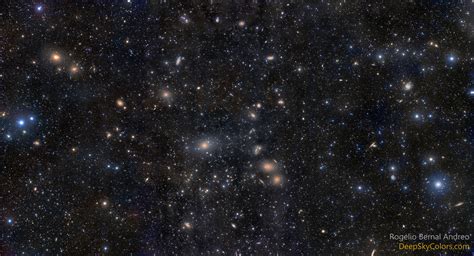
The Virgo Cluster.
M87 is a special galaxy that deserves to be singled out from the Virgo Cluster. It shines at magnitude 8.6 and is therefore easy to detect in any telescope and even in some binoculars. M87 lies about 60 million light-years away. Its potato-shaped clump of stars extends well over half a million light-years across. Additionally, it is thought to be five times the size of the Milky Way’s diameter. However, the diameter of the galaxy’s halo is about a million light-years, and while that is large, astronomers expected it to be even larger. In fact, M87 is home to the largest known number of globular clusters. For comparison, the Milky Way has about 200 globulars, while M87 has thousands. Another amazing feature of M87 is its jet that extends outward from the core for thousands of light-years. A monster black hole at the galaxy’s core is the source of the jet. In fact, M87’s black hole was the 1st ever imaged, in 2019. Then, recently that image was enhanced and released with more detail in April 2023.
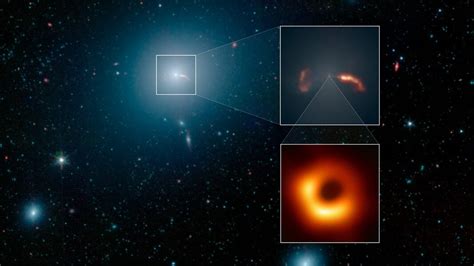
An optical light image of the jet erupting from the black hole at the core of galaxy Messier 87 (M87 or NGC 4486). The Hubble Space Telescope took this image on July 6, 2000.
Not to be overlooked is another bright and notable galaxy that’s apart from the large cluster: M104, or the Sombrero Galaxy. It’s located on the southeastern border of the constellation with Corvus the Crow. Without a doubt, M104 is a stunning galaxy in photographs. Even better, at magnitude 8.3, you can see it in small telescopes. It’s an edge-on, dusty spiral galaxy with a bright core.
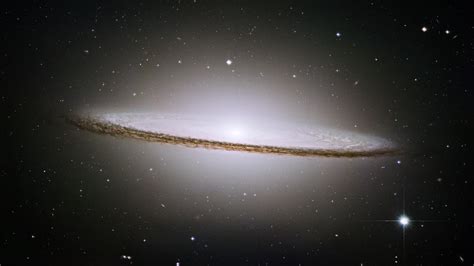
M104, or the Sombrero Galaxy, lies in the constellation Virgo the Maiden.
Notable Galaxies in Virgo:
- Messier 49 (elliptical)
- Messier 58 (spiral)
- Messier 59 (elliptical)
- Messier 60 (elliptical)
- Messier 61 (spiral)
- Messier 84 (lenticular)
- Messier 86 (lenticular)
- Messier 87 (elliptical and a famous radio source)
- Messier 89 (elliptical)
- Messier 90 (spiral)
- Sombrero Galaxy (M104) - an unusual spiral galaxy.
Observation
Since Virgo is one of the zodiac constellations, it's relatively easy to locate in the sky. In the Northern Hemisphere, it's best seen in the late spring and early summer. For those in the Southern Hemisphere, Virgo is best observed in autumn and early winter.
The best way to locate Virgo is by finding its brightest star, Spica. An easy method is to follow the arc of the Big Dipper's handle until you reach a bright blue-white star - that's Spica. The broad and scattered pattern of Virgo's stars can make the constellation slightly challenging to identify, but Spica's brightness serves as a useful guide.
Spanning a large area of the sky, Virgo the Maiden is more than just a zodiac constellation. Its historical significance, coupled with the wealth of celestial bodies it contains, makes Virgo a fascinating constellation for both astronomers and stargazers.
tags: #where #is #constellation #virgo