The majestic Golden Eagle, named for the shining feathers on the back of its head and neck, inspires awe in people around the world. Mankind has been fascinated by the golden eagle as early as the beginning of recorded history. Most early-recorded cultures regarded the golden eagle with reverence.
The Golden Eagle is a huge, dark-brown raptor named for the gleaming wash of gold on its face, crown, and neck. This impressive raptor is larger than a Turkey Vulture, with a wingspan ranging from 6 to over 7 feet. In flight, an adult Golden Eagle shows grayish-brown at the base of the tail and flight feathers and dark brown wing coverts and underside. Its legs are feathered all the way down to the yellow feet. Juveniles have a distinctive white-based tail with a dark tip as well as white patches under (and sometimes atop) the wings, most visible in flight.
The Golden Eagle is a formidable predator, able to take down animals as large as wild and domestic goat kids and calves and birds as large as Sandhill Cranes. Golden Eagles employ a variety of hunting methods, sighting prey from a perch, stooping on it from high in the air, or “contour-hunting” - cruising low over hills and ridge tops to sneak up on prey. The Golden Eagle feeds primarily on small mammals, including rabbits, hares, ground squirrels, marmots, and prairie dogs. It may take prey as large as coyotes, foxes, and badgers, and also hunts large birds such as sage-grouse, Wild Turkey, and cranes.
Golden Eagles begin to breed at approximately five years old, forming monogamous pairs that may remain together for multiple seasons, with the bond sometimes persisting year-round. The Golden Eagle’s huge platform nest is built of sticks, lined with smaller branches, soft grasses, lichens, and animal hair. The eagle pair sometimes incorporates unconventional materials like bones, shed antlers, wire, and bits of fence post into their nest.
The female Golden Eagle lays a clutch of one to three brown-speckled white eggs at intervals of three to five days. The downy eagle chicks hatch in the order they were laid (known as asynchronous hatching), leading to a discrepancy in size and parental attention, with the bigger, stronger chicks getting the most food and care. Both parents bring food to the nest; at first, the female tears it into small pieces for the chicks, but they grow quickly and are soon able to feed themselves. Golden Eagle chicks, juveniles, and adults have a wide repertoire of calls that appear to vary in purpose according to the birds’ ages.
Read also: Panthers vs. Golden Knights: Stanley Cup
It is sad to say that it is starting to disappear to some densely populated area. This creature uses its speed and dexterity to catch different types of prey, their diet may include rabbit, squirrels and sometimes even mid sized mammals like fox. Golden Eagle plays a significant role to different cultures; it is regarded as a sacred bird to Native Americans and the ancient tribes in Canada. Their feather is often an item of ornament worn by some Native Americans.
Consequently this creature is the most regular national animal in the world with over 5 nations that regard this animal as their national symbol. The Golden Eagle is also the most popular symbol of the Roman Legions. The Arabs has also their share of high respect to this bird. Golden Eagle is also a sign of supremacy. People who have this animal as their totem often excels on what they do, a part of that reason is because of their abilities, but their perseverance is playing a great role on that success. This animal has the impeccable ability to triumph over tough challenges in life. They don’t need to exhort much effort; they can do it with a breeze. They also possess immaculate eyesight, giving them a flawless ability to observe their surroundings and use it to their gain, a trait that all humans should follow.
Golden Eagles are often depicted as a messenger of the heavenly gods. When you saw a Golden Eagle, it probably wants to teach you that the answers you are waiting for can be found if you’ll only ask. There is also a chance that you are the only one who has the answer to your question, you are just afraid to find out. Questions must always be answer no matter what outcome it will bring to us.
Only after the Industrial Revolution, when sport-hunting became widespread and commercial stock farming became internationally common, did humans start to widely regard golden eagles as a threat to their livelihoods. This period also brought about the firearm and industrialized poisons, which made it easy for humans to kill the evasive and powerful birds.
Golden Eagle as a National Symbol
The golden eagle is the most common national animal in the world, with five nations-Albania, Germany, Austria, Mexico and Kazakhstan-making it the national animal. It is also a common motif in the national symbols of countries that have not officially made it the national animal or national bird. The reasons for this are various, but among the nations that use the golden eagle as or in a state symbol, there are two clear traditions that help explain the modern usage.
Read also: The Eagle Totem
Among European countries, the golden eagle was the model for the aquila, the most prominent symbol of the Roman legions and more generally the Roman civilization that had such a powerful impact on Western culture; furthermore, some classical Roman traditions were carried on by the Eastern Roman Empire in the Southern and Eastern of Europe and the Holy Roman Empire in Central and Western Europe, transmitting the use of the golden eagle to several modern states.
This association of the golden eagle with Rome has also led to the adoption of similar symbols in other countries; for instance, the adoption of the related and physically similar bald eagle as the national bird of the United States was inspired by the conception of the United States as a modern reincarnation of the Roman Republic, a theme that recurs in other elements as well (including the prevalence of neoclassical architecture in American public buildings and the use of Roman terminology-such as naming the upper house of Congress the Senate-to hark back to the Roman model).
Another large tradition of using the golden eagle can be found in the Arab world, where the eagle is historically a symbol of power in Arabic poetry, and was according to legend the personal emblem of Saladin. The specific depiction of golden eagle legendarily considered to be Saladin's was adopted by the Arab nationalist movement, and currently appears on the arms of Egypt, Iraq, and Palestine; it had previously appeared on the arms of the People's Democratic Republic of Yemen (1967-1990) and on the arms of the Libyan Arab Republic (1970-1972).
Adolf Hitler used a golden eagle regularly as a symbol for the Nazi Party, including large monuments or statues on buildings and bridges as well as the pins worn on lapels of Nazi officers.
The national animal of Kazakhstan is the golden eagle (Aquila Chrysaetos). The golden eagle is revered! People here love the golden eagle so much, and respect it, too. It represents the country's strength, independence, freedom and flight into the future. For centuries, this eagle was incorporated into the flags of Kazakh tribes. The golden eagle symbol carries meaning in the local culture, too.
Read also: Understanding anemia spiritually
For more than one thousand years, eagle hunting has been a part of Kazakh culture. Eagle hunters are called berkutchi (Russian: беркутчи, Kazakh: бүркітші). They capture golden eagles young, often from the nest. They train them over the course of several years.
Berkutchi typically hunt foxes on horseback. The eagle swoops down on the fox and clamps the fox's mouth shut with its talons. In the old days, eagle hunting was an important way for people to get meat and fur for the winter. Today, eagle hunting has become less popular. Now, eagle hunting is mostly done for cultural preservation and tourists.

The Golden Eagle is the National Symbol of several countries. L-R: Symbols of Germany, Mexico, and Egypt
Golden Eagle in Ancient Cultures
In ancient Rome, the eagle, or aquila, was the standard of a Roman legion. Each legion carried one eagle. The importance of keeping the eagle standard safe was of highest importance. The eagle was associated with the god Jupiter; the thunderbolt and the eagle being sculpted on Jupiter’s shield.

In ancient Rome, an infantry unit was divided into legions. A standard bearer carried before the legion a staff with a symbol to lead the troops into battle. The most famous was the aquila, or eagle.
In ancient Greece, the Aetos Dios was a huge golden eagle - thought to be the companion of Zeus as well as his personal messenger. Aristotle, a famous Greek philosopher & scientist, said that the eagle “flies high in order to see over the greatest area” and that men called it divine because of this.
Ancient Germanic tribes associated the Golden Eagle with Odin. In Norse mythology, Oden was a god of war and death, a sky god, and the god of wisdom and poetry. The eagle, considered to be the greatest of all birds, was held sacred to Odin. In Norse tradition, the eagle’s cry signified the birth of a heroic soul. Lleu rises in the form of an eagle.
In Aztec religion, eagles are associated with the god Huitzilopochtli.
Golden Eagle in Judeo-Christian Tradition
Judeo-Christian scriptures praise the eagle with this quote from Isaiah 40:31: “But those who hope in the Lord will renew their strength. Eagles are often prominent in The Bible, though are sometimes mixed with carrion birds and are not specifically identifiable to species. As the most widespread eagle in the Middle East and Eurasia, certainly many said references must pertain to the golden eagle. The use of eagles seems generally heavier in the Torah or the Old Testament than in the New Testament.
Golden Eagle in Native American Culture
Most all Native American Indian Peoples attach special significance to the Eagle and its feathers. Images of eagles and their feathers are used on many tribal logos as symbols of the Native American Indian. Both Bald and Golden Eagles (and their feathers) are highly revered and considered sacred within American Indian traditions, culture and religion. They are honored with great care and shown the deepest respect. They represent honesty, truth, majesty, strength, courage, wisdom, power and freedom.
According to traditional American Indian beliefs, the Creator made all the birds of the sky when the World was new. The Eagle flies higher and sees better than any other bird. Therefore, its perspective is different from other creations that are held close to the Earth, and it is closer to the Creator. The Creator also has a different perspective of what occurs below in this world of physical things in which humankind resides. The Eagle is considered to be a messenger to God.
It was given the honor of carrying the prayers of man between the World of Earth and the World of Spirit, where the Creator and grandfathers reside. To wear or hold an Eagle feather causes the Creator to take immediate notice. When one receives an Eagle feather, that person is being acknowledged with gratitude, love and ultimate respect. The keeper of an Eagle feather makes a little home where the feather will be kept safely and protected. Eagle feathers are never to be abused, shown disrespect, dropped or contaminated.
Many dancers use Eagle feathers as part of their dance regalia. The Creek and Cherokee have an Eagle Dance. If for any reason an eagle feather is dropped, it needs to be cleansed. Eagle feathers were awarded to Indian Braves, warriors and Chieftains for extreme acts of valor and bravery. Regardless of where or how an Indian Brave accumulated Eagle feathers, he was not allowed, according to Tribal Law, to wear them until he won them by a brave deed. He had to appear before the Tribal Council and tell or reenact his exploit. An Indian would rather part with his horse or tepee, than to lose his Eagle feathers. To do so would be dishonor in the eyes of his Tribe.
Many of the old American Indian Chiefs had won enough honors to wear a double-trailed bonnet that dragged the ground. During the “Four Sacred Rituals”, American Indians wear or hold Eagle feathers.
Under normal circumstances, it is illegal to use, sell or possess Eagle feathers. and Canadian law, a permit is required from official governmental conservation authorities of anyone to possess an Eagle feather legally.
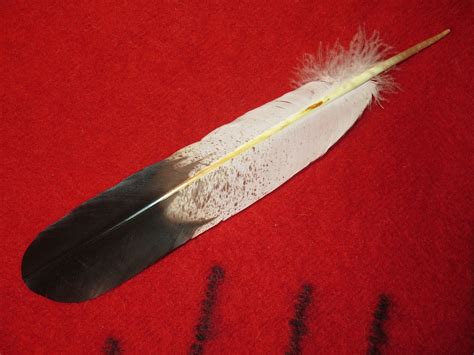
Native Americans considered the eagle to be a messenger of the Gods. Of all the feathers, the Golden Eagle feather was the most coveted.
Golden Eagle and Falconry
Golden eagles can be trained to be highly effective falconry birds, though their size, strength, and aggressiveness require careful handling to control the risk of injury to the falconer. They have been used in this practice at least since the Middle Ages. In Asia, they were reportedly used in teams to hunt such animals as deer, antelope and wolves.
Concurrently in Europe, their use for falconry was typically reserved for emperors and kings, which is why the common names for the golden eagle in various European languages roughly translate as the “royal eagle”. In the United States falconers seldom use golden eagles, as the similarly aggressive Ferruginous hawk is more available and provides a similar hunting experience with most of the same game species with lower risk of injury to the falconer.
The most common interaction of American falconers with golden eagles is in trying to avoid them in order to reduce golden eagle attacks on their trained birds. The very athletic golden eagle is approximately as swift as the large falcons, is quite willing to attack smaller raptors when the opportunity is available, and is often capable of flying down a falcon or hawk.
The culture in which falconry with golden eagles is prominent today is amongst the Kyrgyz people of the Tien Shan Mountains of southeastern Kazakhstan and Kyrgyzstan. This practice is also culturally prominent in western Mongolia and Xinjiang. There are around 250 active eagle hunters in Bayan-Ölgii Province of Mongolia, and 50 in Kazakhstan.
In these cultures, the golden eagle is considered a highly valued working animal which will be used for 15 years or more. Falconers carry their bird on a gloved right hand, usually with a wooden brace to support its considerable weight. In the Tien Shan Mountains, falconry mostly occurs in late fall and early winter.
Full-grown wolves are not believed to be viable prey for wild golden eagles; they are too dangerous due to their large size and large, powerful bite. Despite this, falconers occasionally use golden eagles to hunt wolves.
Here is a table summarizing the national animal status of the Golden Eagle in various countries:
| Country | Status |
|---|---|
| Albania | National Animal |
| Germany | National Animal |
| Austria | National Animal |
| Mexico | National Animal |
| Kazakhstan | National Animal |