In the captivating realm of astrology, each zodiac sign is imbued with a unique energy and symbolism that offers profound insights into an individual's personality, strengths, and life path. Amidst this cosmic tapestry, the sign of Sagittarius stands out as a beacon of adventure, wisdom, and the unquenchable thirst for knowledge.
Sagittarius (♐︎; Ancient Greek: Τοξότης, romanized: Toxótēs, Latin for "archer") is the ninth astrological sign, which is associated with the constellation Sagittarius and spans 240-270th degrees of the zodiac. It is the zodiac sign for people born between November 22 and December 21.
Let's delve into the mythology, characteristics, and astronomical significance of Sagittarius, uncovering the secrets of this fascinating sign.
Mythology and Symbolism
The story of Sagittarius originates from Greek mythology, specifically that of Chiron, an immortal centaur who acted as teacher to many ancient Greek heroes. Sagittarius, the half human and half horse, is the centaur of mythology, the learned healer whose higher intelligence forms a bridge between Earth and Heaven.
The centaur symbolizes Sagittarius, blending human and animal traits. This mix shows how Sagittarius people combine thinking and wild nature. It’s seen in their adventurous and philosophical tendencies. The centaur is part human, part horse.
Read also: The Mythology of Libra
In Greek mythology, the centaur Chiron stands out as a revered figure, a wise and benevolent mentor who imparted his knowledge to legendary heroes such as Achilles and Jason. Chiron's role as a teacher and healer reflects the Sagittarian's own thirst for understanding and their desire to share their wisdom with the world.
However, the centaur archetype also encompasses the more unruly and impulsive aspects of Sagittarius. The wild centaurs, known for their unrestrained passions and reckless behavior, mirror the Sagittarian's tendency towards impulsivity and the occasional disregard for social conventions.
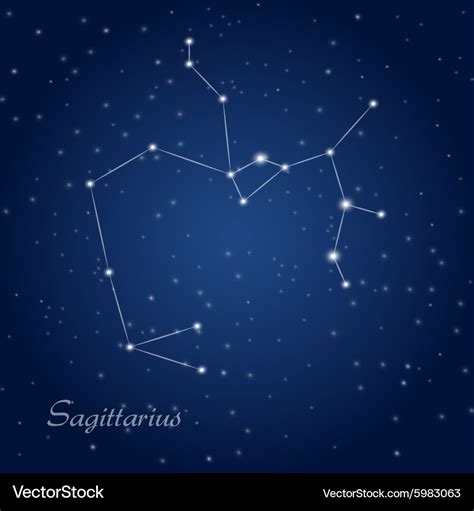
Sagittarius Constellation Map
A symbolic representation of Sagittarius published in Uranographia by Johann Elert Bode.
Sagittarius’ myths make it more than just stars. They are stories that make us wonder about the night sky.
Read also: The Most Disturbing UFO Movies
Other Mythological Connections
- Sumerian myths connect Sagittarius to Nergal, a war god of the underworld.
- Babylonians saw Sagittarius as a god with two heads and wings.
- Crotus, a Greek figure, connects to Sagittarius in Sumerian myths too.
Sagittarius Characteristics
Sagittarians love learning and the world. They are adventurous and love to travel. They are also very positive and enjoy learning about new cultures.
Personality-wise, Saggitarius people are typically friendly, gregarious, and open-minded. They enjoy being around others, and they thrive in social situations where they can learn something new or share their own knowledge with others.
Sagittarius is ruled by Jupiter, which is linked to knowledge and growth. This shows why Sagittarians are always eager to learn and explore.
Sagittarians are eternal students, constantly seeking to know more about the world. Not surprisingly, those born under the sign of the centaur are particularly interested in nature and in animals.
Spirit Animals of Sagittarius
While the centaur may be the most iconic Sagittarius spirit animal, the horse is widely recognized as a powerful totem that resonates deeply with the sign's core traits. Sagittarians, like the horse, are driven by an innate wanderlust that compels them to seek out new experiences and challenge the boundaries of their known world.
Read also: Key Figures in Metaphysical Poetry
Just as the horse possesses a formidable physical strength and resilience, Sagittarians are known for their ability to overcome obstacles and persevere in the face of adversity. The horse's fierce independence and unwillingness to be tamed mirrors the Sagittarian's own need for autonomy and self-expression.
While the horse and the centaur capture the adventurous and exploratory aspects of Sagittarius, the owl spirit animal speaks to the sign's more introspective and philosophical side. Like the owl, Sagittarians possess a remarkable ability to perceive the unseen, to delve into the hidden layers of reality and uncover profound truths.
While the horse and the owl offer distinct perspectives on the Sagittarian archetype, the wolf spirit animal adds another layer of complexity to our understanding of this sign. Like the wolf, Sagittarians possess a deep-rooted need for independence and self-reliance.
The key to harnessing the power of the Sagittarius spirit animal lies in striking a balance between the sign's seemingly contradictory traits. By embracing the duality inherent in the Sagittarius spirit animal, individuals born under this sign can learn to navigate the complexities of life with greater ease and adaptability.
Astronomical Significance
The meaning of Sagittarius goes beyond astrology. In the southern sky, it’s full of bright stars and deep sky objects. It includes Rukbat, a bright star, and Messier 22, a globular cluster.
Sagittarius is located in the southern celestial hemisphere. It was one of the 48 constellations listed by the 2nd century astronomer Ptolemy, and remains one of the 88 modern constellations today.
It’s in the southern sky. You can best see it at latitudes between +55° and -90°. Sagittarius takes up 867 square degrees, being the 15th biggest constellation.
Sagittarius sits near other well-known constellations like Aquila and Capricornus.
The constellation of Sagittarius can be seen in the night sky from late autumn to early spring. It is located in the Milky Way and contains many interesting deep sky objects, including several star clusters and nebulae.
Notable Stars in Sagittarius
Sagittarius is known as the archer and shines with remarkable stars. Some notable stars include:
- Kaus Australis (Epsilon Sagittarii): The brightest star in Sagittarius, its name comes from Arabic and means “southernmost bow.”
- Nunki (Sigma Sagittarii): It marks the end of the archer’s arrow. A hot, bright blue star, Nunki boasts unique spectral features.
- Kaus Media and Kaus Borealis: They’re part of a triple star system, helping to form the archer gracefully.
Deep Sky Objects in Sagittarius
Sagittarius shines with many deep sky wonders. These include nebulae, star clusters, and more. They amaze both astronomers and stargazers.
Some of the most fascinating deep sky objects include:
- The Lagoon Nebula (Messier 8): A beauty with bright colors.
- The Omega Nebula (Messier 17): Shows off fine gas and dust filaments.
- The Trifid Nebula (Messier 20): Named after the three dark lines across it.
- The Sagittarius Star Cloud (Messier 24): A dense group of stars.
- Messier 22: Known for its bright core and sparkling edges.
- Messier 28: Has stars grouped closely.
Lagoon Nebula (Messier 8)
If you’re exploring Sagittarius, make sure to see these sights. They show us just a hint of the universe’s wonders.
Sagittarius is very special in astrology. It’s the zodiac sign for people born between November 22 and December 21. This constellation has unique traits and symbols that make it fascinating.
Exoplanets in Sagittarius
Sagittarius stands out not just for its stories and space role but also its many stars with planets. These stars are key in learning how planets form and the various planetary setups in the area.
Stars like OGLE-2006-BLG-109L, HD 169830, and HD 190647 in Sagittarius are known to have planets around them. This discovery helps us see the vast universe and the chance for life outside our solar system. Even Messier 54, a star cluster in Sagittarius, has many exoplanets, boosting our list of finds.
Every exoplanet found in Sagittarius is a chance to learn more about our galactic area. With better tools and more lookouts, scientists aim to spot even more interesting planets.
In Sagittarius, each new exoplanet teaches us about planet creation, what they’re made of, and if life could exist. This study helps us understand our own planet and the wide universe.
Sagittarius A* - The Milky Way’s Black Hole
Sagittarius A* is a supermassive black hole at the Milky Way’s heart. Known as Sagittarius A too, it has been a focus of scientists for a long time. Its discovery has fascinated many.
This black hole has a mass like 4.154 million Suns. It affects how stars and other objects move near it. It’s about 26,000 light-years from Earth, and it’s very important for our galaxy’s shape and actions.
Sagittarius A* is interesting because it gives off weak radiation. It’s different from other black holes in this way. We see it best in infrared and radio light. This helps us learn more about it.
Its location at the center of our galaxy is critical for astronomy. It’s the focus of a lot of scientific study and space exploration.
The discovery of Sagittarius A* was a big step forward. It was thanks to the Event Horizon Telescope (EHT) project. In 2022, EHT showed us the first image of Sagittarius A*. Seeing its silhouette was a huge moment. It proved there’s a black hole in our galaxy’s center.
Sagittarius A* is an amazing part of the universe. It shows us the beauty and mystery of space. Researching it helps us understand black holes, galaxies, and the forces of the universe.
Sagittarius A* is in the heart of our Milky Way galaxy. It’s about 26,673 ± 42 light years from Earth.
Sagittarius A* is a Super-Massive Black Hole with a mass equal to 4.154 million Suns. Its size is 51.8 million kilometers across. This makes it very interesting to scientists and astronomers.
The dark center of the black hole, called its shadow, is 48.7 microarcseconds wide. These sizes tell us a lot about the black hole’s shape and size.
Sagittarius A* is wider than 51.8 million kilometers and it’s really hot, at about 10 billion Kelvin. These numbers show how extreme this black hole really is.
More than 300 researchers from 80 places worked together to take Sagittarius A*’s picture. They used a lot of data, about 4,000 terabytes, to do it. It was quite a team effort.
Learning more about Sagittarius A* helps us understand supermassive black holes better. This knowledge is key in unlocking the secrets of the universe.

Sagittarius A* Image captured by the Event Horizon Telescope
The Naming of Sagittarius A*
In 1954, experts noticed a strong radio signal coming from the galaxy’s center. They named it Sagittarius A. In 1982, Robert L. Brown added a star to the name, calling it Sagittarius A* (Sgr A*) to show how special it was.
Event Horizon Telescope and Sagittarius A*
The Event Horizon Telescope (EHT) is many radio telescopes working as one. It changed how we see black holes. It took amazing pictures of Sagittarius A*, the massive black hole at our galaxy’s center.
This telescope network acts like a single giant telescope. It combines the power of eight observatories worldwide. This lets us see space’s wonders in more detail than ever before.
tags: #story #about #sagittarius