The Rowan Tree, a small but tough tree native to the British Isles, belongs to the rose family and thrives in high altitudes, celebrated for its beauty and hardiness. These deciduous trees are also known as "Lady of the Mountains" or the "Mountain Ash Tree". Rowan trees are favoured in Scotland and are held with high esteem in Scottish and Ancient Celtic folklore.
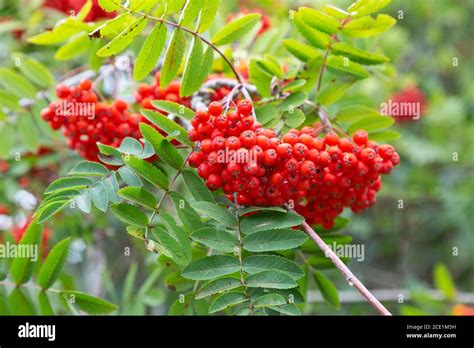
Rowan tree in autumn with its characteristic red berries.
Description and Habitat
One of the smaller UK native trees, the Rowan Tree produces creamy white flowers in spring and vivid red berries in the autumn. Rowan grows well in higher altitudes which is what makes it so popular in Scotland. In Britain, it grows at higher altitudes than any other tree. This does of course mean that it is often gnarly, but this is more than made up for by the froth of tiny white flowers that cover it in the spring, to be replaced by heavy bunches of gloriously red berries in the autumn.
Botanical Details
Rowans are mostly small deciduous trees 10-20 metres (33-66 ft) tall, though a few are shrubs. Rowan leaves are arranged alternately, and are pinnate, with (7-)11-35 leaflets. A terminal leaflet is always present. The flowers are borne in dense corymbs; each flower is creamy white, and 5-10 millimetres (0.20-0.39 in) across with five petals. The fruit is a small pome 4-8 millimetres (0.16-0.31 in) diameter, bright orange or red in most species, but pink, yellow or white in some Asian species.
Protection and Superstition
It is a tree said to offer protection in more ways than one and it was once forbidden to cut one down in the case of bad luck. As well as this, planting a rowan tree by your house is said to keep those who reside within safe from bad luck and evil spirits. Red is seen as a protective colour, this is what attributes protection to the Rowan Tree. The berries were once thought to protect against enchantment and witchcraft.
Read also: The Tree of Life Across Cultures
The rowan is seen as the tree of protection, particularly against witches and enchantment. It is often found near stone circles or ancient burial sites, as it was believed by the Druids to protect the spirits of the dead. Sprigs of rowan were worn or carried as protection against evil spirits. They were thought to protect the wearer but were also used to protect livestock and produce. If milk was stirred with a piece of rowan, it wouldn’t curdle. A rowan growing next to a house was said to afford protection to the house and all its residents, making it a very desirable property.
Each berry also has a tiny five-pointed star or pentagram opposite its stalk and the pentagram is an ancient protective symbol. “Rowan tree and red thread Make the witches tine (lose) their speed”. In Scotland, in the Highlands particularly, there was a strong taboo against cutting down a rowan or even using any part of the tree apart from the berries.
If a rowan seeds in the fork of another tree, like the one in the photo above, it is called a ‘flying rowan” which has especially strong powers of protection against witches and sorcery. The protective power comes from the berries, as red was thought to be the best colour for fighting evil and witchcraft.
Practices and Charms
In the late 19th century, the archaeologist Rev Canon John Christopher donated several loops and crosses made of rowan to the Pitts Rivers Museum in Oxford. They were believed to have been made by an old man in Strathdon, Aberdeenshire. They were traditionally placed above all doorways and windows of a house on St Lammas Day, August 1st, by a person who was forbidden to speak to anyone he met, to ward off evil.
According to a historian at the Pitts Rivers Museum, the people of Strathspey in Scotland would make a loop of rowan on May Day and walk their flocks of sheep and lambs through it in the morning and again in the evening, to protect them against witches. From Scotland to Cornwall, similar equal-armed crosses bound with red thread were sewn into the lining of coats or carried in pockets.
Read also: The Wiccan Perspective on Christmas Trees
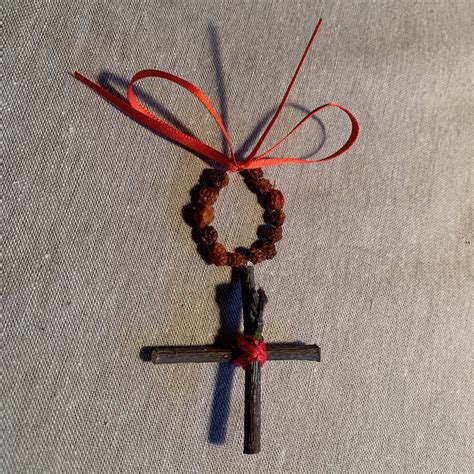
Rowan cross used for protection against evil.
Mythology and Legends
The Rowan Tree: The Legend and Biology of Mountain Ashes
The Rowan is also popular within many other stories and ideologies throughout history. Another story states how the branches from the Rowan Tree saved the life of the mighty Thor, God of Thunder.
In Greek mythology, Hebe, the goddess of youth, gave out ambrosia, the nectar of the gods, from a magical chalice. When the demons took her chalice, the gods sent an eagle to recover the chalice. During the ensuing fight, the eagle shed blood and lost feathers and where each feather or drop of blood fell, a rowan tree sprung up. In Norse mythology, Thor was saved from a fast-flowing river in the Underworld when he clung onto the branches of a rowan. The myth says that this was the tree from which the first woman was made, the first man having been made from an ash.
In Sami mythology, the goddess Ravdna is the consort of the thunder-god Horagalles. In Norse mythology, the goddess Sif is the wife of the thunder god Thor, who has been linked with Ravdna. According to Skáldskaparmál the rowan is called "the salvation of Thor" because Thor once saved himself by clinging to it.
Read also: A Journey Through Witchcraft
In the Fianna Cycle of Irish mythology, The Pursuit of Diarmuid and Grainne sees the couple eloping, trying to escape the vengeance of the legendary leader Fionn Mac Cumhaill, whom Grainne had spurned. The pair came to a forest guarded by the giant Searbhán. Searbhán allowed the pair to rest and hunt in his forest, as long as they did not eat the berries of his magical rowan tree. The pregnant Grainne desired the berries, and Diarmuid was compelled to kill Searbhán to obtain them.
Other Beliefs and Uses
The organic acids, tannins and sugars that are found in the berries produced by the rowan tree have a diuretic effect on the body. The rowan tree can help clear the mind and open up a person’s inspirations. The tree is used within vibrational medicine due to the belief that it is able to tune our bodies into nature.
Also called the traveller’s or wayfarer’s tree because it was thought to prevent travellers from getting lost. If you are planning to take a journey and wish to find enlightenment on your path then take a walking stick made traditionally made of rowan wood. It is believed to protect travellers from becoming lost and will help clear the mind and open up perspectives.
And then of course, there is the belief that a bountiful berry crop is the harbinger of a hard winter, although the specifics of this belief vary from place to place. In Newfoundland, popular folklore maintains that a heavy crop of fruit means a hard or difficult winter.
Practical Uses
The wood is dense and used for carving and turning and for tool handles and walking sticks. Rowan fruit are a traditional source of tannins for mordanting vegetable dyes. In Finland, it has been a traditional wood of choice for horse sled shafts and rake spikes.
The fruit of the European rowan (Sorbus aucuparia) can be made into a slightly bitter jelly which in Britain is traditionally eaten as an accompaniment to game, and into jams and other preserves either on their own or with other fruit. The fruit can also be a substitute for coffee beans, and has many uses in alcoholic beverages: to flavour liqueurs and cordials, to produce country wine, and to flavour ale.
Rowan fruit contains sorbic acid, and when raw also contains parasorbic acid (about 0.4%-0.7% in the European rowan), which causes indigestion and can lead to kidney damage, but heat treatment (cooking, heat-drying etc.) and, to a lesser extent, freezing, renders it nontoxic by changing it to the benign sorbic acid. They are also usually too astringent to be palatable when raw.
Rowan in Modern Times
The Rowan Tree Gift is amongst one of our most popular saplings to send to friends and family. With just the positive energy of their presence, people born under the Rowan sign have the ability to make people feel comfortable and can transform any situation they place themselves in. Rowan signs are a quieter type and have a calm outward demeanour but look inside and you will see a completely different story. They burn bright with a passion for change that propels them through life. As people, they are individuals. They don’t fit inside a box and will often dance to the beat of their own drum. They are idealists and progressive thinkers.
References to the rowan fruit's red color and the flowers' beauty are common in Celtic music. J. R. R. Tolkien's novel The Two Towers employs rowans as the signature tree for the Ent, Quickbeam. The forest of Fangorn, where Quickbeam and other Ents live, is populated with numerous rowans that were said to have been planted by male Ents to please the female Entwives.
tags: #rowan #tree #witchcraft