Nineveh, an ancient city located on the eastern bank of the Tigris River, holds a significant place in biblical history and theology. It served as the capital of the Assyrian Empire, one of the most powerful empires in the ancient Near East. Its prominence is well-documented in the Bible, where it is often depicted as a symbol of human pride and wickedness, as well as a testament to God's mercy and justice.
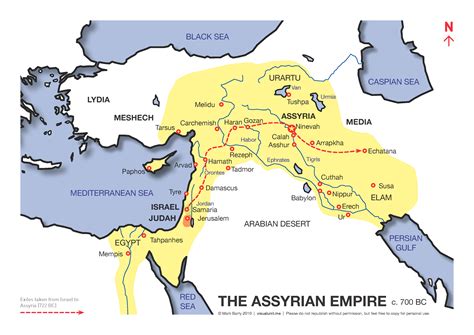
Map of the Assyrian Empire.
I. Beginnings, Name, Position
1. First Biblical Mention
The first Biblical mention of Nineveh is in Genesis 10:11, where it is stated that Nimrod or Asshur went out into Assyria and built Nineveh, Rehoboth-Ir, Calah, and Resen between Nineveh and Calah, with the addition, "the same is the great city." Everything indicates that these statements are correct, for Nineveh was certainly at one time under Babylonian rule and was at first not governed by Assyrian kings, but by issake or viceroys of Assur, the old capital. To all appearance, Nineveh took its name from the Babylonian Nina near Lagas in South Babylonia, on the Euphrates, from which early foundation it was probably colonized.
2. Etymology of the Name
The native name appears as Ninua or Nina (Ninaa), written with the character for "water enclosure" with that for "fish" inside, implying a connection between Nina and the Semitic nun, "fish." The Babylonian Nina was a place where fish were very abundant, and Ishtar or Nina, the goddess of the city, was associated with Nin-mah, Merodach's spouse, as goddess of reproduction. Fish are also plentiful in the Tigris at Mosul, the modern town on the other side of the river, and this may have influenced the choice of the site by the Babylonian settlers, and the foundation there of the great temple of Ishtar or Nina. The date of this foundation is unknown, but it may have taken place about 3000 BC.
3. Position on the Tigris
Nineveh lay on the eastern bank of the Tigris, at the point where the Khosr falls into that stream. The outline of the wall is rectangular on the West, but of an irregular shape on the East. The western fortifications run from Northwest to Southeast, following, roughly, the course of the river, which now flows about 1,500 yards from the walls, instead of close to them, as in ancient times.
Read also: Understanding anemia spiritually
II. Nineveh and Its Surroundings
1. Its Walls
According to the late G. Smith, the southwestern wall has a length of about 2 1/2 miles and is joined at its western corner by the northwestern wall, which runs in a northeasterly direction for about 1 1/3 miles. The northeastern wall, starting here, runs at first in a southeasterly direction but turns southward, gradually approaching the southwestern wall, to which, at the end of about 3 1/4 miles, it is joined by a short wall, facing nearly South, rather more than half a mile long.
2. Principal Mounds and Gateways
The principal mounds are Kouyunjik, a little Northeast of the village of `Amusiyeh, and Nebi-Yunas, about 1,500 yards to the Southeast. Both of these lie just within the Southwest wall. Extensive remains of buildings occupy the fortified area. Numerous openings occur in the walls, many of them ancient, though some seem to have been made after the abandonment of the site. The principal gate on the Northwest was guarded by winged bulls. Other gates gave access to the various commercial roads of the country, those on the East passing through the curved outworks and the double line of fortifications which protected the northeastern wall from attack on that side, where the Ninevites evidently considered that they had most to fear.
3. Extent and Population within the Walls
According to G. Smith, the circuit of the inner wall is about 8 miles, and Captain Jones, who made a trigonometrical survey in 1854, estimated that, allotting to each inhabitant 50 square yards, the city may have contained 174,000 inhabitants. If the statement in Jonah 4:11, that the city contained 120,000 persons who could not discern between their right hand and their left, be intended to give the number of the city's children only, then the population must have numbered about 600,000, and more than three cities of the same extent would have been needed to contain them.
4. Extent outside the Walls
It has therefore been supposed--and that with great probability--that there was a large extension of the city outside its walls. This is not only indicated by Jonah 3:3, where it is described as "an exceeding great city of three days' journey" to traverse, but also by the extant ruins, which stretch Southeast along the banks of the Tigris as far as Nimroud (Calah) while its northern extension may have been regarded as including Khorsabad.
5. Calah, Resen and Rehoboth-Ir
Concerning the positions of two of the cities mentioned with Nineveh, namely, Calah and Resen, there can be no doubt, notwithstanding that Resen has not yet been identified--Calah is the modern Nimroud, and Resen lay between that site and Nineveh. The name Rehoboth-Ir has not yet been found in the inscriptions, but Fried. Delitzsch has suggested that it may be the rebit Ninua of the inscriptions, Northeast of Nineveh. If this be the case, the Nineveh of Jonah contained within it all the places in Genesis 10:11,12, and Khorsabad besides.
Read also: Light Blue: Calmness and Healing
6. Khorsabad
Taking the outlying ruins from North to South, we begin with Khorsabad (Dur-Sarru-kin or Dur-Sargina), 12 miles Northeast of Kouyunjik, the great palace mound of Nineveh proper. Khorsabad is a great enclosure about 2,000 yards square, with the remains of towers and gateways. The palace mound lies on its northwest face and consists of an extensive platform with the remains of Sargon's palace and its temple, with a ziqqurat or temple-tower similar to those at Babylon, Borsippa, Calah, and elsewhere. The palace ruins show numerous halls, rooms, and passages, many of which were faced with slabs of coarse alabaster, sculptured in relief with military operations, hunting-scenes, mythological figures, etc., while the principal entrances were flanked with the finest winged human-headed bulls which Assyrian art has so far revealed. The palace was built about 712 BC and was probably destroyed by fire when Nineveh fell in 606 BC, sharing the same fate.
7. Sherif Khan and Selamieh
Another outlying suburb was probably Tarbicu, now represented by the ruins at Sherif Khan, about 3 miles North of Kouyunjik. In this lay a temple--"palace" Sennacherib calls it--dedicated to Nergal. In ancient times it must have been a place of some importance, as Esarhaddon seems to have built a palace there, as well as a "seat" for his eldest son, Assur-bani-apli. The site of Resen, "between Nineveh and Calah," is thought to be the modern Selamieh, 12 miles South of Nineveh, and 3 miles North of Nimroud (Calah). It is in the form of an irregular enclosure on a high mound overlooking the Tigris, with a surface of about 400 acres. No remains of buildings, sculptures, or inscriptions have, however, been found there.
8. Nimroud
After Nineveh. itself (Kouyunjik), the ruins known as Nimroud, 14 or 15 miles Southeast, are the most important. They mark the site of the ancient Calah. The general tendency of the accumulated references to these sites supports theory that they were regarded as belonging to Nineveh, if not by the Assyrians themselves (who knew well the various municipal districts), at least by the foreigners who had either visited the city or had heard or read descriptions of it.
III. Palaces at Nineveh Proper
The palaces at Nineveh were built upon extensive artificial platforms between 30 and 50 ft. high, either of sundried brick, as at Nimroud, or of earth and rubbish, as at Kouyunjik. It is thought that they were faced with masonry, and that access was gained to them by means of flights of deep steps, or sloping pathways. Naturally it is the plan of the basement floor alone that can at present be traced, any upper stories that may have existed having long since disappeared. The halls and rooms discovered were faced with slabs of alabaster or other stone, often sculptured with bas-reliefs depicting warlike expeditions, the chase, religious ceremonies and divine figures.
1. The Palace of Sennacherib
The palace of Sennacherib lay in the southeast corner of the platform and consisted of a courtyard surrounded on all four sides by numerous long halls and rooms, of which the innermost were capable of being rendered private. It was in this palace that were found the reliefs depicting the siege of Lachish, with the representation of Sennacherib seated on his "standing" throne, while the captives and the spoil of the city passed before him. The grand entrance was flanked by winged bulls facing toward the spectator as he entered. They were in couples, back to back, on each side of the doorway, and between each pair the ancient Babylonian hero-giant, carrying in one hand the "boomerang," and holding tightly with his left arm a struggling lion was represented, just as at his father Sargon's palace at Khorsabad.
Read also: Explained: Spiritual Blessings
2. The Palace of Assur-bani-apli
In the north of the mound are the ruins of the palace of Assur-bani-apli or Assur-bani-pal, discovered by Hormuzd Rassam. The general arrangement of the rooms was upon the traditional lines. The slabs with which they were paneled showed bas-reliefs illustrating the Assyrian campaigns against Babylonia, certain Arab tribes, and Elam. As far as they are preserved, the sculptures are wonderfully good, and the whole decorative scheme of the paneled walls, of which, probably, the greater part is forever lost, may be characterized, notwithstanding their defects of perspective and their mannerisms, as nothing less than magnificent.
IV. Sennacherib's Description of Nineveh
1. The Walls
In all probability the best description of the city is that given by Sennacherib on the cylinder recording his expedition to Tarsus in Cilicia. From ancient times, he says, the circuit of the city had measured 9,300 cubits, and he makes the rather surprising statement that his predecessors had not built either the inner or the outer wall, which, if true, shows how confident they were of their security from attack. He claims to have enlarged the city by 12,515 (cubits). The great defensive wall which he built was called by the Sumerian name of Bad-imgallabi-lu-susu, which he translates as "the wall whose glory overthrows the enemy." He made the brickwork 40 (cubits) thick, which would probably not greatly exceed the estimate of G. Smith, who reckoned it to have measured about 50 ft. The height of the wall he raised to 180 tipki, which, admitting the estimate of Diodorus, should amount to about 100 ft.
2. The Gates--Northwest
In this enclosing wall were 15 gates, which he enumerates in full. Three of these were situated in the short northwest wall--the gate of Hadad; the gate of Uru or Hadad of Tarbisu (Sherif Khan), and the gate of the moon-god Nannar, Sennacherib's own deity. The plans show five openings in the wall on this side, any of which may have been the gate used when going to Tarbicu, but that adorned with winged bulls probably furnished the shortest route.
3. The Gates--South and East
The gates looking toward the South and the East were the Assur-gate (leading to the old capital); Sennacherib's Halzi-gate; the gate of Samas of Gagal, the gate of the god Enlil of Kar-Ninlil, and the "covered gate," which seems to have had the reputation of letting forth the fever-demon. After this are mentioned the Sibaniba-gate, and the gate of Halah in Mesopotamia. This last must have been the extreme northeastern opening, now communicating with the road to Khorsabad, implying that Halah lay in that direction.
4. The Gates--West
The gates on the west or river-side of the city were "the gate of Ea, director of my watersprings"; the quay-gate, "bringer of the tribute of my peoples"; the gate of the land of Bari, within which the presents of the Sumilites entered (brought down by the Tigris from Babylonia, in all probability); the gate of the tribute-palace or armory; and the gate of the god Sar-ur--"altogether 5 gates in the direction of the West."
V. Last Days and Fall of Nineveh
Although Nineveh escaped destruction during the time of Jonah, a later generation still had to face a reckoning. The prophet Nahum prophesied of the destruction of the city because of the peopleâs evilness. Nahumâs predictions for Ninevehâs destruction came to pass when the Babylonians, Medes, and Scythians sacked the city in 612 BC. Ninevehâs walls had been breached by flood waters, allowing their attackers to enter the city. The cityâs ruin was ultimately a product of Godâs divine wrath. Godâs judgment on Nineveh and the nation of Assyria as a whole was holy and just, given their cruelty, bloodshed, and idolatry.
The Ninevites during Jonahâs time, who believed Godâs message and repented, will forever be remembered as a people who turned their hearts toward the Lord and believed despite their overall lack of knowledge about Him.
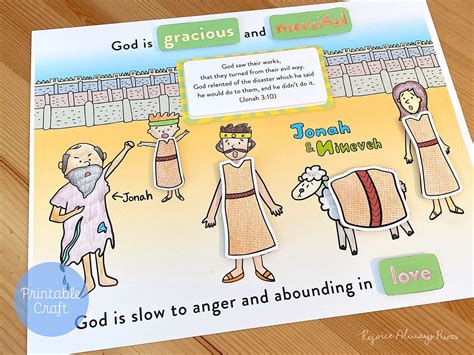
The Repentance of Nineveh.
Biblical References
Nineveh is first mentioned in Genesis 10:11-12, where it is attributed to Nimrod, a mighty hunter and a great-grandson of Noah: "From that land he went forth into Assyria, where he built Nineveh, Rehoboth-Ir, Calah, and Resen, which is between Nineveh and the great city of Calah." This early reference establishes Nineveh as a significant city from the post-flood generations.
The city is most famously associated with the prophet Jonah. In the Book of Jonah, God commands Jonah to go to Nineveh and preach against its wickedness. Jonah 1:2 states, "Arise, go to the great city of Nineveh and cry out against it, because its wickedness has come up before Me." Jonah's initial reluctance and subsequent obedience highlight Nineveh's reputation for sinfulness, yet also God's willingness to offer repentance.
Upon Jonah's eventual arrival and proclamation of impending judgment, the people of Nineveh, from the king to the commoners, repent in sackcloth and ashes. Jonah 3:5 records, "And the people of Nineveh believed God. They proclaimed a fast and dressed in sackcloth, from the greatest of them to the least." This act of repentance leads God to relent from the disaster He had planned, demonstrating His mercy and the power of genuine repentance.
Nineveh is also mentioned in the prophetic book of Nahum, which foretells its destruction. Nahum 1:1-3 introduces the prophecy: "This is the burden against Nineveh, the book of the vision of Nahum the Elkoshite: The LORD is a jealous and avenging God; the LORD is avenging and full of wrath. The LORD takes vengeance on His foes and reserves wrath for His enemies. The LORD is slow to anger and great in power; the LORD will by no means leave the guilty unpunished." This prophecy underscores the eventual downfall of Nineveh due to its return to wickedness, serving as a reminder of divine justice.
In 2 Kings 19:36 and Isaiah 37:37, Nineveh is depicted as the center of the Assyrian Empire and home to King Sennacherib. Sennacherib led a successful campaign against many nations, but he failed to take Jerusalem due to the Lordâs intervention.
Jesus mentioned the Ninevites and their repentance, contrasting that response to the unbelief of the Pharisees and teachers of the law (Matthew 12:39â41). Rejecting Christ has no excuse: âThe people of Nineveh will also stand up against this generation on judgment day and condemn it, for they repented of their sins at the preaching of Jonah. Now someone greater than Jonah is hereâbut you refuse to repentâ (Luke 11:32, NLT).
Consider the timelines of key events in the history of Nineveh:
| Date | Event |
|---|---|
| c. 3000 BC | Possible foundation of Nineveh by Babylonian settlers |
| 712 BC | Construction of Sargon's palace at Khorsabad |
| 701 BC | Sennacherib lays siege to Jerusalem |
| 612 BC | Fall of Nineveh to Babylonians, Medes, and Scythians |
Jonah and the Whale | Stories of God I Animated Children's Bible Stories | Bedtime Stories | 4K UHD
Theological Significance
Nineveh's narrative in the Bible serves multiple theological purposes. It illustrates the themes of sin, repentance, and divine mercy. The city's initial repentance under Jonah's preaching is a powerful testament to the transformative power of God's word and the possibility of redemption for even the most sinful of nations. This aligns with the broader biblical theme that God desires all people to turn from their wicked ways and live (Ezekiel 18:23).
Furthermore, Nineveh's eventual destruction, as prophesied by Nahum, serves as a sobering reminder of God's justice. It emphasizes that while God is patient and merciful, He is also righteous and will not tolerate unrepentant sin indefinitely. This duality of mercy and justice is a recurring theme throughout Scripture, reflecting God's holy nature.
Cultural and Archaeological Insights
Archaeological discoveries have provided additional insights into Nineveh's grandeur and eventual fall. Excavations have uncovered the city's impressive walls, palaces, and libraries, including the famous library of Ashurbanipal, which contained thousands of cuneiform tablets. These findings corroborate the biblical depiction of Nineveh as a "great city" (Jonah 3:3) and provide context for its historical and cultural significance.
The fall of Nineveh in 612 BC to a coalition of Babylonians, Medes, and Scythians marked the end of the Assyrian Empire, fulfilling Nahum's prophecy. This event is a historical testament to the accuracy of biblical prophecy and the sovereignty of God over the nations.
In conclusion, Nineveh's account in the Bible is a profound narrative of sin, repentance, and divine justice. It serves as a powerful reminder of God's desire for repentance and His ultimate authority over the affairs of nations.