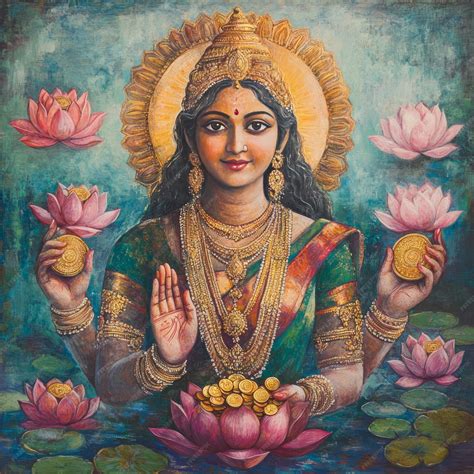
Shri Mahalakshmi Ashtakam is a Sanskrit prayer for Goddess Lakshmi, revered as the giver of wealth, beauty, fortune, and auspiciousness. This Goddess is of great importance for the Hindus.
According to the Puranas and scriptures, Mahalakshmi Ashtakam was composed by Lord Indra himself to please Goddess Lakshmi. As mentioned earlier, the Padma Purana has the sacred text of Mahalakshmi Ashtakam. The king of heaven, Indira, to receive grace from Lakshmi, recited this.
The term Lakshmi originates from the Sanskrit word ‘Lakshya,’ which means aim or goal. The word Lakshmi comes from the word Lakshya in Sanskrit, which means goal. So offering prayers to her helps reach the aim or goal. She stands for everything auspicious, beneficial, and good. To invoke her blessings and to have a prosperous and peaceful life, devotees chant her prayers.
Shri Mahalakshmi Ashtakam is a very divine stotra. The scriptures say that by reciting Mahalakshmi Stotra, Goddess Mahalakshmi becomes happy very quickly. Mahalakshmi Stotra is more effective.
Why Was Mahalakshmi Ashtakam Created?
Read also: The Significance of Lakshmi Stotram
Indra Dev, the king of heaven, was going in his vehicle Airavat. Then Maharishi Durvasa Rishi met Indra Dev on the way, and Durvasa Rishi took out the garland and offered a garland to Indra Dev. Lord Indra put this garland on the elephant Airavata in front of sage Durvasa. Airavata the elephant, disturbed by the strong smell of this garland, threw it on the earth in front of sage Durvasa. Seeing this, sage Durvasa cursed Indra Dev out of anger that O Indra, with such pride you have disrespected my garland, this garland was the abode of Mahalakshmi. Due to the curse of Durvasa, Rajyalakshmi immediately entered the ocean. When the Gods and Goddesses started praying to Mahalakshmi, Goddess Lakshmi appeared and the Gods and Goddesses, sages, etc. anointed Mahalakshmi.
The Eight Forms of Mahalakshmi
The Shri Maha Lakshmi Ashtakam is a divine collection of eight verses dedicated to Goddess Lakshmi.
The Verses and Their Meanings
नमस्तेऽस्तु महामाये श्रीपीठे सुरपूजिते ।
शङ्खचक्रगदाहस्ते महालक्ष्मि नमोऽस्तुते ॥१॥
Namastestu Mahaa-Maaye Shrii-Piitthe Sura-Puujite |
Shangkha-Cakra-Gadaa-Haste Mahaalakssmi Namostute ||1||
Read also: Read the Aparadha Kshamapana Stotram
Meaning:
Reverential Salutations to You O Mahamaya (the Primordial Cause of Creation); Who Abides in Sri Pitha (Her Transcendental Abode) and is Worshipped by the Suras,
Who is adorned with Shankha (Conch), Chakra (Discus) and Gada (Mace) in Her Hands; Reverential Salutations to You, O Devi Mahalakshmi.
नमस्ते गरुडारूढे कोलासुरभयंकरि ।
सर्वपापहरे देवि महालक्ष्मि नमोऽस्तुते ॥२॥
Namaste Garudda-[A]aruuddhe Kola-[A]asura-Bhayangkari |
Sarva-Paapa-Hare Devi Mahaalakssmi Namostute ||2||
Meaning:
Reverential Salutations to You Who is mounted on the Garuda, and Who is the Terror to Kolasura,
(Reverential Salutations to You) O Devi Who Remove All Sins (when we Surrender to Her); Reverential Salutations to You, O Devi Mahalakshmi.
सर्वज्ञे सर्ववरदे सर्वदुष्टभयंकरि ।
सर्वदुःखहरे देवि महालक्ष्मि नमोऽस्तुते ॥३॥
Sarvajnye Sarva-Varade Sarva-Dusstta-Bhayangkari |
Sarva-Duhkha-Hare Devi Mahaalakssmi Namostute ||3||
Meaning:
(Reverential Salutations to You) Who is All-Knowing (Knowing even our Innermost Thoughts), and Who Gives All Boons (When Her Grace is Aroused); (Reverential Salutations to You) Who is the Terror to All the Wicked (Tendencies) (Destroying our Evil Tendencies),
(Reverential Salutations to You) O Devi Who Removes All Sorrows (When Her Compassion is Aroused); Reverential Salutations to You, O Devi Mahalakshmi.
Read also: The Rudrashtakam
सिद्धिबुद्धिप्रदे देवि भुक्तिमुक्तिप्रदायिनि ।
मन्त्रमूर्ते सदा देवि महालक्ष्मि नमोऽस्तुते ॥४॥
Siddhi-Buddhi-Prade Devi Bhukti-Mukti-Pradaayini |
Mantra-Muurte Sadaa Devi Mahaalakssmi Namostute ||4||
Meaning:
(Reverential Salutations to You) O Devi Who Bestows Accomplishments (When She becomes Gracious) and Intelligence (to direct our Lives properly with those Accomplishments); (Reverential Salutations to You) Who Bestows both Worldly Prosperity as well as directs our lives towards final Liberation (Merging in Her Lotus Feet),
(Reverential Salutations to You) O Devi Who Always Abide as the Subtle Form of Mantra (behind Everything in Creation and Within our Hearts); Reverential Salutations to You, O Devi Mahalakshmi.
आद्यन्तरहिते देवि आद्यशक्तिमहेश्वरि ।
योगजे योगसम्भूते महालक्ष्मि नमोऽस्तुते ॥५॥
Aadya[i-A]nta-Rahite Devi Aadya-Shakti-Maheshvari |
Yoga-Je Yoga-Sambhuute Mahaalakssmi Namostute ||5||
Meaning:
(Reverential Salutations to You) O Devi Who is Without Beginning (Aadi) and Without End (Anta), and Who is the Great Goddess representing the Primordial Shakti,
(Reverential Salutations to You) Who is Born of Yoga (out of the Great Consciousness) and Who is always United with Yoga; Reverential Salutations to You, O Devi Mahalakshmi.
स्थूलसूक्ष्ममहारौद्रे महाशक्तिमहोदरे ।
महापापहरे देवि महालक्ष्मि नमोऽस्तुते ॥६॥
Sthuula-Suukssma-Mahaaroudre Mahaa-Shakti-Mahodare |
Mahaa-Paapa-Hare Devi Mahaalakssmi Namostute ||6||
Meaning:
(Reverential Salutations to You) Whose Power is present behind both Gross and Subtle Forms as well as behind the Most Terrible Form of Rudrani; (Reverential Salutations to You) Who is the Great Womb of Mahashakti (from where every manifestation of Power arises),
(Reverential Salutations to You) O Devi, Who is the Great Remover of Sins, and Who Removes Great Sins from our Lives (when Her Great Power passes through our Lives and Cleanses us) (maybe during adverse circumstances); Reverential Salutations to You, O Devi Mahalakshmi.
पद्मासनस्थिते देवि परब्रह्मस्वरूपिणि ।
परमेशि जगन्मातर्महालक्ष्मि नमोऽस्तुते ॥७॥
Padma-[A]asana-Sthite Devi Para-Brahma-Svaruupinni |
Parameshi Jagan-Maatar-Mahaalakssmi Namostute ||7||
Meaning:
(After Her Great Power Cleanses us we feel Her Peaceful Form) O Devi Who is Seated on a Lotus (Lotus of Kundalini) (with a Gracious Face); And Who is abiding as the Supreme Brahman (behind all Creation),
Who is the Supreme Goddess and the Mother of the Universe; Reverential Salutations to You, O Devi Mahalakshmi.
श्वेताम्बरधरे देवि नानालङ्कारभूषिते ।
जगत्स्थिते जगन्मातर्महालक्ष्मि नमोऽस्तुते ॥८॥
Shveta-[A]mbara-Dhare Devi Naana-[A]langkaara-Bhuussite |
Jagatsthite Jagan-Maatar-Mahaalakssmi Namostute ||8||
Meaning:
(Reverential Salutations to You) O Devi Who is Adorned with White Garments (representing our Inner Purity); (Reverential Salutations to You) Who is Adorned with Various Ornaments (representing our Inner Beauty),
(Reverential Salutations to You) Who Abide within the Universe as the Mother of the Universe (directing our Lives and all Activities); Reverential Salutations to You, O Devi Mahalakshmi.
महालक्ष्म्यष्टकं स्तोत्रं यः पठेद्भक्तिमान्नरः ।
सर्वसिद्धिमवाप्नोति राज्यं प्राप्नोति सर्वदा ॥९॥
Mahaalakssmy-Assttakam Stotram Yah Patthed-Bhaktimaan-Narah |
Sarva-Siddhim-Avaapnoti Raajyam Praapnoti Sarvadaa ||9||
He who recites this Mahalakshmi Ashtakam Stotram with Devotion (surrendering to Her), ...
Benefits of Chanting Mahalakshmi Ashtakam
As per the sacred text, chanting the Mahalakshmi Ashtakam can help you fulfil your wishes, get clarity of mind, remove sins, gain material wealth, spiritual abundance, have good health, and keep enemies at arm’s length.
Here are some key benefits of reciting the Shri Mahalakshmi Ashtakam:
- It is believed to bring peace, prosperity, and spiritual growth into a person’s life.
- Reciting the hymn daily helps wipe away all sins, whether you are aware of them or not.
- According to this hymn anyone who recites it three times a day will be free from all enemies.
- Chanting the hymn regularly can enhance ones spiritual abilities and wisdom.
- Reciting this hymn not only brings material pleasures but also helps you achieve liberation (moksha).
When and How to Chant
People often chant it during festivals, special occasions, or as part of their daily prayers, seeking her divine grace for success and happiness. Thus, Friday is dedicated to Mahalakshmi, and the tradition of worshiping Mahalakshmi on this day is mentioned in the scriptures.
Here are some guidelines to follow when chanting the hymns:
- The Shri Mahalakshmi Ashtakam is especially chanted to attain wealth, prosperity, and happiness.
- It is best to chant the Shri Mahalakshmi Ashtakam in the morning and evening.
- Choose a quiet, clean, and sacred place to recite the Shri Mahalakshmi Ashtakam.
- Goddess Lakshmi loves white or red colors, so its better to choose white or red clothes to wear after bath.
- Always sit on a kusha grass mat or a clean cloth while chanting.
- Now, light a Diya with ghee or sesame oil in front of Goddess Lakshmi.
- Before starting your chanting, first remember Lord Ganesha and your ishta devata. Then, focus and invite Goddess Lakshmi.
- After you finish chanting, bow to Goddess Lakshmi and share your wishes with her.
- Chant this hymn every day if you can.
Experiences of Devotees
Here are some experiences from devotees who chant the Shri Mahalakshmyashtakam Stotram:
California, United States: The first verse in Shri Mahalakshmyashtakam Stotram always intrigued me. How could “the great illusion that is manifested in the world” be “the abode of auspiciousness and prosperity?” Today I understood it. I realize that my entire experience-including that of the parts of me that feel like a burdensome illusion about who I truly am-is a manifestation of the dance of Shiva. As I sing these sacred verses, I feel Mahalakshmi bringing me back to a greater understanding through my direct experience of the Self.
California, United States: On the twentieth day of every month, another Siddha Yoga student and I meet to sing this captivating hymn together. This is one of the ways that I remember and pay homage to the abundance that inhabits my being in the form of Mahalakshmi. Every time I sing this sacred hymn, its chords awaken feelings of beauty, softness, and gratitude within me. It seems that my heart recognizes the presence of divine grace and wants to expand its reach into all my actions. I believe that this practice has strengthened my resolve to act from love in all that I do. I have started a gratitude journal, in which I try to write down the abundance of gifts that Mahalakshmi has bestowed upon me in many forms. This has helped me to see that even in times when I have stumbled, I have always been upheld. I recognize that, for me, while life is never completely certain, I am able to find joy in the discovery of new horizons in my inner and outer landscapes. The practice of singing and listening to this sacred hymn is a gift and a blessing that I cherish.
Tepoztlán, Mexico: My three-year-old son loves to listen to Shri Mahalakshmyashtakam Stotram. He feels so happy when he does! My eight-year-old daughter says that she feels like it removes fear from her. As for me, the verses awaken devotion within me when I sing them. I feel very fortunate to be walking the Siddha Yoga path.
Bedford Gardens, South Africa: For me, the chant of Shri Mahalakshmyashtakam Stotram has an ambrosia-like fragrance! In 1995, I was blessed to attend a course about Shri Mahalakshmi in Shree Muktananda Ashram. Swami Kripananda was the teacher for this course, and she meticulously described the eight divine forms of the goddess Mahalakshmi. She also taught us how to set up, with deep devotion and intention, a puja tray for offering to Shri Mahalakshmi. Since then, I chant the stotram daily to honor Shri Mahalakshmi’s boundless attributes! The most cherished boon I have received from Shri Mahalakshmi is the quality of contentment-because this virtue grants peace within me, in my home, and in my workplace.
Wellington, New Zealand: My favorite part about being in residence at Gurudev Siddha Peeth was singing the Mahalakshmyashtakam Stotram and other hymns with my seva group before beginning seva. I am very grateful to be able to access this hymn so easily right here in my sunny home in New Zealand. Singing to Shri Lakshmi today, I felt a daring energy rise within me. I am finding myself called to fill new roles in seva and my work life that require a delicate balancing act. Singing this beautiful hymn gives me the strength to meet these occasions and the confidence to rise willingly and happily to new situations, no matter how challenging they may seem.
New Zealand: I was describing a life situation to a fellow sevite, and he suggested I sing to Lakshmi. His words resonated deeply, and I resolved to sing the Mahalakshmyashtakam Stotram every day for a month. Wow! What a purely divine experience! I have been singing this beautiful hymn every day for a week, and every time I do, I feel Gurumayi’s love swirling in and around me, into places I didn’t know existed within me: places where the sweetest bliss resides. As I sang it this morning, the phrase “I am loved” arose from deep within, and echoed through me with tenderness and compassion.
Practical Advice for Recitation
When chanting the hymns of any deity, it’s important to follow certain guidelines to receive their blessings. The Shri Mahalakshmi Ashtakam is especially chanted to attain wealth, prosperity, and happiness.
You can recite the Shri Maha Lakshmi Ashtakam daily in the morning or evening.
What Does This Hymn Offer?
While many chant it for money, it also brings happiness, peace of mind, and spiritual growth. No, this hymn isn’t just for wealth.
How to Worship Mahalakshmi | Mantra for Wealth and Prosperity | Guru Pashupati
tags: #sri #mahalakshmi #stotram