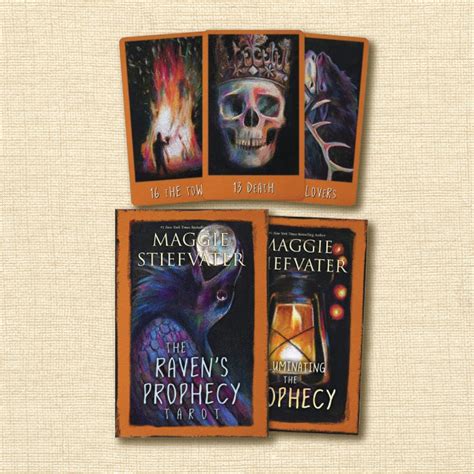
The Raven's Prophecy Tarot deck, created by Maggie Stiefvater, has garnered attention for its unique approach to tarot. This review delves into the deck's intricacies, its connection to Stiefvater's "The Raven Cycle" book series, and its suitability for both beginners and experienced tarot readers.
A Deck Rooted in the Raven Cycle
This deck has literally leapt from the pages of Maggie Stiefvater’s book series: The Raven Cycle. This deck is absolutely full little pieces of the books, placed neatly into the cards’ meanings. There are some cards that are very pointedly referring to a certain character from the books.
Arguably, most striking thing about the deck is Maggie’s use of hands throughout it. His hand first appears as The Magician, clenches with Strength, and protectively cups the little glow of The Sun. His hands dominate the Swords suit and grace several of the Wands cards. Also, there is no shortage of Ravens, flames, and other strange, quiet things. The energy I get from this deck is decidedly masculine while simultaneously feeling very inward-focused. A perfect example of this is The Sun card. There are also some fascinating cards whose artwork kind of goes together.
Is This Deck for Beginners?
Okay, so, I’m about to say some weird shit: this guidebook is absolutely perfect for the beginning tarot reader. That being said, I would not recommend the actual deck itself to a complete beginner. Especially a beginner who has never read The Raven Cycle books. There’s an easy fix for this, though.
Illuminating the Prophecy: A Novelist's Guide to Tarot
Back in September, Jason bought me the Raven’s Prophecy Tarot deck, which came (like most tarot decks) with a book of instructions. This, however, wasn’t just a short, concise list of definitions. Stiefvater wrote a whole book, explaining the tarot in a way that follows a kind of internal narrative arc. She uses tarot as a way of storytelling, which of course appeals to me immensely, as a fellow storyteller.
Read also: Dreams About Ravens
Illuminating the Prophecy is essentially an instruction manual written by a novelist, and it reads that way. As Stiefvater discusses each of the 78 tarot cards, she doesn’t just hand out a random list of meanings. She explains the card’s position in the circle of events that it inhabits. She discusses the artwork and the process behind the artwork. She links cards to each other, makes connections and cross-connections.
Imagine trying to memorize 78 different card meanings, especially when each of those 78 cards has a separate reversed meaning and the meanings are generally disconnected from the artwork, so there are no visual cues, and (mostly) disconnected from each other, so there are no patterns. I’ve been studying tarot for 15 years, and still every time I read a spread, I had to refer back to the little instruction booklet for certain cards. Now, though, with literally one read through this manual, I know exactly what every card in the deck means, how they all relate to each other, and all the patterns that repeat in concentric circles throughout the deck. I no longer need to look at the manual to read spreads. After one read through the book! Furthermore, each card is so alive and nuanced that I can easily look at a spread and see how they all link after laying the cards out. It has become easier to see the patterns in front of me, and so gaining clarity is far more effective.
It’s the difference between reading a dry and poorly-written book about a subject you love and discovering an illuminating and well-written book on the same subject. No matter how hard you tried to read that first book, you could only glean so much about the subject. That second book, though, taught you the foundations of everything you needed to know. I spent fifteen years on the old, dry, poorly-written book.
Some lovely person bought me a copy of Maggie Stiefvater's The Raven's Prophecy Tarot deck off my Amazon wishlist. While most decks come with a little pamphlet that fits inside the card box, with a bare-bones explanation of each card -- usually one sentence or less -- this deck comes with a proper instruction book, although the result is that the box does not really fit the deck of cards. I'll need to find something to wrap them in. The instruction book is called Illuminating the Prophecy and it's shorter than my main tarot instructional book, but it's still more than enough to get a beginner started, and it's an excellent supplement to other materials.
Stiefvater explains the artistic choices she's made for this deck in particular, which makes it easier to remember the card meanings when using it to do readings, It's also a very good explanation of tarot in general, so it should be useful to use for other decks, if you have other decks that come with useless tiny pamphlets like most of them. Each card is given a couple of keywords, then a page or two of explanation on how it fits into the greater patterns in the deck, what it can mean in different parts of a reading, how Stiefvater feels about the card personally, and anything else that she deems highly relevant. The personal stuff is quite useful--tarot readings are very personal and how one person reads something might not quite fit in the same way with how someone else reads it, based on a reader or querent's life/personality/relationship to the concepts represented by the card. The booklet also has much of Stiefvater's characteristic voice, if not quite as nutty as the one she uses on Tumblr, so it is quite entertaining as well as informative.
Read also: End Time Prophecies Analysis
I've started entering some of the notes from this book into my own tarot notebook, which is a jumble of things I've learned from different sources but overall draws heavily on Tarot Plain and Simple, which has been my main instructional for years (I lost most of the notes I had from when I first started reading tarot, so now I only use the things I remembered from back then, which was more than a dozen years ago, so that's not a huge amount and it's not nearly enough to do readings from memory with). I think I'm going to end up incorporating a lot of what Stiefvater says into the way I read; I think it's a bit more on my wavelength than some of the tone of the other book. Overall, A+ deck, A+ instructional booklet, would occult with again. Also, the Queen of Pentacles card is so preeetty.
The Art and Symbolism
The Raven's Prophecy is a beautiful tarot deck with striking images. You do not have to be a fan of Stiefvater's fiction to enjoy these images. They are, according to her, based on Welsh symbolism, and the book she's written fits the images into the traditional RWS tradition with her own unique twists. I love reading with this deck. It's a bit snarky, but very clear. The changes from the RWS provide some new and interesting ways of looking at problems. My biggest issue is that the card stock is quite flimsy. But otherwise this is a brilliant deck with gorgeous art.
Hermosas ilustraciones en cada una de las cartas y un manual detallado de forma muy amigable para el entendimiento del lector. Maggie no solo es una excelente escritora sino también una brillante artista.
The deck is absolutely gorgeous! I also really like Maggie's take on the cards and descriptions throughout the book. It makes it easy for a beginner to give a couple different kinds of readings.
Una belleza!!!!Impresionante el arte que maneja esta mujer. Creo que jamás dejará de sorprenderme. Cada carta, cada trazo, increible en verdad.
Read also: Heartbreak and the Three of Swords
I purchased this because Stiefvater published it, and because of its relationship to The Raven Cycle books, but I was absolutely blindsided by this deck and its artwork. It's a deck that I didn't know was missing in my life, and I'm thoroughly pleased with all the work I've done with it thus far. The cards are nicely made with enough resiliency to stay unfrayed despite use and enough resistance to make working with them (and shuffling them) easy rather than arduous. The book is pretty solid, but occupies a kind of funny spot for the typical "little white book" in that Stiefvater's audience is YA, but the deck itself is rather sophisticated for the novice or casual interest in tarot. It's written in a fairly introductory and neutral fashion, so that first-timers can work with it somewhat straightforwardly; but because the cards don't derive much from the genre-defining Rider-Waite-Smith deck, it's not a useful entry point into practically any other aspect of the tarot community and practice.
I was surprised by how well these cards works for me, considering that until recently the only deck that's ever clicked with me had been the Crowley tarot, which is in many ways the opposite of this one: full to the point of overflowing with symbols, hardly a square millimeter left blank in any given card, and oh-so-brightly coloured. With the Crowley tarot, you have to distill the pictures down to the essence that matters to you, whereas the Raven's Prophecy invites you expand the simple image that you see into a story for yourself. Some reviewers have said that this is not a deck for beginners. I'd say, let the beginners be the judges of that. One thing I will say, though: the manual is just that: a manual for this specific deck, and it cannot replace a comprehensive guide book that will give you a systematic introduction to the tarot card system.
The Raven’s Prophecy Tarot is the creation of author and artist Maggie Stiefvater, writer of the Raven's Cycle books. The 78 non-traditional cards are stark and brooding, with dark and enigmatic artwork. The raven in the Ravens Prophecy Tarot symbolises the conscious mind logic and rationality, while the suit of Wands and the element of fire represent creative powers. This is a 78 card tarot with 22 Major Arcana and 56 Minor Arcana. No cards have been renamed, and the suits are Cups, Coins, Swords, and Wands. The Court cards are the standard Page, Knight, Queen, and King.
This deck initially appears to be quite dark and a little foreboding. All the images have a stark black background with no modulation, however this actually serves to offset the luminous colours of the artwork. The cards are printed on excellent card stock thin, flexible, smooth, and low sheen. The images have been done in pastels which gives them a grainy texture, and tend to be close views so that a single object - feather, flame, hand, rose, leaf etc. dominates the illustration to the exclusion of all else. All cards have a narrow orange border.
The cards and guidebook come packaged in a light cardboard box printed with some cursory information about the deck, and images from theRavens Prophecy Tarot. The 184 page guidebook is written by Maggie Stiefvater. It has a brief introduction which outlines her interest and motivation for creating the deck. There is also short chapter that discusses the theme of the deck. Introductory information on How to Do a Reading is included, as is a ritual the Seeker can do prior to using the cards.
Undoubtably readers of Maggie Stiefvater will be interested in this deck, but its appeal should not end there. This is a curious deck that conjures visions of myth and mystery on the moors. It is quite stark, a little eerie, but also beautiful. It is not suitable for beginners as its symbolism is peculiar to its creator and not at all traditional.
Here is a table summarizing the key features of the deck:
| Feature | Description |
|---|---|
| Creator | Maggie Stiefvater |
| Number of Cards | 78 |
| Suits | Cups, Coins, Swords, Wands |
| Major Arcana | 22 |
| Minor Arcana | 56 |
| Card Stock | Thin, flexible, smooth, low sheen |
| Guidebook | 184 pages, written by Maggie Stiefvater |
| Symbolism | Based on Welsh symbolism, related to The Raven Cycle |