The Shanku (conch shell) and the Chakra (discus) are two powerful symbols that combine to form the holy Shankh Chakra Tilak. In Hinduism, these symbols have great spiritual meaning; they stand for divine qualities and celestial powers that grant believers protection and blessings. Let's delve into the rich symbolism and significance of Vishnu's Shanku Chakra.
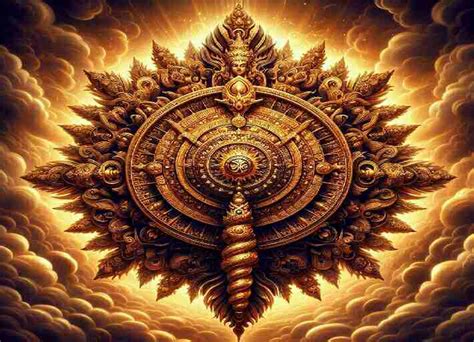
Vishnu with Sudarshana Chakra and Panchajanya Shankha
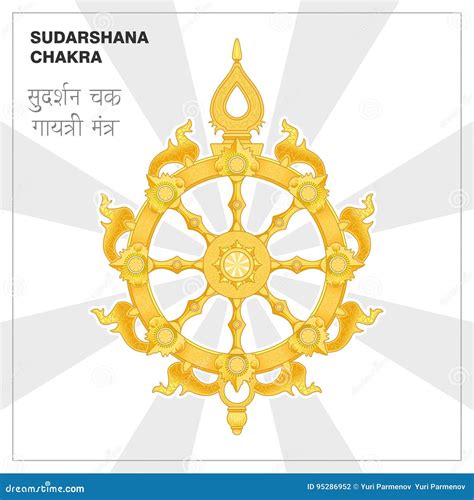
The Sudarshana Chakra: A Divine Weapon
The word Sudarshana is derived from two Sanskrit words - Su (सु) meaning "good/auspicious" and Darshana (दर्शन) meaning "vision". In the Rigveda, the Sudarshana Chakra is stated to be Vishnu's symbol as the wheel of time. The discus later emerged as an ayudhapurusha (an anthropomorphic form), as a fierce form of Vishnu, used for the destruction of demons. The Mahabharata features the divine discus as a weapon of Krishna, identified with Vishnu. The deity beheads Shishupala with the Sudarshana Chakra at the rajasuya yajna of Emperor Yudhishthira. He also employs it during the fourteenth day of the Kurukshetra War to obscure the sun.
The Ramayana states that the Sudarshana Chakra was created by the divine architect, Vishvakarma. The Puranas also state the Sudarshana Chakra was made by Vishvakarma, featuring a legend regarding its origin: Vishvakarma's daughter, Sanjña, was married to the sun god, Surya. However, due to her consort's blazing light and heat, she could not approach him. When she informed her father regarding this, Vishvakarma diminished the brilliance of the sun so that his daughter could be with him.
Following the self-immolation of Sati in the Daksha yajna, a grieving Shiva carried around her lifeless body and was inconsolable. To liberate him from his anguish, Vishnu employed Sudarshana Chakra to cut the corpse of Sati into fifty-one pieces.
Read also: Science of Chakras
Historical Evidence
Early historical evidence of the Sudarshana-Chakra is found in a rare tribal Vrishni silver coin with the legend Vṛishṇi-rājaṅṅya-gaṇasya-trātasya which P. L. Gupta thought was possibly jointly issued by the gana (tribal confederation) after the Vrishnis formed a confederation with the Rajanya tribe. However, there is no conclusive proof so far. Discovered by Cunningham, and currently placed in the British Museum, the silver coin is witness to the political existence of the Vrishnis. It is dated to around 1st century BCE. Vrishni copper coins dated to later time were found in Punjab.
Among the only two types of Chakra-vikrama coins known so far, there is one gold coin in which Vishnu is depicted as the Chakra-purusha. While the chakra is ancient, with the emergence of the anthropomorphic forms of chakra and shankha traceable in the north and east of India as the Chakra-Purusha and Shanka-Purusha; in the south of India, the Nayak period popularized the personified images of Sudarshana with the flames. In the Kilmavilangai cave is an archaic rock-cut structure in which an image of Vishnu has been hallowed out, holding the Shanka and Chakra, without flames. At this point, the Chakrapurusha with the flames had not been conceived in the south of India.
The Ahirbudhnya Samhita and Sudarshana
The Ahirbudhnya Samhita (Sanskrit: अहिर्बुध्न्यसंहिता, IAST: Ahiburdhnyasaṃhitā) is a Hindu Vaishnava text belonging to the Pancharatra tradition. In the Ahirbudhnya Samhita, Vishnu emanated in 39 different forms. The Samhita is characteristic for its concept of Sudarshana.
It provides mantras for Sudarshana, and details the method of worship of the multi-armed Sudarshana. Its chapters include explanations on the origin of astras (weapons), anga (mantras), Vyuhas, sounds, and diseases, how to make Sudarshana Purusha appear, how to resist divine weapons and black magic, and provides method for making and worshipping the Sudarshana Yantra. The Ahirbudhnya Samhita is the source of Taraka Mantra, Narasimhanustubha Mantra, three occult alphabets, Sashtitantra and select astra mantras. It also mentions the Purusha Sukta.
Various Pancharatra texts describe the Sudarshan chakra as prana, Maya, kriya, shakti, bhava, unmera, udyama and saṃkalpa. In the Ahirbudhnya Samhita of the Pancharatra, on bondage and liberation, the soul is represented as belonging to bhuti-shakti (made of 2 parts, viz., time (bhuti) and shakti (maya) which passes through rebirths until it is reborn in its own natural form which is liberated; with the reason and object of samsara remaining a mystery. Samsara is represented as the 'play' of God even though God in the Samhita's representation is the perfect one with no desire to play. The beginning and the end of the play is effected through Sudarshana, who in the Ahirbudhnya Samhita is the will of the omnipotent, omniscient, omnipresent God.
Read also: Anatomy of the Sacral Chakra
"In contrast to the relatively simple religious function of the Cakra-Purusa, the iconographic role of the medieval Sudarsana-Purusa of South India was exceedingly complex. The medieval Sudarsana was conceived as a terrifying deity of destruction, for whose worship special tantric rituals were devised. An early scriptural reference in obtaining the 'grace of Sudarshana' through building a temple for him can be found in the Ahirbudhnya Samhita, in the story of Kushadhvaja, a king of the Janakas, who felt possessed by the devil causing him various ills, due to a sin from his past life in killing a righteous king.
Temples Dedicated to Sudarshana
- Chakrapani Temple, Kumbakonam - located on the banks of the Chakra Bathing Ghat of the Kaveri river.
- Alathiyur Pavelikkara Narayanathu Kavu Sudarshana Temple, Triprangode, Malappuram. A rare sudarshana temple complex in Kerala dedicated to Lord Sudarshana. Along with the main deity, Badrakali, Shastha and naga are worshipped here.
- Thuravoor Sree Narasimha Moorthy Temple, Alappuzha- One of the rare temple complexes in Kerala, where two sanctum sanctorums are situated within a single Nalambalam (temple structure), one of the sanctums in dedicated to Lord Narasimha and the other to Maha Sudarsana Moorthy.
- Sreevallabha Temple, Thiruvalla, Pathanamthitta - One of the oldest and largest temples in Kerala and one of the 108 Divya Desams, Sudharsana Moorthy is worshipped along with Sreevallabha in this temple.
- Thrichakrapuram Temple, Puthanchira- The main deity is Sudharsana Moorthy. In the morning, the deity is worshiped as the fierce Maha Sudharsana Moorthy, and in the evening as the calmer Sudharsana Moorthy. The evening pujas are conducted without incense lamps and bells, in the form of hand gestures.
Iconography of Chakra Perumal
The icons of Chakra Perumal are generally built in the Vijayanagar style. There are two forms of Chakraperumal, one with 16 arms and another with 8 arms. The one with 16 arms is considered the god of destruction and is rarely found. The Chakraperumal shrine inside the Simhachalam Temple is home to the rare 16-armed form. The one with 8 arms is benevolent and is the form generally found in Vishnu's temples.
The Simhachalam Temple follows the ritual of Baliharana or purification ceremony. Sudarshana or Chakraperumal is the bali bera (icon that accepts sacrifices, as a representative of the chief deity) of Narasimha, where he stands with 16 arms holding emblems of Vishnu with a circular background halo. In Baliharana, Chakraperumal is taken to a yajnasala where a yajna (sacrifice) is performed, wherein cooked rice with ghee is offered while due murti mantras are chanted, along with the Vishnu Sukta and Purusha Sukta. The Sudarshana homam is performed by invoking Sudarshana along with his consort Vijayavalli into the sacrificial fire.
Lord Balaji Vishnu Shankh Symbol is used for mental and emotional healing. Brass is well known for its grasping capacity. It grasps the divine spirit upto 30%, when compared to other metals. Invoking divine blessings and protection is greatly enhanced in Hindu spirituality by the use of rituals and symbols.
Who Created Sudarshan Chakra? The Deadliest Weapon In Hinduism
Shankh Chakra Tilak for Doors
One of the most important of them is the custom of decorating entrances with Shankh Chakra Tilak for doors, which acts as a powerful talisman to fend off evil spirits and welcome good fortune into the house. The Shankh (conch shell) and the Chakra (discus) are two powerful symbols that combine to form the holy Shankh Chakra Tilak. In Hinduism, these symbols have great spiritual meaning; they stand for divine qualities and celestial powers that grant believers protection and blessings.
Read also: Discover Your Inner Chakra
The Shankh represents the primordial vibration of creation, resonating the cosmic hymn of existence with its spiraling form and resonant tone. Lord Vishnu wields a weapon called the Chakra, which resembles a disc and represents the cosmic order, divine justice, and the never-ending cycle of creation and destruction. As a potent protector of the house, the Shankh Chakra Tilak for Doors draws good fortune and blessings from the divine while fending off bad vibes and malevolent influences. Devotees establish a protective barrier that guards their home from harm and guarantees the wellbeing of everyone who resides within by displaying this holy insignia above the entrance door.
In addition, the Shankh Chakra Tilak creates a holy environment in the house that is full of reverence and devotion, encouraging family members to practice virtues like gratitude, compassion, and spiritual ambition.
Applying Shankh Chakra Tilak
Applying Shankh Chakra Tilak to entrances is a ritualistic practice that demands careful consideration and respect. Traditionally, water is blended with vermillion powder to make Tilak, which represents the holy blood of the gods. Devotees cleanse the gateway with holy mantras and turmeric-infused water before putting on the Tilak. Next, they meticulously sketch the Shankh and Chakra symbols on the doorframe with the right ring finger, then the Tilak in the middle. Devotees pray to Lord Vishnu while they apply the Tilak, asking for his divine presence and blessings on the house and its people.
Shankh Chakra Tilak installation at doors is a holy ceremony. Start by using turmeric-infused water to purify the doorway. Using the ring finger, apply a reverent vermilion Tilak while creating Shankh and Chakra symbols. Pray to Lord Vishnu and seek heavenly blessings for the house. Carry out this ceremony on a daily basis or on momentous occasions to create a holy environment. As a talisman, Shankh Chakra Tilak invites good fortune and protects against negativity.
Shanku Chakra Namam
For centuries, Shanku Chakra Namam has held immense spiritual and cultural importance in Hinduism. Shanku Chakra Namam, also known as the Vaishnava Tilak, serves as a sacred symbol in Hinduism, particularly among followers of Lord Vishnu. It represents devotion, purity, and the eternal presence of the divine.
Shanku Chakra Namam is typically applied on the forehead using sandalwood paste or clay. The design includes three vertical lines, with the middle line often being broader and white, representing the foot of Lord Vishnu. The tradition of wearing Shanku Chakra Namam dates back to ancient times. It has origins in the Vedic scriptures, where it is mentioned as a mark of divine favor and spiritual awakening.
Applying Shanku Chakra Namam is not just a ritualistic act; it is imbued with deep spiritual meaning. The process involves mindfulness and devotion, often accompanied by prayers and mantras. Shanku Chakra Namam is prominently featured during Hindu festivals such as Janmashtami, Diwali, and Rama Navami. Devotees apply it as part of their daily worship, symbolizing their dedication and spiritual discipline.
Beyond its visual representation, Shanku Chakra Namam holds profound philosophical significance. The conch symbolizes the primordial sound of creation, while the discus represents the cyclical nature of time and the universe. The impact of Shanku Chakra Namam extends beyond its religious symbolism. Many devotees and spiritual seekers share personal experiences of transformation and divine connection through this practice. The practice of Shanku Chakra Namam varies across different regions and communities in India. Each sect and region may have its distinct style and interpretation, reflecting the rich diversity within Hinduism.
Shanku Chakra Namam is more than a religious symbol; it is a profound emblem of faith, devotion, and spiritual awakening.
| Symbol | Meaning |
|---|---|
| Shankh (Conch) | Primordial sound of creation, mental and emotional healing |
| Chakra (Discus) | Cosmic order, divine justice, protection from negative energy |
| Shankh Chakra Tilak | Talisman for good fortune, protection against evil spirits |
| Shanku Chakra Namam | Devotion, purity, eternal presence of the divine |
Devotees who traverse life with bravery, wisdom, and unwavering faith find consolation, inspiration, and heavenly protection in the brilliant embrace of the Shankh Chakra Tilak for Doors. By decorating our homes with this holy symbol, we may call Lord Vishnu and Goddess Lakshmi into our lives and create a holy environment of love, wealth, and spiritual health.