Many first-time observers of the ancient art of dowsing have watched in mute fascination as a dowser seeks out - and finds - underground water. Although millions of people have come to accept dowsing as a unique ability or even a divine gift, few have examined this widespread and seemingly innocuous practice critically - with an eye to uncovering the real source behind its power.
Dowsing, also called “water witching,” is a method of locating underground water or buried treasure by tapping into what dowsers call spiritual energy. It involves different methods, but often the dowser holds a forked rod with the straight end pointed toward the ground. It is believed that the rod moves up or down when the dowser walks directly over the place where water or other material is present.
This article first appeared in the Christian Research Journal, volume 14, number 4 (Spring 1992). The modern impact of dowsing is unmistakable. Dowsing societies exist throughout the world - in Britain (e.g., The British Society of Dowsers), Kenya, Sweden, New Zealand, Austria, Argentina, Vietnam, Germany, India, Spain, Israel, Mexico, and other countries. In France, dowsers have a national union, and dowsing societies in many countries - such as the United States and Germany - have memberships of several thousand.
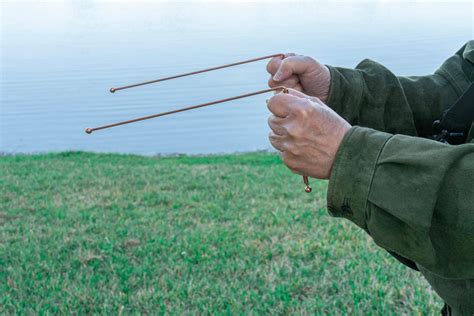
Dowsing rods being used to find water.
The Instruments and Methods of Dowsing
Dowsing itself is a broad category encompassing many different forms, one of which is dowsing for water. Consider the variety of implements that have been employed to dowse: pencils, scissors, pliers, welding rods, jewelry, candles, seashells, needles, bent coat hangers, crowbars, guns, whale or shark bones, barbed wire, clothes, water “bobbers,” feathers, “aura” meters, cut tree or shrub branches - even thumbs, fingers, hands, or feet (i.e., no instruments at all). Obviously, the kind of equipment one uses is irrelevant. The power resides somewhere else.
Read also: The Connection Between Buddhism and Spirituality
Traditionally, the most common method used is the dowsing twig, a forked (Y-shaped) branch from a tree or bush. Some dowsers prefer branches from particular trees, and some prefer the branches to be freshly cut. Hazel twigs in Europe and witch-hazel in the United States are traditionally commonly chosen, as are branches from willow or peach trees. The two ends on the forked side are held one in each hand with the third (the stem of the Y) pointing straight ahead.
Many modern dowsers use a pair of L-shaped metal rods. One rod is held in each hand, with the short arm of the L held upright, and the long arm pointing forward. The upright arm is often free to rotate inside a tube. When something is "found," the rods move in synchrony. Depending on the dowser, they may cross over or swing apart. If the object is long and straight, such as a water pipe, the rods may point in opposite directions, showing its orientation.
A pendulum weight on a short cord or thread is the tool of choice for many modern dowsers. The dowser holds the cord in one hand and allows the pendulum to swing freely.
How to Use Dowsing Rods to Talk to Spirit and Passed Loved Ones
Dowsing in Spirituality
Dowsing, an ancient practice used to detect unseen energies, water, minerals, and even lost objects, has fascinated spiritual seekers for centuries. Often associated with the mystical and the esoteric, dowsing is a powerful tool that bridges the gap between the physical and the spiritual realms. At its core, dowsing is about sensitivity to the energies around us. It requires the dowser to be in tune with their surroundings and to use their intuition to interpret the movements of the dowsing tool.
Dowsers claim that they possess a natural sensitivity to alleged earth magnetism, water “radiations,” or some other natural phenomenon. Worldwide, scientific testing of dowsing consistently disproves the dowser’s claim that it merely represents a natural or learned sensitivity to radiations or some other physical phenomenon. Careful examination of the claims and activities of dowsers (which are frequently contradictory) reveal that there is no factual basis for regarding dowsing as a physical phenomenon.
Read also: Defining Nature-Based Spirituality
Dowsing has a long and storied history, with evidence of its practice dating back thousands of years. The ancient Egyptians, Chinese, and Europeans all engaged in forms of dowsing, often using it to locate water sources or precious minerals. Despite its ancient roots, dowsing has remained relevant in modern times, with practitioners using it for a wide range of purposes, from finding underground water sources to connecting with spiritual energies.
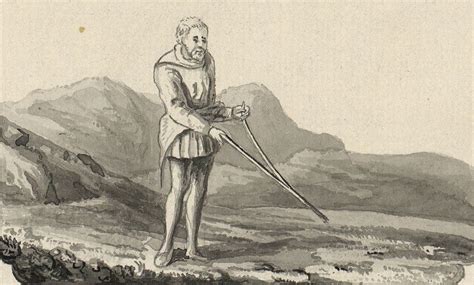
Dowsing for water using a forked branch.
Different Types of Dowsing
Raymond C. Willey is the author of Modern Dowsing: The Dowser’s Handbook. He has dowsed for over fifty years and was instrumental in organizing the American Society of Dowsers (ASD). He served as its secretary and was editor of its periodical, The American Dowser, for over a decade. Willey accepts four basic methods of dowsing:
- Field Dowsing - the “traditional” use of dowsing which involves locating water, objects, and so forth on a given terrain. This is called “witching the area”.
- Remote Dowsing - “witching the area” is not required in this approach. Instead, the dowser locates the target from a distance of up to several miles.
- Map Dowsing - the dowser locates the target using a map or sketch, often accompanied by the use of an occult pendulum. There are no distance limits here, since the dowser can supposedly locate his or her target even 10,000 miles away.
- Information Dowsing - the dowser obtains needed information on any subject with neither space nor time limits.
When people think of dowsing they often assume the process is confined to category one - field dowsing. In fact, it is all four categories that constitute the practice of dowsing. The reason for this is simple. Field dowsing appears to offer the greatest opportunity for a mundane explanation. Here we are presented with a variety of “naturalistic” theories to supposedly explain the phenomena - from an innate sensitivity, to so-called radiations, to currently unexplored alleged geophysical phenomena.
Dowsing and the Occult
From ancient times dowsing has been considered an occult art and has often been defined as a form of witchcraft. The common descriptive terms “witching” and “water witching” reveal how closely the taint of witchcraft has remained to this day. Let's consider one example of how Christian dowsers seek to justify their practice. In his article, “Dowsing: Its Biblical Background” (from The American Dowser), Reverend Norman Evans finds it difficult to admit that dowsing is not taught in Scripture. Still, he proceeds to claim, “Abraham, Issac and Jacob were undoubtedly dowsers.” He even classifies dowsing as one of the gifts of the Holy Spirit.
Read also: Exploring Spirituality and Evolution
The key question is: What is the true origin of the power used by the dowser? Nevertheless, every effort is made to remove dowsing from the halls of occultism. Here are reasons for classifying dowsing as an occultic, spiritistic power rather than the normal human ability or divine gift that dowsers claim:
- Many dowsers enter a trance when dowsing.
- Dowsing may cause one to develop other psychic abilities.
- Dowsing requires faith, respect, and a personal interaction/response with the rod.
- Dowsing is linked to other forms of the occult.
- Christian activities such as conversion and prayer hinder dowsing powers.
- Dowsing power is uncontrollable and supernatural.
Dowsing and Ghost Hunting
Water divining is just one use for divination rods. More recently, they’ve been adopted by the ghost-hunting community to locate ghostly inhabitants or ask questions in the spirit world. Many find a pair of L-shaped copper rods ideal for this purpose. To use dowsing rods in this manner, hold them firmly but not too tightly. You want to hold each divining rod in a relaxed position with your elbows close to your sides.
Next, you’ll need to calibrate your rods - this means determining what movement means yes and what means no. You can simply state aloud which action means which to do so. After you’ve established which action means what (i.e., crossed rods indicate a “yes” and open rods indicate a “no”), you can begin asking questions. Many diviners using rods to speak with spirits recommend first introducing yourself and asking if the spirit would like to talk to you. If they say no, it’s best to respect their wishes.
If the response is positive, you can continue asking questions that require yes or no responses. If you would like to use your rods to detect the presence of a spirit, many say that the rods will turn inward to form an X to represent a site where a spirit’s energy may be especially strong. You can begin any investigation with this step, locating the presence of a spirit. If the rods begin to react erratically at any point, you can ask the spirit if they would like to lead you somewhere, show you anything, or tell you something.
Scientific Studies and Skepticism
Dowsing studies from the early twentieth century were examined by geologist John Walter Gregory in a report for the Smithsonian Institution. Geologist W. A. MacFadyen tested three dowsers during 1943-1944 in Algeria. A 1948 study in New Zealand by P. A. Ongley tested 75 dowsers' ability to detect water. None of them was more reliable than chance.
A 1990 double-blind study was undertaken in Kassel, Germany, under the direction of the Gesellschaft zur Wissenschaftlichen Untersuchung von Parawissenschaften (Society for the Scientific Investigation of the Parasciences). James Randi offered a US$10,000 prize to any successful dowser. The three-day test of some thirty dowsers involved plastic pipes through which water flow could be controlled and directed. The pipes were buried 50 centimeters (19.7 in) under a level field, the position of each marked on the surface with a colored strip. The dowsers had to tell whether water was running through each pipe. All the dowsers signed a statement agreeing this was a fair test of their abilities and that they expected a 100% success rate.
The dowsing apparatus is known to amplify slight movements of the hands caused by a phenomenon known as the ideomotor response: people's subconscious minds may influence their bodies without consciously deciding to take action. Science writer Peter Daempfle has noted that when dowsing is subjected to scientific testing, it fails.
Ultimately, whether these divination techniques hold any water is for the user to decide. You’ll find plenty of skeptics out there - but there are also heaps of dedicated supporters who adamantly believe in the power of dowsing, be it for finding groundwater or answering life’s deepest questions. The only way you’ll ever know for sure is to try the practice yourself.
tags: #dowsing #rods #for #spirituality