Reiki is an ancient healing practice passed down orally from master to student. Administered by laying-on of the hands, Reiki’s popularity is growing. Anybody can learn how to apply this healing tradition.
Many have debated the correct Reiki hand positions, forgetting that this healing modality is more of an art form than an exact science.
The hand positions should be used as a guide in Reiki practice. A Reiki practitioner should always remain responsive to what the client needs in the moment and this may entail a deviation away from a ‘typical’ treatment session.
Traditional vs. Modern Reiki Hand Positions
Like anything else, Reiki has evolved, and so did the techniques people use these days. That’s how the Reiki hand positions split today into “traditional” and “modern.” These are not official terms but an easy way to differentiate the two. Both work just as well.
Most schools of modern Reiki follow a process of specific Reiki hand placements corresponding with the seven Chakras of the body - beginning at the head and working down to the feet. This approach delivers a session akin to a total body tune-up.
Read also: Enhancing Well-being with Reiki
Traditional or Oriental Reiki schools give more control to the practitioner, focusing on specific problem areas and relying on intuition more than adherence to a rigid protocol.
With time, Reiki has evolved, and new approaches have emerged by borrowing from other traditions. Still, both the traditional and non-traditional hand positions have their benefits.
General Guidelines for Reiki Hand Positioning
In Reiki hand positioning, the thumb and fingers are typically held close together. Because each finger contains the ending of a zone or meridian with alternating positive or negative charges, keeping them all together creates a linked energy field - resulting in a stronger, unified healing power.
Since the hand positions are primarily located over the chakras, a deep understanding of the chakra system is helpful when studying of Reiki. Every hand position is typically held for several minutes - or until an energetic change is detected.
It’s important for the practitioner to be in a comfortable, relaxed position.
Read also: Reiki Levels Seattle
Reiki Hand Positions Guide
Here are some of the most common Reiki hand positions:
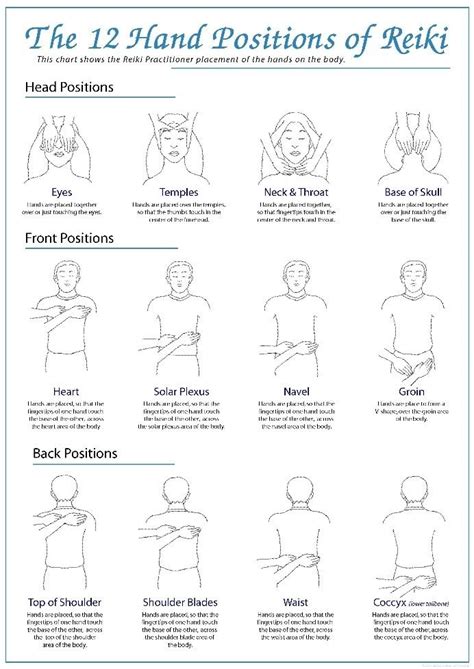
Head Positions
- Brow: Without applying any pressure, the hands are delicately positioned on (or over) the recipient’s face, with the palms cupped over the eyes and fingers on the cheekbones.
- Third Eye/Brow/Crown: On the sides of the head, the fingers are in front of or over the recipient’s ears - resting the palms on the client’s temples.
- Crown/Occiput: Behind the head, fingers touch the top of the neck, allowing the occiput to rest naturally in the practitioner’s slightly cupped palms. Added to the Crown/Occipital hold, many Reiki practitioners include the Cranial-Sacral technique of finding the Still Point to aid spinal alignment.
Torso Positions
- Throat: The hands come across both sides of the throat so that the fingers meet in the center, with the hands either making a tent over the throat or gently resting on the throat. Since many find this chakra extra sensitive, additional awareness of the client’s comfort is warranted. Alternate placements are one hand at the front and the other at the back of the neck or creating a V with the hands just below the throat.
- Heart: With hands beside each other or end-to-end (fingers of one hand at the wrist of the other), hands are placed over the breastbone or above the breasts. An incredibly efficient position for women is placing the palms over the breasts. We know from Sensei Takata that if you feel an area drawing in more energy, it means that it requires more attention.
- Solar Plexus: Hands are held beside each other on one side of the recipient’s lower ribs and then moved to the other side.
- Solar Plexus/Belly: Below the ribs, hands are placed end-to-end across the recipient’s waist, covering most of the internal organs.
- Belly: Hands are placed over the pelvic bones. Most schools describe this position with hands pointing inferiorly over the pelvic bones. Again, this position is best applied sitting to one side of the client.
- Root: The hands are brought together in the center of the lower abdomen, one above the other, just above the pubic bone. Due to the sensitive nature of this location, some practitioners will skip the root chakra. However, it can be a very powerful Reiki location.
Lower Body Positions
- Knees: Several schools consider this position optional, but it can be greatly appreciated by clients with knee problems. Our knees are strongly connected with our vital energy and to our deep, inner-self manifestation.
- Ankles: Also regarded as an optional Reiki location, this position involves covering the ankles with the hands. Similar to your knees, your feet and ankles can trap residual energies from the places you’ve visited.
- Feet: The final position is to place hands on the soles of the feet. Our soles are like maps. They have reflex points that treat multiple parts of our body. Sending Reiki to them will gradually stimulate those points. As said before, our legs, knees, feet, and soles are in strong connection to the Earth Star, Root and Sacral chakras. Sit in a chair and hold each foot between your palms. Send light for 10 minutes or for as long as you feel like.
Reiki Self-Care Treatment Guide
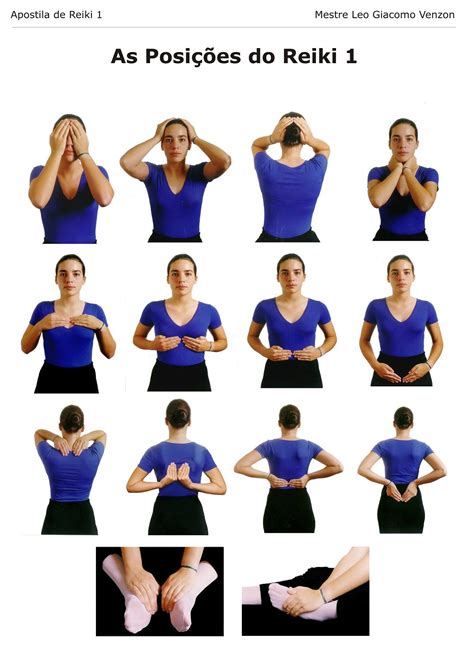
To show the hand positions, we’ve included a suggested Reiki self-care treatment taken from the Reiki Guidebook to Self-care. This session should take approximately 20 minutes with each hand position taking approximately 2 minutes each. The time frame should only be used as a guide. If this is your first time conducting a session like this, take your time and don’t worry about exact hand positioning. Relax and immerse yourself in the process of connecting to your body and the sensations that arise as you change each hand position.
- Place your hands in a prayer position in the center of your chest, just beneath your chin. Focus on your breathing as you breathe in and out slowly.
- Place both hands on top of the head. Maintain your deep breathing in and out. Focus on the top of your head and begin to relax this area as you feel the connection of your hands to the skin on your head.
- Place both hands over your eyes. Maintain your slow breathing in and out. Focus on your forehead, eyes, and face. Relax this area as you feel the connection of your hands to the skin on your face.
- Place your right hand over your throat and your left hand over your heart. Maintain your relaxed breathing in and out. Focus on your hands over your throat and heart. Relax these areas as you feel the connection of your hands to the skin.
- Place your hands just below your breast line. Connect your middle fingers from each hand. Maintain your relaxed breathing in and out. Focus on your hands over your chest and ribs. Relax these areas as you feel the connection of your hands to the skin.
- Place your hands over your upper stomach and solar plexus area. Maintain your relaxed breathing in and out. Focus on your hands over this area. Relax these areas as you feel the connection of your hands to the skin.
- Place your hands over your stomach and navel area. Maintain your relaxed breathing in and out. Focus on your hands over your stomach. Relax these areas as you feel the connection of your hands to the skin.
- Place both hands on the shoulder muscles. Maintain your relaxed breathing in and out. Focus on your hands over your shoulders. Relax these areas as you feel the connection of your hands to the skin.
- Place your hands around your waist and kidney area. Maintain your relaxed breathing in and out. Focus on your hands over this area. Relax as you feel the connection of your hands to the skin.
- Place your hands on the top of your feet or you may choose to place your hands over the soles of your feet. If covering both feet together is uncomfortable, do this exercise one foot at a time. Do not over stretch or create any tension as this is the opposite of the feeling you are attempting to pursue in this Reiki session. Maintain your relaxed breathing in and out. Focus on your hands over your feet. Relax as you feel the connection of your hands to the skin.
Tips for Remembering Reiki Hand Positions
Learning the Reiki hand positions is like learning anything new that involves new concepts. In total, there are 10 positions in this flow. Below is a suggested guide on how to remember the Reiki hand positions:
- Read through all 10 positions.
- Read through all 10 positions again as you hold your hands in the same positions
- TEST: Can you remember the first 2 positions yet? If not, then focus on memorizing the first 2 positions - center chest and top of the head
- Run through the first 4 positions and say them out loud - chest, head, eyes, throat/heart. These techniques are based on the common learning techniques of spaced repetition and chunking. Spaced repetition is based on the premise of regularly practicing learning new content over time. Chunking is based on breaking down content and reforming it into meaningful groups of information.
- Learn the next 3 positions (chunking) are all around the middle area in the front part of the body - breast line, upper stomach, stomach/navel
- TEST: Recall the first 4 positions again and say them out loud - chest, head, eyes, throat/heart. Run through these positions again using your hands.
- TEST: Recall the middle 3 positions again and say them out loud - breast line, upper stomach, stomach/navel. Run through these positions again using your hands.
- Learn the next 2 positions are on the back of your body - shoulders and waist/kidney area
- TEST: Recall the first 4 positions, the middle 3 positions, and the back 2 positions.
- Learn the past position - the feet. The above is 10 steps to learning the 10 hand positions. Take a break after your work through the 10 steps. Then come back to see how many you can recall from the 10 hand positions.
Incorporating Reiki into Daily Life
Perhaps you’ve completed that Reiki Level 1 training you’ve had your eye on for so long-or perhaps even Levels 2 and 3! Spending as little as 15 minutes a day in your self Reiki routine can yield powerful benefits for your mind, body, and spirit.
People from all walks of life, ranging from young adults to the elderly, stay-at-home parents to working professionals, practice self Reiki and experience transformation through consistent treatments.
Read also: Practicing Reiki Prayer
Include all elements of Reiki in your practice. This can encompass the Precepts, attunements, meditation, breathing exercises, hands-on healing, mindfulness, and the symbols. Doing so will keep your practice dynamic and interesting while also challenging you on multiple fronts.
Setting overly high expectations can lead to disappointment, so instead, choose a realistic commitment that you can maintain. It might be 15 minutes a day or 30 minutes every other day. Once you’ve established your goal, create a system to track your practice, whether it’s on a calendar, in a journal, or using a spreadsheet. After each practice session, jot down a few thoughts and feelings.
Hold yourself accountable by following a practice plan or course. In my Reiki training sessions, I provide students with a 21-day practice plan. This plan allows them to explore various elements of the Usui Reiki system and different styles of practice. I also recommend repeating the plan multiple times to delve deeper into the exercises.
Approach your practice with compassion, patience, and acceptance. Challenge yourself to release judgment and let your 15 minutes on the mat be a time of self-exploration rather than seeking perfection. Remember that the effectiveness of the techniques you study is enhanced by the softness you bring to them.
Similar to many other disciplines, Reiki isn’t learned in a single day of training or even across three levels of training. It’s an ongoing practice, and having a mentor can help you identify ‘blind spots’ in your practice. They can also guide you in recognizing your personal growth, upcoming opportunities, and special gifts that you may be hesitant to embrace.
Reiki Self-treatment Hand Positions (20 minutes)
Important Considerations
While touch is a fundamental element of Reiki that is grounding the nervous system and symbolizes compassion, there is no single protocol of hand positions that is correct or superior to others. As your practice evolves, you may find that meditation, visualization, intention, breathwork, and the quality of heart-mind (Kokoro) are equally significant, if not more so, than physical touch. In fact, Reiki can be practiced with or without touch.
The positioning of the hands does not inherently draw ‘more’ energy or produce better results. In your self-healing practice, you can position your hands either directly on the body or a few inches away from it (within the aura). Some practitioners prefer to begin at their feet and gradually move their hands upward, while others may start at the crown of the head or another location. You can opt to place your hands over ten or more areas of the body or focus on a single area, depending on the time available. The key is to allow yourself to experiment with different protocols until you find a routine that works for you.
Some practitioners may feel guided to balance the flow of energy between two areas of the body. You may also trust your intuition if you feel compelled to sweep energy away, cut energetic cords, or seal the aura.
The placement of hands in your self Reiki practice can also be guided by Byosen Scanning, a Usui technique in which the aura is ‘combed’ to identify areas of imbalance.
Potential Side Effects of Self Reiki
Since Reiki is a holistic therapy that relaxes the nervous system and restores the mind, body, and spirit, there are very few contraindications to Reiki. When receiving Reiki or practicing self Reiki, you may experience detoxification of the body, heightened self-awareness, increased intuition, and heightened empathic tendencies. However, these experiences are part of the healing journey and can be managed with appropriate supervision.
If you experience detoxification as a result of Reiki, it typically lasts 1-3 days. It’s best to support your body with rest, water, and gentle foods. It’s also normal to become more aware of feelings and stories that you were previously suppressing.
When practitioners develop a lifestyle with greater self-awareness, they may notice increased feelings of sadness, frustration, and overwhelm. Most importantly, do not identify too closely with these emotions. Acknowledge that they are simply energies that you have the power to shift and release.
If you experience heightened intuition or empathic tendencies in a way that is uncomfortable or fear-inducing, you can work with your teacher to ground the energy body. There are numerous techniques for creating energetic protection to ensure that you can experience your spiritual nature safely.
Meditative Awareness and Reiki
Developing meditative awareness is foundational to practicing reiki. It can teach us to be witnesses of our experiences and to become open channels. Reiki meditations encompass breathing exercises, intention setting, contemplation, hands-on-healing, chanting, visualization and more.
How to Begin Channeling Reiki
Reiki is an energy healing modality that has been made accessible and approachable for those who are new to a spiritual lifestyle. Dr. Mikao Usui introduced meditations and philosophies that can facilitate self-healing and self-awakening.
You can begin to channel Reiki by participating in Reiki Level 1 training and receiving the appropriate attunements. Attunements are sacred rituals that open your energy field and facilitate a remembrance of the healing light that has always been within you. Students typically have a more tangible experience of Reiki and can access the energy as needed.
You can develop your ability to channel Reiki through daily self Reiki meditations.
Additional Reiki Techniques
Reiki practitioners often look to enhance their practice, and find new ways to do so. The key is using the right one for the situation. Here are a few additional techniques:
- Distant Reiki: Simply put, this represents the idea of sending light to someone, something or an event. Just hold your palms up with the intention of sending Reiki to the desired person or situation. It is advisable to visualize the beam of light ejecting out of your hands. This action will amplify its effect.
- Scanning: While holding your palms one next to the other, slowly scan the body (from the head, down to the feet) for any difference in vibration. The received sensations may differ from one person or one area to another.
- Combing: This is a technique that you will rarely find written anywhere and it is very effective. Basically, after self-treatment you can use your hands or just visualize how you are brushing with your hands any residue/negative energy from your energy fields, sending it to the ground (like combing).
- Tapping: Simply use a rhythmic tap, using your fingers (or the tip of your fingers) on the affected area.
- Swiping: After your self-treatment, simply use the right arm to swipe on the left arm and vice versa - 3 times for both. The same for the upper body part - use the right arm to swipe starting from your left shoulder and finishing to the right hip.