Starch retrogradation is a fascinating and crucial phenomenon in food science, impacting the texture, digestibility, and overall quality of many starch-based foods. It refers to the recrystallization or realignment of amylose and amylopectin chains upon cooling of gelatinized starch gels.
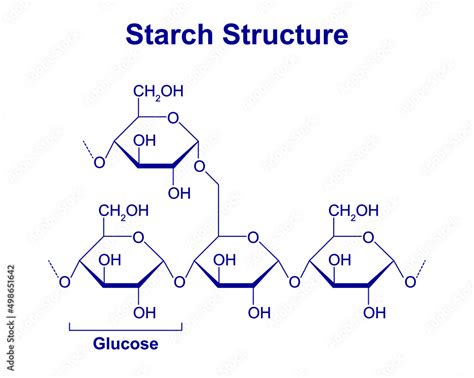
Structure of amylose and amylopectin molecules in starch
The Basics of Starch and Gelatinization
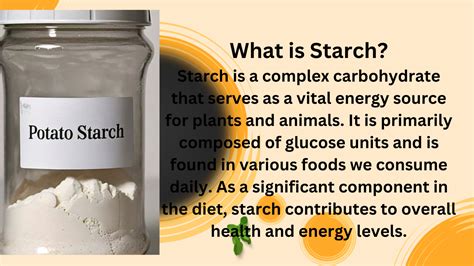
Starch, a homopolysaccharide, is a complex carbohydrate composed of two main types of molecules: linear amylose and branched amylopectin. These molecules are arranged in microscopic round granules. Starch is the ultimate storage carbohydrate in plants and is further composed of linear amylose and branched amylopectin. Starch is used broadly in food industries because of its abundance, renewability, and low price [2].
Gelatinization is a process that occurs when starch is heated in the presence of water. During gelatinization, the crystalline structure of amylose and amylopectin molecules is lost, and they hydrate to form a viscous solution. Starch is usually gelatinized by heating in the presence of water, which results in the disruption of the native starch granules along with an order-to-disorder transition [4]. This causes the food to become softer and more digestible, as the starch and water form a gel. This process is called gelation. Amylopectin gelates at a lower temperature than amylose, and swells up more, because the molecule’s shape allows it to take in a lot more water.
The Retrogradation Process
Retrogradation is just opposite of the starch gelatinization. Here, the term retrogradation denotes the reversal mechanism. On storage or cooling after gelatinization, the disordered amylose and amylopectin chains gradually reassociate or rearrange into a different ordered structure, and this is known as retrogradation [5].
Read also: Human Design: Triple Split Explained
If the viscous solution is cooled or left at lower temperature for a long enough period, the linear molecules, amylose, and linear parts of amylopectin molecules retrograde and rearrange themselves again to a more crystalline structure. In viscous solutions the viscosity increases to form a gel. Upon cooling, the amylose and amylopectin chains retrograde in a parallel fashion. Then, it leads to the formation of a compact or crystalline structure of starch.
The retrogradation process involves:
- Realignment of Amylose Chains: Amylose recombines in an irreversible manner to produce a crystal nucleus. It is a rapid process, as the reassociation becomes faster due to the linear structure of amylose.
- Reorganization of Amylopectin Chains: Unlike amylose, amylopectin retrogradation takes a long time to crystallize, taking several days or weeks due to its branched structure.
Retrogradation can expel water from the polymer network. This process is known as syneresis. A small amount of water can be seen on top of the gel. Upon ageing of the gelatinized substance, amylose and amylopectin reassociate or recrystallize.
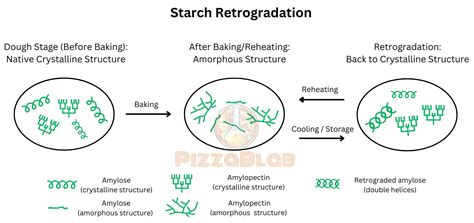
Schematic representation of the starch retrogradation process
Factors Influencing Retrogradation
Several factors can influence the rate and extent of starch retrogradation:
Read also: The Role of the Spiritual Gatekeeper
- Temperature: At temperatures between −8 °C (18 °F) and 8 °C (46 °F), the aging process is enhanced drastically. The temperature range between cooking starch and storing in room temperature is optimum for amylose crystallization, and therefore amylose crystallization is responsible for the development of the initial hardness of the starch gel.
- Type of Starch: The retrogradation rate differs depending upon the starch type and composition. Waxy, high amylopectin, starches also have much less of a tendency to retrogradate.
- Amylose Content: Since amylose is more susceptible to retrogradation than amylopectin, the influence of retrogradation on gelatinization temperatures is less pronounced for varieties belonging to the waxy group (exhibiting AAC% ≤ 10%).
- Length of Amylopectin Chains: Amylopectin with short branches constitute the crystalline region.
- Proteins: These serve as emulsifiers and can negatively affect the retrogradation properties of the paste.
- Lipids: Monoglycerides are lipids that interact with free amylose, forming complexes that obstruct amylopectin crystal formation.
- Physical Modification: Repeated freezing of the starch gel aggravates retrogradation, resulting in the formation of RS-III (resistant starch).
- Chemical Modification: A chemical process like acetylation reduces the retrogradation tendency of starch. Sugar molecules also delay retrogradation. Chemical modification of starches can reduce or enhance the retrogradation.
- Storage Conditions: The storage conditions such as the storage time and temperature are crucial factors that influence and govern the degree of retrogradation and in turn, affect the formation of resistant starch and alteration of thermal and rheological properties.
Retrogradation and Resistant Starch
Based on its digestibility, Total starch (TS) is categorized into resistant starch (RS), and non-resistant starch (NRS). RS is characterized as a starch fraction that does not undergo digestion or breakdown by digestive enzymes in the human gastrointestinal tract and hence results in a low glycemic index. It has been reported that retrogradation of starch alters its RS content and ultimately varies its digestibility. On the other hand, NRS is the starch faction that is easily digested and releases glucose into the bloodstream after consumption [6].
Retrogradation of starch alters its RS content and ultimately varies its digestibility. The alteration in the thermal properties of retrograded rice compared to native raw rice starch is beneficial for several applications in the food industry such as rice vermicelli, noodles, breakfast cereals, and parboiled rice.
Total starch (TS%), non-resistant starch (NRS%), and resistant starch (RS%) with increasing time and decreasing temperature of storage
Examples of Starch Retrogradation
Here, we will take the example of starch retrogradation in bread and rice.
- Bread: In the dough stage, starch molecules are in crystalline form. Then, the raw bread dough gelatinizes at about 150° C. The starch absorbs water, swells, and becomes semi-firm during this stage. Upon ageing and cooling below the gelatinization temperature, the starch molecules recrystallize.
- Rice: Starch molecules in raw rice have a crystalline structure. By cooking rice in water, the starch molecules gelatinize. The rice grain swells by absorbing water.
Ever eaten cold leftover rice? Then you, like so many of us, have the imperishable sense memory of retrogradation, the way the grains rattle as you scoop them and grind grittily between your teeth. One reason many cooks prefer day-old rice for making fried rice is because, with the moisture locked inside, the surfaces of the grains are nice and dry so they sear rather than steam in the hot wok.
Table 1: Peak Gelatinization Temperature (Tp) of Native and Retrograded Rice Samples
| Rice Variety | Raw (°C) | Freshly Cooked (°C) | Stored 6h at 4°C (°C) | Stored 12h at 4°C (°C) | Stored 6h at -20°C (°C) | Stored 12h at -20°C (°C) |
|---|---|---|---|---|---|---|
| Diasang lahi | 56.12 | 62.50 | 64.80 | 66.20 | 67.50 | 69.10 |
| Khaju lahi | 68.45 | 70.12 | 72.34 | 73.56 | 74.89 | 76.23 |
| Dhusuri bao | 72.50 | 74.20 | 76.50 | 77.80 | 79.10 | 80.50 |
| Omkar | 75.30 | 77.10 | 79.40 | 80.70 | 82.00 | 83.40 |
| Bili rajamudi | 79.05 | 80.80 | 78.50 | 82.60 | 83.90 | 85.30 |
Table 2: Degree of Retrogradation (%DR) of Rice Samples with Increasing Time and Decreasing Temperature of Storage
| Rice Variety | Freshly Cooked | Stored 6h at 4°C | Stored 12h at 4°C | Stored 6h at -20°C | Stored 12h at -20°C |
|---|---|---|---|---|---|
| Diasang lahi | 10.2 | 15.5 | 20.3 | 25.8 | 30.2 |
| Khaju lahi | 12.5 | 18.0 | 23.1 | 28.7 | 33.5 |
| Dhusuri bao | 15.0 | 20.6 | 25.9 | 31.6 | 36.5 |
| Omkar | 17.8 | 23.5 | 29.0 | 34.8 | 40.0 |
| Bili rajamudi | 16.2 | 21.9 | 27.3 | 33.0 | 38.0 |
Table 3: Total starch (TS%), non-resistant starch (NRS%), and resistant starch (RS%) with increasing time and decreasing temperature of storage
| Rice Variety | Starch Type | Raw | Freshly Cooked | Stored 6h at 4°C | Stored 12h at 4°C | Stored 6h at -20°C | Stored 12h at -20°C |
|---|---|---|---|---|---|---|---|
| Diasang lahi | TS% | 85.2 | 84.5 | 84.0 | 83.5 | 83.0 | 82.5 |
| NRS% | 70.1 | 78.3 | 75.6 | 73.2 | 70.5 | 68.0 | |
| RS% | 15.1 | 6.2 | 8.4 | 10.3 | 12.5 | 14.5 | |
| Khaju lahi | TS% | 86.5 | 85.8 | 85.3 | 84.8 | 84.3 | 83.8 |
| NRS% | 71.2 | 79.5 | 76.8 | 74.4 | 71.7 | 69.2 | |
| RS% | 15.3 | 6.3 | 8.5 | 10.4 | 12.6 | 14.6 | |
| Dhusuri bao | TS% | 87.8 | 87.1 | 86.6 | 86.1 | 85.6 | 85.1 |
| NRS% | 72.3 | 80.6 | 77.9 | 75.5 | 72.8 | 70.3 | |
| RS% | 15.5 | 6.5 | 8.7 | 10.6 | 12.8 | 14.8 | |
| Omkar | TS% | 89.1 | 88.4 | 87.9 | 87.4 | 86.9 | 86.4 |
| NRS% | 73.4 | 81.7 | 79.0 | 76.6 | 73.9 | 71.4 | |
| RS% | 15.7 | 6.7 | 8.9 | 10.8 | 13.0 | 15.0 | |
| Bili rajamudi | TS% | 90.4 | 89.7 | 89.2 | 88.7 | 88.2 | 87.7 |
| NRS% | 74.5 | 82.8 | 80.1 | 77.7 | 75.0 | 72.5 | |
| RS% | 15.9 | 6.9 | 9.1 | 11.0 | 13.2 | 15.2 |
Retrogradation isn’t just an annoyance; it’s also a useful property of starch, and not just for fried rice. For instance, the injunction to WAIT after you take a fresh-baked, incredible-smelling loaf of bread out of the oven before you cut into it is not just to torment you: The important thing that happens during those agonizing minutes is that the amylose in the bread retrogrades as it cools, turning from a gummy and somewhat formless hot mess into a sliceable, chewable structure.
Over the next few days, of course, the amylopectin in the bread retrogrades, which is part of what makes it turn stale.
Why bread Become stale!? Retrogradation of starch Why bread Become hard!!? weeping of water
tags: #retrogradation #of #starch #definition