Mars has long been a focal point in the search for extraterrestrial life, captivating enthusiasts with its rocky landscapes and canyon-filled terrain reminiscent of Arizona. Amateur explorers have dedicated years to scrutinizing images from Mars rovers and orbiters, seeking clues of past or present life. Among the most intriguing, yet controversial, theories is the possibility of a crashed alien spacecraft on the Red Planet.
It's a lovely and intriguing idea. It's also unlikely to pan out. Indeed, these homebody detectives just suffered another setback.
Recently, new images released by NASA reveal what looks like a crashed flying saucer on the planet Mars belonging to aliens. And while it may appear this way, the space agency says that’s not the case.
According to NASA, the agency’s Ingenuity Mars Helicopter recently surveyed the parachute that helped the agency’s Perseverance rover land on Mars, along with a cone-shaped backshell that protected the rover in deep space during its descent toward the Martian surface on February 18.
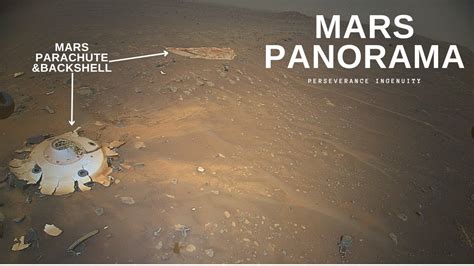
This image of Perseverance’s backshell and parachute was collected by NASA’s Ingenuity Mars Helicopter during its 26th flight on April 19, 2022.
Read also: Socorro UFO Incident
The Medusae Fossae Formation: A Volcanic Deception?
One particular artifact, located in a region of Mars known as the Medusae Fossae Formation, has been mistaken by some for a crashed alien spaceship. The Medusae Fossae Formation is a strange-looking geologic deposit the size of Alaska and Texas combined.
The artifact is located in a region of Mars known as the Medusae Fossae Formation. It's a strange-looking geologic deposit the size of Alaska and Texas combined. It's also notable for the fact that radar signals aimed its way are only weakly reflected, a "stealth" attribute that some consider to be possibly unnatural.
The purported spaceship is big compared to our own rockets - about the size of the Notre Dame football stadium. Even so, it's nearly lost in the corrugated expanse of the Medusae Fossae Formation.
But if you can find it, and if you screw up your eyes, it looks like a saucer-shaped craft that bungled its landing and slid into the Martian dirt.
In a paper published recently in the "Journal of Geophysical Research: Planets," scientists at Johns Hopkins University offer a simple explanation for the odd topography of an artifact that some mistook for a crashed alien spaceship. They say the purported spacecraft is actually something only a geologist could love - the handiwork of ancient volcanism, not Vulcans.
Read also: Unraveling UFO Mysteries
The Johns Hopkins researchers carefully determined the properties of the "landing site." They measured the average density of the material in Medusae Fossae, and it turns out to be low - only 1.7 times the density of water. That's lightweight compared to the average density of Earth's crust, which is 3.0 times that of water.
Medusae Fossae is not solid rock, but layers of debris - volcanic ash that was spewed into the Martian skies long ago. Its low radar reflectance is not some manifestation of Klingon cloaking technology but what you'd expect from a pile of grainy, volcanic ejecta.
According to Ross Beyer, a research scientist at the SETI Institute, the supposed spacecraft is "just a hill." It's some elevated topography that was swamped billions of years ago by all that volcanic debris, he said, a "lone small hill or knob that existed before the ash blanketed a lot of real estate. This may be the tip of a taller hill that was buried, and there may be other hills in this region that were not as tall and are buried completely, leaving only this one standing above the debris."
In other words, just like an iceberg, most of the suspected saucer's bulk is invisible - hidden by a sea of loose crud. It's ash, not a crash.
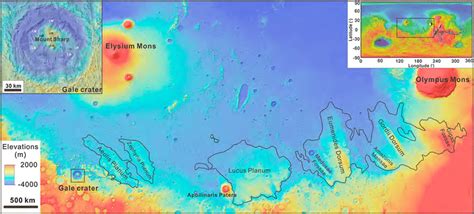
A global geographic map of Mars, with the location of the Medusae Fossae Formation circled in red.
Ingenuity's Aerial Survey: A New Perspective
NASA's Ingenuity helicopter, the first to fly on another planet, has beamed back some of the most fascinating photos of the red planet yet, showing off what is actually debris from its landing aboard the Perseverance rover in February 2021.
Read also: Details on the UFO crash retrieval whistleblower's claims.
The 10 aerial color photos feature both the parachute that aided the roughly $2.5 billion rover's landing, as well as the cone-shaped backshell that protected it during its intense descent to the surface. They were taken during Ingenuity's 26th flight, NASA said.
"NASA extended Ingenuity flight operations to perform pioneering flights such as this," said Teddy Tzanetos, Ingenuity's team lead at the Jet Propulsion Laboratory. "Every time we're airborne, Ingenuity covers new ground and offers a perspective no previous planetary mission could achieve."
Scientists say that the entry, descent and landing on Mars is stressful not just for them, but for the rovers themselves - due to the high temperatures and other extremes that come with it.
The backshell impacted the surface of Mars at about 78 miles per hour - but the images show that its protective coating appears to have remained intact, as did many of the 80 high-strength suspension lines that connect it to the parachute. Only about a third of the massive 70.5-foot-wide striped parachute, which contains a hidden message, is visible in the images, the rest crumpled and covered in dust.
This image of the backshell and supersonic parachute of NASA’s Perseverance rover was captured by the agency’s Ingenuity Mars Helicopter during its 26th flight on Mars on April 19, 2022. (Credit: NASA/JPL-Caltech)
"The aeroshell protects the spacecraft from the intense heating and deceleration of atmospheric entry. The supersonic parachute helped slow the spacecraft from around 1000 mph to 180 mph. Since 180 mph is still too fast to land safely, the aeroshell and parachute were jettisoned at about 1.3 miles above the ground and the rest of the descent was completed using rocket engines," Chen continued.
"The jettisoned aeroshell and parachuted continued to fall to where we can see them in these images and likely hit the ground around 80 mph. The aeroshell wasn’t designed to survive a ground impact of that speed so it’s not surprising that it has broken up a bit."
NASA says the images have the potential to help ensure safer landings for future spacecraft such as the Mars Sample Return Lander - a campaign that will bring Perservence’s samples of Martian rocks, atmosphere and sediment back to Earth for analysis.
Ingenuity helicopter on Mars! See Perseverance's latest pics
"Perseverance had the best-documented Mars landing in history, with cameras showing everything from parachute inflation to touchdown," said JPL’s Ian Clark, former Perseverance systems engineer and now Mars Sample Return ascent phase lead. "But Ingenuity’s images offer a different vantage point. If they either reinforce that our systems worked as we think they worked or provide even one dataset of engineering information we can use for Mars Sample Return planning, it will be amazing. And if not, the pictures are still phenomenal and inspiring."
| Feature | Description |
|---|---|
| Medusae Fossae Formation | Large geologic deposit, size of Alaska and Texas combined |
| Density of Medusae Fossae | 1.7 times the density of water |
| Density of Earth's crust | 3.0 times the density of water |
| Ingenuity Helicopter | First helicopter to fly on another planet |
| Perseverance Rover | Rover searching for signs of ancient life on Mars |
Could NASA Have Accidentally Discovered and Killed Life on Mars?
Dr. A controversial claim suggest that there may be living microbes just below the surface of Mars, which have gone undetected because they were killed in previous experiments.
A scientist recently claimed that NASA may have inadvertently discovered life on Mars almost 50 years ago and then accidentally killed it before realizing what it was.
After landing on the Red Planet in 1976, NASA's Viking landers may have sampled tiny, dry-resistant life-forms hiding inside Martian rocks, Dirk Schulze-Makuch, an astrobiologist at Technical University Berlin, suggested in a June 27 article for Big Think. If these extreme life-forms did and continue to exist, the experiments carried out by the landers may have killed them before they were identified, because the tests would have "overwhelmed these potential microbes," Schulze-Makuch wrote.
The results of the Viking experiments were confusing, and have continued to perplex some scientists ever since. The labeled release and pyrolytic release experiments produced some results that supported the idea of life on Mars: In both experiments, small changes in the concentrations of some gases hinted that some sort of metabolism was taking place.
The GCMS also found some traces of chlorinated organic compounds, but at the time, mission scientists believed the compounds were contamination from cleaning products used on Earth. (Subsequent landers and rovers have since proved that these organic compounds occur naturally on Mars.)
However, the gas exchange experiment, which was deemed the most important of the four, produced a negative result, leading most scientists to eventually conclude that the Viking experiments did not detect Martian life. But Schulze-Makuch believes most of the experiments may have produced skewed results because they used too much water. (The labeled release, pyrolytic release and gas exchange experiments all involved adding water to the soil.)
In very dry Earth environments, such as the Atacama Desert in Chile, there are extreme microbes that can thrive by hiding in hygroscopic rocks, which are extremely salty and draw in tiny amounts of water from the air surrounding them. These rocks are present on Mars, which does have some level of humidity that could hypothetically sustain such microbes.
But too much water can be deadly to these tiny organisms. In a 2018 study published in the journal Scientific Reports, researchers found that extreme floods in the Atacama Desert had killed up to 85% of indigenous microbes that could not adapt to wetter conditions. Therefore, adding water to any potential microbes in the Viking soil samples may have been equivalent to stranding humans in the middle of an ocean: Both need water to survive, but in the wrong concentrations, it can be deadly to them, Schulze-Makuch wrote.