The concept of the evil eye, known as "ayin ha'ra" in Hebrew, is deeply rooted in various cultures and traditions, including Judaism. It refers to the belief that a person or supernatural being can inflict harm or misfortune on an individual simply through a malevolent gaze.
The evil eye is a critical element of Jewish magical lore, causing disease, injury, insanity, death and mayhem. Cases of the evil eye were documented across all the major Jewish ethnic groups (e.g. Ashkenazi, Mizrachi, and Sephardic).
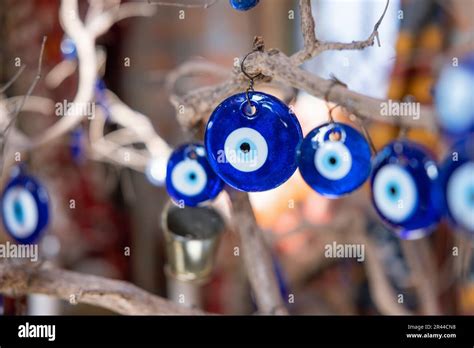
Nazar amulet, a symbol used to ward off the evil eye.
Origins and Historical Context
Belief in the evil eye likely originated within Indo-European, Mediterranean, and Middle Eastern cultures. Probably starting in Sumeria, it spread through the Greco-Roman world, India, Portugal, Spain, northern Europe and North Africa.
Early evidence excavated from various ancient cities include alabaster idols with incised eyes found in Tell Brak, one of Mesopotamia's oldest cities. Texts from ancient Ugarit, a port city in what is now Syria, attest to the concept of the 'evil eye' - the city existed until about 1180 BC, during the late Bronze Age collapse.
Read also: Cultural Significance of the Evil Eye
In Greek Classical antiquity, the 'evil eye' is referenced by Hesiod, Callimachus, Plato, Diodorus Siculus, Theocritus, Plutarch, Heliodorus, Pliny the Elder, and Aulus Gellius.
As widely documented in archaeologic findings and in ancient literature, the Illyrians believed in the force of spells and the evil eye, in the magic power of protective and beneficial amulets which could avert the evil eye or the bad intentions of enemies.
Classical authors attempted both to describe and to explain the function of the evil eye. Plutarch in his work entitled Symposium has a separate chapter describing such beliefs. In his scientific explanation, he stated that the eyes were the chief, if not sole, source of the deadly rays that were supposed to spring up like poisoned darts from the inner recesses of a person possessing the evil eye.
The idea of the evil eye appears in the poetry of Virgil in a conversation between the shepherds Menalcas and Damoetas. In the passage, Menalcas is lamenting the poor health of his stock: "What eye is it that has fascinated my tender lambs?".
Jewish Perspectives on the Evil Eye
In several pieces of Midrash, rabbis suggest that the Evil Eye played a role in various incidents in the Torah. For example, they say that Sarah cast an evil eye on Hagar while Hagar was pregnant, causing her to miscarry before going on to become pregnant with Ishmael.
Read also: The Meaning of Jewish Luck Symbols
Elsewhere, rabbis argue that Leah’s fertility was adversely impacted when she “became subject to the power of the evil eye” for thanking God for allowing her to bear more than a fourth of Jacob’s sons.
Some Jews believe that a "good eye" designates an attitude of goodwill and kindness towards others. Someone who has this attitude in life will rejoice when his fellow man prospers; he will wish everyone well. An "evil eye" denotes the opposite attitude. A man with "an evil eye" will not only feel no joy but experience actual distress when others prosper and will rejoice when others suffer.
Rabbi Abraham Isaac Kook explained that the evil eye is "an example of how one soul may affect another through unseen connections between them.
Many observant Jews avoid talking about valuable items they own, good luck that has come to them and, in particular, their children. If any of these are mentioned, the speaker and/or listener will say b'li ayin hara (Hebrew: בלי עין הרע), meaning "without an evil eye", or keyn eyn-hore (Yiddish: קיין עין־הרע; often shortened to kinehore, קינעהאָרע), "no evil eye". Another way to ward off the evil eye is to spit three times (or pretend to).
According to rabbinic texts, the best way to combat the evil eye was knowledge of the Torah. In addition to citing Scripture, there were also spells that could be used to counteract magic. Since removing the evil eye was difficult and sometimes even impossible, however, focus was mostly placed protecting against it. For example, benedictions could be uttered regularly to ward off the eye.
Read also: Guide to Jewish Witchcraft
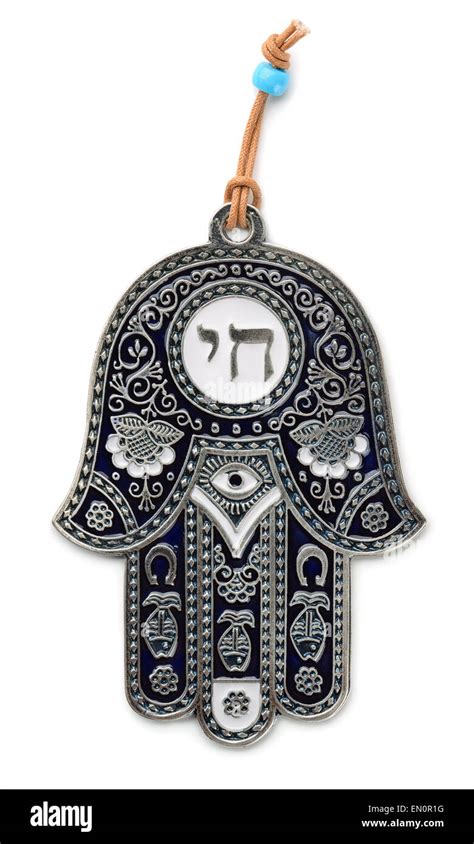
Hamsa, a hand-shaped amulet used for protection.
Protective Measures and Amulets
Attempts to ward off the curse of the evil eye have resulted in a number of talismans in many cultures. Some of the most famous talismans against the evil eye include the nazar amulet, itself a representation of an eye, and the hamsa, a hand-shaped amulet.
The word hamsa, also spelled khamsa, means "five" referring to the fingers of the hand. In the Levantine Christian culture is called the Hand of Mary, in some Muslim and Balkan cultures, the Hand of Fatima.
Over time, other methods and practices were developed as security measures. One of the most famous methods was the placement of incantation bowls (also known as Aramaic magic bowls or demon bowls) under the corners or thresholds of buildings. These magic bowls were used mostly in Upper Mesopotamia and Syria between the 6th and 8th centuries CE and acted as traps to snare demons trying to enter the building through the ground.
Another apotropaic device was amulets (kame’a or kami’a), which are referred to throughout the Talmud. bt. pesachim 111b tells of a rabbi writing an amulet to protect a city-ruler against a demon and another rabbi writing an amulet to protect against 60 demons, indicating that rabbis were involved in the manufacture of these devices.
The Talmud even states that a person may carry an amulet in public on Shabbat provided it was made by an “expert” (m. Shabbat 6:2; t. Shabbat 4:5, 9, 10; bt. Shabbat 53a, 61a).
Amulets could come in various shapes and materials, but the most common ones were pieces of paper, parchment, or metal inscribed with various formulae in Aramaic. A specific example is the amulet with the Seal of Solomon to restrain the evil eye, discovered in various archaeological excavations.
The use of inscriptions to ward off the evil eye stemmed from a belief in the holiness and power of words. The text of the Priestly Blessing (Num 6:24-26) was considered effective against the evil eye. Permutations and combinations of the letters of the different names of God were frequently used; names of angels were also common.
The simplest amulets were inscribed with the name of God on a piece of parchment or metal, usually made of silver. They were worn close to the person, as a piece of jewelry or sown into the clothing.
Amulets have also been found in ancient synagogues in Palestine, mostly in the form of inscribed thin metal plaques (called lamellae) rolled up or folded, indicating a connection between synagogues and the supernatural.
Practical Techniques for Avoiding the Evil Eye
Aside from humility, there is a long list of practical techniques for avoiding the evil eye. Way too many to cover in this post. The first technique is the shir ha’amalot amulet. A shir ha’amalot is a parchment with the text of Psalm 121, which emphasizes God’s protection. It opens saying, “My help comes from the LORD, maker of heaven and earth. He will not let your foot give way; your guardian will not slumber; See, the guardian of Israel neither slumbers nor sleeps!” (9). While the use of these amulets was once wide spread in both the Ashkenazi and Sephardic communities, today only the Chabad Hassidic community still encourages their use. Chabad recommends that not only should they be used in the home, but they should also be placed in hospital rooms to reclaim the birthing room as Jewish space as well as to invoke divine protection (10). That means you can buy one online as Mikvah.org (11) or print one out from the Chabad site (12). It’s good to have a couple in your gear box. I do. As Shir Ha’amalot card with Psalm 121, for protecting baby’s from the evil eye. They are often hung in hospital delivery rooms or baby’s nurseries.
The second technique is the hamsa amulet. A hamsa is a visual symbol of an open hand with a stylized eye in the palm. Hamsa is Arabic for five, which references the five fingers on a hand. With related gestures and verbal charms, it’s a common symbol of protection in Jewish and Islamic cultures, predating both, and has been integral to both Jewish Mizrahi and Sephardic cultures. Noam Sienna, in his essay Five in Your Eye: The Khamsa Image among Moroccan Jewry (13) gathered a number of ethnographic examples of how the hamsa was used to ward off the evil eye. According to Sienna, Moroccan and Tunisian Jews in the late 1880’s used hamsas made of silver, iron, coral, and blue stones with additional symbols of fish, salamanders, and birds. The use of the hamsa amulet was often accompanied by gestures or spoken charms. For example, Sienna notes a member of the Tunisian Jewish community, “when his children’s pictures or horses are praised, the Tunisian Jew extends his five fingers, or pronounces the number ‘five;’ he tries by this means to prevent the praise doing damage.” Other, similar, protective statements included “hamsa fi ‘ainek [five in your eye],” “hamsa ‘ala ‘ainek [five on your eye],” “hamsa ukhmissa [five and little five]”, or “hmames [the fives].” While these utterances, matched with the gesture of raising the hand, and the specifics of hamsa construction were specific to that community at that time, the practice can be adapted to any local area or community. Proper usage, though, also requires a keen sense of the moment the protection is needed.
The third technique is henna tattoos, used by Mizrahi Jews as well as Muslims, Hindus, Christians, Baha’is, Zoroastrians, and others. Henna is a natural orange-red or purple dye, made from the leaves of the henna plant. It is used throughout North Africa, the Middle East, and Central Asia as the basis for body art that fades over time, but cannot be washed off. Applying henna tattoos is a common preparation for Mizrahi celebrations, including weddings and births. While henna tattoos can take on a wide variety of different cultural roles, one of the prominent ones is protection from the evil eye. But henna is not just a pigment. It’s a core part of the magic itself. Much of henna’s importance came from the beliefs associated with the plant itself, which transmitted what is known in Hebrew as berakha, Arabic baraka - blessedness. This quality is essential not only in ensuring happiness and success but also in warding off negative forces and energies, variously understood as demons (Hebrew shedim, Arabic jnun) or the Evil Eye (Hebrew ‘ayin ha-ra‘). This protective quality is understood to be inherent in the plant material itself, as it is in other substances (for example: iron, the rue plant, the number five, or the colours blue and red). An elderly Moroccan woman I interviewed explained that her father, a doctor and rabbinic scholar, taught her that “each plant has the name of an angel, an angel that tells it the job it has to do in the world. The angel of the henna plant is Mevi-Mazal [Bringer of Luck]. That is the job of the henna plant: to bring luck. I’ll write more about the role of protective angels in Jewish magic in later posts. For now, focusing on the henna tattoos, the practical implications are clear. First, as with the shir ha’amalot and hamsa amulets, it’s important to understand that events that bring joy bring envy and need protection. Second, Jewish amulets can take different forms, whether parchment, metal, or, in the case of henna tattoos, our own skin. Third, and finally, these amulets are beautiful, raising up the joyful moments they’re part of, even as they protect them.
Even with the best protective measures, the evil eye can still strike. One description of the symptoms caused by the evil eye are “broken sleep, or loss of sleep, headache, constant yawning, buzzing in the ears, any kind of digestive pain or derangement, fever, depression, and general weakness. Even death may result.” (16) This list of symptoms comes from Derya Agis’ essay “Beliefs of American Sephardic Women Related to the Evil Eye,” which is based on her interviews with and readings of autobiographies of, women who are either immigrants from the former Ottoman Empire or descendants or relatives of immigrants. According to Agis’ sources, healing these effects involved prayer and rituals that were generally performed by women.
Esther C from New York depicts the following cure against the pernicious effects of the evil eye: the performer of the ritual gathers fifteen cloves, divides them into groups of five by saying, “let the evil eye, all the evil talk go into the depths of the sea, five for the sea, five for the land, five for the people, let no badness affect X…”; this ritual is repeated three times; the performer of the ritual takes each group of cloves in her/his hand, and passes the cloves all over the body of the affected person fifteen times in total. Afterwards, the performer of the ritual gets an aluminum plate, and burns these cloves with a match. In addition to cloves, lead is also used in rituals performed against the evil eye.
Agis provides a variety of examples of evil eye healing rituals and others histories and ethnographies provide even more, including applying salt, breathing aromatic herbs, heating and popping black seeds, and melting bits of rubber or gum. Each of these methods uses local ingredients, but linked to common themes, such as purity (salt) or redirection (popping seeds) (17). One of my personal favorite redirection methods is smashing a glass at a wedding. At the moment the wedding couple is most joyful and most vulnerable, they smash a glass to inject a moment of surprise and whoosh…the evil eye is distracted and passes them by.